There is a wonderful film buried inside Pressure, and it lasts about fifteen minutes.
The history it draws on is irresistible, and almost no one knows it. In the seventy-two hours before D-Day, the largest seaborne invasion ever attempted hinged not on a general’s nerve but on a forecast. Group Captain James Stagg, a punctilious Scottish meteorologist, was made chief weather officer for Operation Overlord and handed the most consequential prediction in modern history: tell Eisenhower whether the Channel would hold. The original date was June 5. Stagg saw a narrow, fragile break in a vicious Atlantic storm and argued for a twenty-four-hour delay to June 6 — against the Americans, against the clock, against the very real possibility that the Germans, who had lost their Atlantic weather stations and assumed no fleet would dare the swells, might catch on if the armada sat waiting in its harbors. He was right. Tens of thousands of men did not drown. The war turned on a barometer.
What makes the episode so cinematic, and what the film keeps gesturing toward without ever quite seizing, is that this was not a contest between a genius and a storm. It was a contest between two ways of knowing. Stagg and his British colleagues worked from synoptic analysis — building a physical picture of the systems wheeling across the North Atlantic and reasoning forward from the mechanics of the weather itself. The Americans, led by Irving Krick, trusted analog forecasting: comb the historical record, find the days that looked like this one, and bet that history would repeat. Krick was confident, charismatic, and certain the weather would hold for June 5. He was wrong, and the gap between his certainty and his error is the whole drama. The terror of Stagg’s position was never simply that he might be mistaken; it was that he might be right and still lose the argument to a more persuasive man with a sunnier chart. That is a magnificent premise — a story about uncertainty, institutional authority, professional jealousy, and the particular loneliness of being the one person in the room who has to say wait while everyone above you is desperate to hear go.
Anthony Maras, adapting David Haig’s 2014 stage play clearly understands what he has. Haig himself co-wrote the screenplay, so the bones of the thing are sound, and the structure is shrewd: a ticking-clock chamber piece set almost entirely inside Southwick House, the requisitioned country mansion that served as Allied headquarters, with a wall clock counting down the hours until a decision that cannot be unmade. The film opens cannily, too. Before we meet anyone, Maras gives us a brief, terrible glimpse of aftermath — bodies, wreckage, the cost of getting it wrong — and then cuts hard to domestic calm, with Stagg making breakfast for his very pregnant wife in the grey light of an ordinary English morning. It is an efficient bit of filmmaking: in ninety seconds we understand both the scale of the catastrophe being courted and the small, breakable life this man would like to get back to. There is also, threaded through the early scenes, the memory of a botched invasion rehearsal that went disastrously wrong, a real horror Stagg carries into the war room like a stone in his coat. The man we meet is already haunted before the storm even forms.
So the raw material is there, the framing is intelligent, and the apparatus of the period is rendered with obvious care — the barographs and pressure charts, the teleprinters clattering out readings, the telephone lines strung to ships and reconnaissance aircraft and lonely stations on the Atlantic coast, the whole analog nervous system by which men once tried to read the sky. Maras and his designers clearly relish this world, and when the film simply watches it work, it is gripping. The problem — and it is a large, structural, finally fatal problem — is that Maras seems almost embarrassed to be making a war film at all, and that an otherwise extraordinary cast assembles around Andrew Scott and, with one shining exception, fails him completely.
Take the first issue first, because it is the more forgivable one. Pressure is built as a chamber drama, which is a defensible idea and even a brave one. The invasion of Normandy has been filmed to exhaustion, from the CinemaScope sprawl of The Longest Day to the visceral horror of Saving Private Ryan, and there is real ambition in deciding to stand with your back to the beach and tell the story of the men who never fired a shot but decided everything. For a while the conceit pays off; the claustrophobia of the house, the rising barometric dread, the sense of an entire war compressed into a few sleepless rooms — all of it promises something genuinely new in a thoroughly mapped genre.
But the film leans on the conceit so hard that it stops feeling like a choice and starts feeling like a phobia. For most of its runtime it actively withholds the very thing the entire story is pointing toward, as though showing Normandy would be a vulgar concession to the multiplex crowd. It keeps cutting away, keeps changing the subject, keeps congratulating itself on its own restraint until the restraint curdles into evasion. There is a difference between discipline and nerves, and for long stretches Pressure mistakes the second for the first. Worse, it compensates for what it won’t show by having people say the stakes out loud — the word “millions” gets a real workout — when a single well-chosen image would have done the work of a dozen anxious speeches. A film about the most physically consequential weather event of the twentieth century spends an enormous amount of time with men in a room describing weather to one another, and the theatrical origins, so well disguised in the production design, start to show through the dialogue like studs through plaster. You can feel the stage play underneath, and you start to wish someone had been braver about opening it up.
And then, in the final fifteen minutes, the film relents — and the invasion finally arrives. I won’t spoil how Maras stages it, but it is staggering: the single most emotionally overwhelming sequence I have seen in any film this year. It lands the way it does precisely because the picture has spent ninety minutes refusing it to us. Everything the movie has hoarded — the dread, the arithmetic of risk, the unbearable weight of one man’s signature on an order, the breakfast and the pregnant wife and the rehearsal that went wrong — finally breaks at once, and the withholding I had spent an hour and a half resenting suddenly justifies itself in a rush that nearly knocked me out of my seat. For those fifteen minutes, Pressure is the film it always believed it was.
The cruel irony is that the withholding works exactly once, and it cost the film everything that came before. You cannot starve an audience for an hour and a half and then call the single bite a feast. The payoff is genuinely great; it is also a quiet indictment of the eighty-five minutes that bought it, because a better film would not have needed to ransom its own ending against ninety minutes of audience patience. The arithmetic here is almost literal — the picture runs a hundred minutes, and roughly the first eighty-five of them are close to unwatchable. And the fault, crucially, is not the script’s. It is the cast’s.
Andrew Scott is, predictably, magnificent. He is a classically trained Shakespearean actor doing real interior work — you can watch him calculating risk and swallowing fear in the same breath, holding an entire war inside a clenched jaw and a too-careful Scottish vowel. There is a moment late in the second act where he does nothing but listen to a report come in over a crackling line, and Scott lets you see the exact instant hope and dread trade places behind his eyes; it is the kind of acting that does not announce itself and is impossible to look away from. He is operating on a register the rest of the ensemble simply cannot reach, and the imbalance is not flattering to him so much as it is brutal to the film. He is essentially performing a one-man play while the people around him read lines back at him, and every time a scene partner opens their mouth you can feel the temperature in the room drop. A great central performance should lift everything around it. Here it only exposes how little there is to lift.
Chris Messina, as Irving Krick, is grossly miscast. I usually like Messina a great deal — he is a wonderful character actor with a gift for rumpled, lived-in decency, the sort of man who anchors a scene by underplaying it — but here he plays confidence as sheer volume, and the result is a cartoon standing where a genuine intellectual rival ought to be. Krick’s whole danger was that he was plausible: an accomplished scientist whose method was reasonable, whose manner was persuasive, and whose conclusion happened to be catastrophically wrong. Played at this hand-waving, extroverted pitch, he becomes a blowhard you can dismiss in his first scene, which means the film never persuades us that Stagg was actually frightened of being overruled by him. Remove the credibility of the rival forecast and you remove the suspense entirely; the central argument stops being a knife-edge and becomes a foregone conclusion in fancy dress.
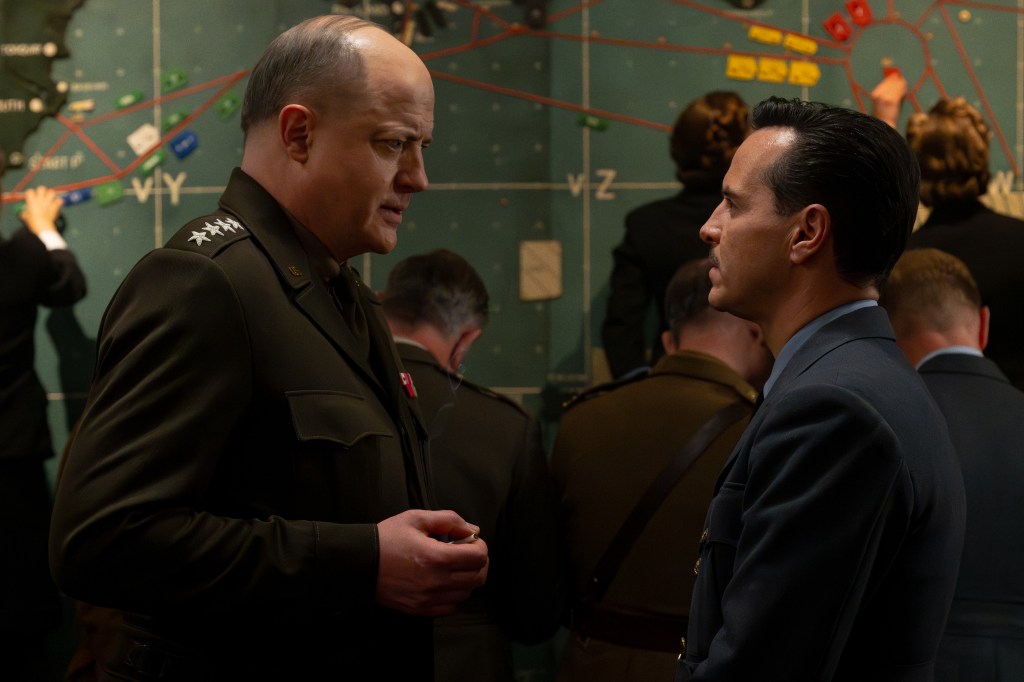
And then there is Brendan Fraser’s Eisenhower, which is, I am sorry to report, one of the worst lead performances I have ever watched in a prestige film. There is no Ike anywhere in this performance. None of the strain, none of the political tightrope-walking, none of the awful arithmetic loneliness of a man who knows that whatever he decides, men will die because of it, and that the choice is his alone. What is on screen instead is bluster in a uniform — a big, baronial, thoroughly modern American line reading wearing a 1944 costume, all surface and no weather, with none of the pinched, steely containment the real Eisenhower carried like a second skin. Every scene Scott shares with him goes slack, because Scott is playing fear of authority while Fraser is not playing authority at all; he is playing loud. When your Supreme Allied Commander cannot hold the screen against your weatherman, the entire dramatic architecture of the film tilts and collapses, and Pressure collapses with it for long, painful stretches in the middle.
Kerry Condon, as Eisenhower’s aide Kay Summersby, is badly misused, which is its own small tragedy, because Condon is one of the finest actors alive and has proved as much carrying far thinner material than this. There are vestiges in the early scenes of some romantic tension between her Summersby and Scott’s Stagg — a few charged glances, a lingering beat or two — a thread that flickers, never develops, and is then, mercifully, abandoned. I say mercifully because it would have been both ahistorical and entirely beside the point, a love subplot grafted onto a story whose actual subject is sleeplessness and probability and the moral weight of a guess. But the half-life of that abandoned idea leaves Condon stranded. What remains is a gifted performer given almost nothing to do but carry messages, pour coffee, and react to the men deciding history around her — kept in the frame and out of the story. Damian Lewis turns up among the brass and is similarly squandered, handed a uniform and a few lines of exposition where a real character should be. The film keeps assembling first-rate talent and then forgetting to write any of them anything to play.
Two things genuinely work, and they are worth dwelling on because they show, in miniature, the film Pressure could have been. Both montages of the weather reports coming in — the slow accretion of readings from ships and aircraft and lonely coastal stations into something that gradually resembles a verdict — are beautifully built. Here, at last, Maras trusts process over speechmaking. He lets the pens scratch and the teleprinters chatter and the chart fill in, lets the data accumulate into meaning the way it actually did, and the sequences hum with precisely the tension the dialogue scenes keep reaching for and missing. They are the only stretches of the film that feel like cinema rather than filmed theater, and they make the case, all on their own, that the raw material was never the problem. Watching them, you understand exactly what a more confident director would have done with the whole picture: trusted the texture of the work itself to generate the suspense, and gotten out of the way.
A word, too, for the craft around the edges, because it is consistently better than the film deserves. Southwick House and its war rooms are rendered with a tactile, lamplit conviction; the period apparatus feels used rather than displayed. Volker Bertelmann’s score does real, unshowy work, holding a low anxious pulse beneath scenes the actors too often let go limp, and the photography keeps the palette grey and close and weatherbound in a way that quietly reinforces the theme. The technical package is more than competent — it is, frequently, lovely. It is the human center, three of the four principal performances, that gives way beneath it.
So where does that leave us. Pressure has a once-in-a-generation true story, a good lead performance from Andrew Scott, fifteen of the best minutes of 2026, two genuinely thrilling montages, an intelligent structure, careful craft — and almost nothing else that works. It is a film that finally becomes great at the exact moment it ends, which is only another way of saying it spends most of its length failing the material it so obviously loves. There is a version of this movie — same script, same sets, the same superb Andrew Scott — directed by someone willing to point the camera at the beach a little sooner rather than making the audience wonder if we got it wrong all through school, and if D Day was actually June 5th instead of June 6th. (It was June 6th, the fact that the primary tension was deciding whether to delay the invasion of the 5th was just bizarre.) But overall, if the film was cast by someone who could surround its lead with actors capable of meeting him even halfway, that would sit comfortably among one of the year’s best films. This is not that version. It is worth seeing for the last reel, for those two montages, for Scott, who deserves a far better film built around him than the one he got, and above all for the history that few people will likely know the minute details of. Endure the rest, and bring your patience: the forecast is good, but it arrives very, very late.
★★★


Leave a Reply