Eighteen years ago, my grandmother sat me down in front of E.T. the Extra-Terrestrial. I did not know then that I was being handed a lifelong relationship. I have loved Steven Spielberg ever since. The first film of his I saw in theaters was The Adventures of Tintin, just before Christmas in 2011. A few days after Christmas, I ventured back to the same theater to see War Horse. Two Spielberg pictures in one holiday season now feels like abundance. Even in his lesser films, The BFG, Bridge of Spies, he has never lost his sense of wonder. That is one of the many things I love about him. The man simply cannot make a movie without looking at the world with curiosity.
And looking up is what Disclosure Day is about.
Spielberg has been staring at the sky his entire career. Close Encounters of the Third Kind. E.T. War of the Worlds. This is his first alien picture in twenty-one years, and he keeps returning to the question of whether we are alone, answering it with hope, terror, and everything in between. He is not alone in the obsession. The American public has been primed for this story since Orson Welles got on the radio in 1938 and convinced a sliver of the country that Martians had landed in Grover’s Mill, New Jersey, with his broadcast of The War of the Worlds. Then came Roswell in 1947. Then Area 51, that patch of Nevada desert that launched a thousand documentaries and at least one ill-advised Facebook raid. And just a few years ago, an entire nation craned its neck to watch a Chinese weather balloon drift lazily across the continent while cable news treated it like the opening act of Independence Day. We want to believe. We have always wanted to believe. Spielberg knows this better than anyone alive.
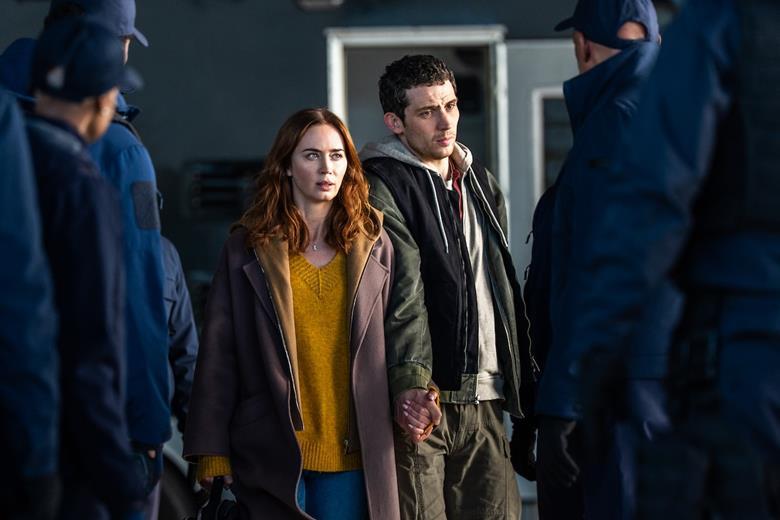
The setup, from a David Koepp screenplay built on Spielberg’s own story, is irresistible. The world stands on the brink of World War III. A cybersecurity specialist named Daniel Kellner steals a piece of extraterrestrial technology, along with files documenting human-alien contact dating back to Roswell, from the Wardex Corporation, a secret arm of the U.S. government. Wardex CEO Noah Scanlon brands him a foreign spy and sics the federal government on him. Meanwhile, in Kansas City, television meteorologist Margaret Fairchild is getting ready for work when a cardinal flies into her home, looks at her, and flies away. The encounter awakens psychic abilities she did not know she had, and during a live weather broadcast she begins speaking a language no one on Earth has ever heard. Yes, you read that correctly. Large chunks of the film are set right here in Kansas City, which I will admit gave me a thrill. It is not every day that Hollywood acknowledges we exist for reasons other than barbecue and Patrick Mahomes. Watching a Spielberg camera find first contact in a local weather studio, the kind that looks like what I flip past every morning to do my daily diligence of being “weather aware”, was its own small act of disclosure. My only objection as a lifelong Royals fan is the bird. A cardinal, Steven? In this town? Unforgivable.
I wish I could tell you the first forty-five minutes live up to that setup. They do not. Here is where I get specific, so consider this your spoiler warning. The opening stretch is overloaded with table-setting. The film splits itself between Daniel hiding out in a convent with his girlfriend Jane and Margaret’s slow unraveling in Kansas City, and the cross-cutting drains momentum from both halves. The convent scenes, which should hum with paranoia, mostly just sit there. Margaret’s viral broadcast, the inciting incident the entire movie hinges on, comes and goes with strangely little force, and then the film spends another long stretch keeping its two protagonists apart while Scanlon’s agents circle. The film withholds its central revelation so aggressively in the early going that the withholding becomes the plot, and withholding is not a plot. It is a delay tactic. For three quarters of an hour, Disclosure Day feels like a movie circling the runway.
Then it lands, and once it lands, it soars.
The performances deserve much of the credit, though not all of them. Josh O’Connor’s Daniel spends most of the film looking like a deer caught in headlights, which may be a character choice for a man branded a traitor by his own government, and may simply be what happens when an actor is asked to react to stolen files for two and a half hours. The film is saved by the people around him. Emily Blunt does career-best work as Margaret, a woman whose ordinary Midwestern life dissolves in real time as she discovers what was done to her, and what she can now do. Eve Hewson is remarkable, full stop, as Jane, a role that starts as the girlfriend in hiding and becomes something far greater. It is Jane who escapes with the alien device when Daniel is captured, and Jane who, in the finale, literally turns the lights back on. And Colman Domingo, given perhaps twenty total minutes of screen time as Hugo Wakefield, the leader of the Wardex whistleblowers, walks away with the entire picture. He plays a man who has carried the weight of his employer’s secrets for decades, and the scene in which he finally unburdens himself is the finest piece of acting I have seen this year. Colin Firth is also here as Scanlon. He does not do much beyond act like a Bond villain, all quiet menace and telepathic surveillance, but he seems to be enjoying himself.
Here is the strange thing about Disclosure Day, and the thing I keep turning over days later. The philosophy of the film outshines the craft. That is not what happens in a Spielberg picture. Spielberg is craft. He is the most fluent visual storyteller the medium has produced. And the craft here is genuinely good. The car chase that ends with a vehicle being rammed into the side of a passing train is a marvel of staging. The sequence in which a SWAT team storms a local firehouse is fun to watch and beautifully shot. But both pale beside the moments when the film slows down and simply lets its characters talk. Lets them explain what they want. Lets Wakefield shelter Margaret in a warehouse containing a full reconstruction of her childhood home, an image so purely Spielbergian it nearly made me laugh, and lets her walk those rooms until she remembers what happened to her there. Disclosure Day is most alive when it is sitting still, asking what a government owes its people, and what people lose when they stop being trusted with the truth.
That question spoke directly to me, and I should disclose why. My MA thesis examines the paranoid cinema of the early 1970s, the years when The Godfather, The Exorcist, and The Parallax View taught American audiences to process institutional collapse in the dark of a movie theater. The Parallax View in particular hangs over Disclosure Day like a ghost. Alan Pakula’s film ended with the machinery of secrecy grinding its hero into nothing. The commission delivers its findings, the lie becomes the record, and the credits roll. Spielberg has made the optimist’s answer to that film, fifty years later. Where Pakula said the truth dies in committee, Spielberg’s whistleblowers seize a television studio and put the truth on the air. I have spent two years reading congressional correspondence and studio press books from the Watergate era, tracing how audiences metabolized the discovery that their institutions were lying to them. Watching Spielberg stage the inverse, the cover-up cracked open on live television, felt like watching my research talk back to me.
John Williams is back in full form. I will say what needed saying about The Fabelmans, which is that the one flaw in an otherwise flawless memory piece was an underwhelming score. Williams more than compensates here, in what is now his thirtieth collaboration with Spielberg. The disclosure theme, built on a five-note phrase that cannot help but echo Close Encounters, swells in the final act with the kind of orchestral conviction that no living composer can match. The man is ninety-four years old. The music sounds like it was written by someone who still believes.
Janusz Kamiński’s cinematography, in typical fashion, gives us frame after frame that looks like a beautifully rendered painting. A cardinal perched in a suburban kitchen, haloed in morning light. The reconstructed childhood home glowing inside the darkness of a warehouse. Margaret silhouetted against a wall of dead studio monitors in the seconds before the power returns. You could hang half this movie on a wall.
The editing is a more complicated story. Michael Kahn, cutting alongside Sarah Broshar, has been shaping Spielberg’s films for nearly half a century, which makes the clunky opening act all the more surprising. Scenes end a beat too early or a beat too late, and I suspect the cutting is responsible for much of that first stretch’s shapelessness. But somewhere around the midpoint, the rhythm arrives, and by the finale the editing becomes one of the film’s key attributes. The last act intercuts the studio break-in, Scanlon’s assault on the power grid, and Jane’s race to deliver the device with a confidence that recalls the climax of Munich.
And the sound mixing deserves a very special shoutout. This is a film about listening, about signals and static and languages we have never learned, and the mix understands that. The way ambient sound drops out when Margaret’s abilities take hold. The way the alien language cuts through the noise of a live broadcast. The way the archival footage in the finale plays with degraded, period-accurate audio. See this one in the best theater you can find. It plays in IMAX for a reason.
Which brings me to the ending, and the reason this review runs as long as it does. The final twenty minutes of Disclosure Day are a spectacular sustained sequence. Margaret, Daniel, and the whistleblowers break into her old television studio to broadcast everything. Full disclosure to the entire world. The transmission reveals to a stunned world the historical evidence of alien contact and the decades of cover-up, and as it spreads across the globe, it halts an impending war and ends with a haunting call to audiences in the world of the film, and our own: “Listen.”
The footage they broadcast is not real. It cannot be real. And still it made me feel something. The footage of the Roswell field in the summer of 1947, military personnel digging through the wreckage in the heat, I do not know why, but it put a lump in my throat. Maybe because part of me, not the cynic, not the realist, but the part that still openly cries when I watch E.T. every Halloween night, the part that tosses a little salt over her shoulder if I ever happen to spill some, maybe that part wants to believe there is something out there. There has to be.
That is what Spielberg does. His films make you feel something you cannot replicate anywhere else. And we have to acknowledge that mortality comes for us all. Spielberg is no longer the young man fighting with a mechanical shark off the coast of Martha’s Vineyard. He is older now, and wiser. I will never skip one of his films. Because this older man, whom generations have come to know through his orchestral style of storytelling, still gives us the same energy he had when he was a teenager making movies in his backyard. He is still looking up. As long as he does, so will I.
★★★★
 Show Me Cinema
Leave a comment