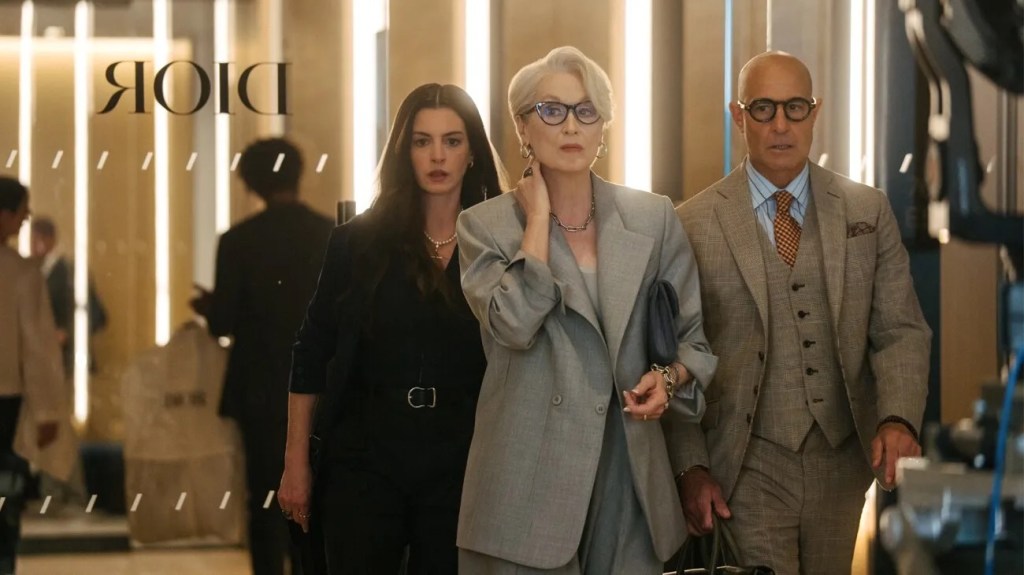
There is a moment near the end of The Devil Wears Prada 2 — Miranda Priestly turns to Andy Sachs from the back of a car and says, quietly, “I just love working, don’t you? I love what I do and I feel I have a few more good years to do it.” Andy says nothing. She doesn’t have to. The line lands not because Miranda has said it but because Meryl has. Sometimes a movie cracks open and the performer steps through the costume, and for a second you are watching the woman, not the role. That is what happens here. The icy editrix who froze a generation of viewers in 2006 is still there in the posture and the mouth, but the words belong to a 76-year-old actress who has spent fifty years doing this and is telling us, plainly, that she is not done. It is the best moment in the movie, and it has almost nothing to do with the movie.
It also reminded me of something I had not quite registered until I felt the room react to her: Streep has not been in a theatrical release in nearly five years. Her last one was Don’t Look Up in December 2021 — a Netflix film with a token theatrical window, and she is great in it, by the way, doing some of the funniest broad-comedic work of her late career as a vain, venal President who treats an extinction-level event like a polling problem. But that was streaming, and most of the country watched her do it on a couch. Since then she has been on television (Only Murders in the Building), in documentaries, doing voice work. To see her on a big screen again, in a wide-release Disney tentpole, in a part she originated, is to be reminded of a fact that is easy to forget in the streaming era: whatever Streep is in — movie, show, voiceover, walk-on — is in good hands the moment she shows up. The whole frame organizes itself around her. It is not a career performance. She is not asked to do what she did in Sophie’s Choice or The Bridges of Madison County or, for that matter, the first Prada, where she essentially reverse-engineered Miranda from a cartoon into one of the great American screen villains of the 2000s. Here she is doing maintenance work on an icon. But maintenance work from Meryl Streep is still the best thing in most movies, and it is the best thing in this one.
What surprised me most about the sequel is how little it cares about clothes. The first film was a fashion movie that happened to be about journalism; this one is a journalism movie that happens to take place at a fashion magazine, and I think that is the right call. The cultural stakes of 2026 are not the cerulean monologue. They are whether print magazines like Runway — the august, doorstopper-thick objects that used to set the visual grammar of the century — can survive their own irrelevance. The movie knows this, and it spends most of its runtime watching Andy edit, pitch, kill, and resurrect copy. There is a wonderful little montage in the first forty minutes that is just Andy at her laptop, mug after mug of coffee going cold beside her, the cursor blinking, sentences getting cut and re-cut. The film treats the work of writing as work, which is a kind of respect and even slightly romanticized.
It also keeps the original’s best instinct, which is that New York is a city where interesting people gather around food and argue about culture. There are dinner scenes here — a tasting menu in Tribeca, a late drink at a hotel bar, a brunch where someone tries to explain TikTok to someone who does not want it explained — that feel like the first movie’s DNA carried forward. The conversation has changed (it is about the death of print, the colonization of attention, the way Gen Z talks about anything on a magazine masthead as if it were a fossil), but the rhythm is the same: smart people, good wine, a city humming outside the window. It is less New York-centric than the first film — there is more globe-trotting and corporate-suite material — but the New York scenes still glow.
The performances are all good, some of them very good. Anne Hathaway has the hardest job, which is taking the wide-eyed Andy of 2006 and aging her into a woman who has lived through the past twenty years of American life without going entirely brittle. She manages it. There is still a flicker of the girl who walked into Elias-Clarke not knowing what cerulean meant — but she has also clearly been hardened, the way most of us have been, by two decades of bad news and worse takes. It is a real performance, not just a victory lap. Stanley Tucci is, as ever, a gift: every movie he is in is improved by his being in it, and the math is starting to look pretty stark on this — we need more Tucci, more often, and in bigger parts. Emily Blunt is excellent but underused; the movie reaches for her whenever it needs a laugh and she always delivers, but the script does not give her the connective tissue it gives the other three. And Justin Theroux plays a new character and is hysterical — playing a kind of baboonish private-equity bro who spends the movie in blazers and turtlenecks getting outmaneuvered in ways I will not spoil here, he gets the biggest laughs in the picture by simply existing.
Meryl is the engine, though. She has never been better — I do not mean that in some absolute sense, I mean it in the sense that watching her at this stage of her career, knowing what Miranda represented in the first film (the revelation of the woman behind the dragon, the loneliness inside the power), there is something almost moving about how comfortably she wears this role again. Miranda is older now. So is Meryl. The film knows the difference and lets us see both.
This is a legacy-sequel done right. The genre has produced a lot of misery in the last decade — movies that exist to remind you of older, better movies, that mistake recognition for emotion. Prada 2 avoids almost all of those traps. The callbacks land because they earn their landings. The new characters expand the world rather than crowding it. The plot moves forward instead of in a circle. And the updates — Gen Z assistants who have never held a print magazine, ad-revenue panic, a fashion industry trying to figure out whether it still needs editors when it has algorithms — are funny and pointed without ever curdling into a lecture. The film is genuinely sad about the death of print without being a eulogy; it is, finally, an argument for the value of doing the work, which is what the line in the car is really about.
Not a masterpiece, but a truly enjoyable film. A sequel that respects its first film, respects its audience, and gives Meryl Streep a screen to be Meryl Streep on. I’ll take it!
★★★1/2


Leave a Reply