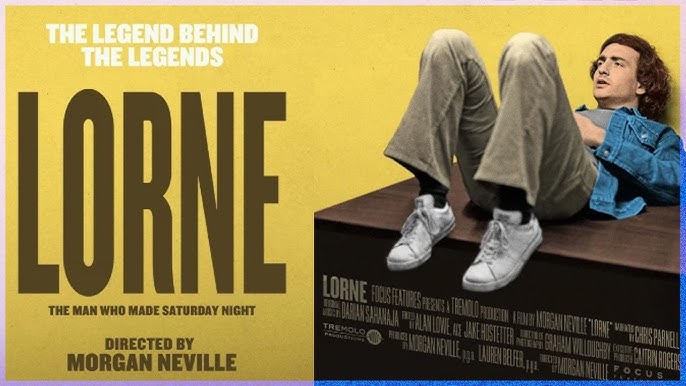
I have loved Saturday Night Live for as long as I can remember loving anything on television. I came to it the way most people do, through reruns and clips and the slow accumulation of the cultural shorthand the show has been generating for half a century, and I have stayed with it through the eras you’re supposed to love and the eras you’re supposed to apologize for. So when the fiftieth season arrived in the fall of 2024 and rolled into the SNL50 celebrations in early 2025, I reveled in the pageantry of it. The anniversary specials, the homecoming episodes, the documentaries that ran alongside them, the parade of returning hosts and cast members and the strange, moving sense that an entire institution was taking a victory lap in real time — I watched all of it, and I watched a lot of it twice. Which is the long way of saying that I came to Morgan Neville’s Lorne with both anticipation and a certain wariness, because the well of SNL retrospection had been, by this spring, very thoroughly drawn from.
Neville was the right choice for this one. He has built a career on documentaries about creative figures who don’t quite want to be looked at directly — Fred Rogers, Anthony Bourdain, Orson Welles — and you feel that almost immediately. There’s a moment early in the film when the camera catches Michaels mid-stride down a Studio 8H hallway, blissfully unaware, then all too aware, that a camera is waiting for him. He spots the camera, then waves the crew off with a half-smile, mutters something about needing to find Colin, and disappears into a writers’ room where he clearly does not need to be. Seconds later, he reemerges and walks in the complete opposite direction. It is the third or fourth time in the film he has done this. Each time, it is funnier than the last.
The film frames Michaels as something close to a Shakespearean composite, and I found myself reading him as a mixture of three figures rather than two. There is Puck in him, the trickster impresario, the man who delights in collisions and in the joke that lands because no one saw it coming. There is also a great deal of Prospero — the magus on the island of 30 Rock, conjuring a storm every Saturday night, summoning and dismissing performers with a gesture, more interested in the mechanics of illusion than in being inside it. But there is some Lear in him too, and the documentary is not afraid to look at that. He is a man in his eighties who has built a kingdom and now has to think about what happens to it. He has divided his attention, his affection, and his trust among a long succession of children, some of whom have stayed close and some of whom have not. The film does not press the comparison, but it is there in the quieter passages, particularly when Michaels talks about the future of the show and his voice gets a little less certain.
The single best creative decision in the film is the narration, which is delivered by Chris Parnell. It is hilarious and, I think, genuinely brilliant. Parnell’s voice has the dry, slightly over-formal quality of every prestige documentary narrator you’ve ever heard, and Neville uses that recognition against itself. At one point, after a stretch of straightforward biographical material, Parnell announces, “Okay, and this is the part of every documentary where we show footage of Vietnam and hippies while playing a song by the Rolling Stones,” and the film proceeds to do exactly that, with full awareness of how tired the gesture is. The documentary mocks its own medium repeatedly, and the joke never gets old, partly because Parnell’s delivery is so precise and partly because the self-awareness feels of a piece with Michaels himself — a man whose entire career has involved knowing exactly what the conventional version of something looks like and then deciding whether to bend it.
What keeps Lorne from being the kind of canonization documentary that has become so common is its willingness to be playful and grounded at the same time. The film has a comic register, full of dry asides and well-timed cuts, but it never confuses tone for depth. When the documentary turns to the death of Michaels’ father when he was a boy in Toronto, the film simply lets the moment land. There is no swelling score. Michaels speaks about it briefly, almost reluctantly, and the camera holds. You understand, without anyone having to say it, that a great deal of what followed — the surrogate families, the institution-building, the protective ferocity around his cast — proceeds from a wound that was sustained very early.
The cast interviews could have gone wrong, and largely don’t. There is, of course, the predictable parade of “he gave me my career, so here are some lovely sentences” appearances. But the film knows the difference between obligation and affection, and it cuts accordingly. Tina Fey’s interviews are the emotional spine of the documentary. You can simply tell that she has great love and respect for this man, and the film trusts that without trying to dress it up. She is not performing reverence. She means it, and Neville lets her say what she means.
Adam Sandler’s interviews carry a different kind of weight. He speaks about Michaels with deep admiration — the admiration of a man who was let go, and who understands now, in a way he perhaps didn’t then, what that letting-go cost the person doing it. Sandler is generous and clear-eyed about the mid-1990s NBC executives, who he describes as functionally tyrannical, and he makes the point that no one could outsmart them in that era, not even Lorne Michaels. It is one of the most interesting moments in the film because it complicates the Prospero reading. Even the magus has a network above him.
Lorne gives us, I think, the most complete depiction of what it actually looks like to make an episode of Saturday Night Live that has ever been put on film. The SNL50 documentary that ran during the anniversary celebration — the weeklong embed I watched twice — was excellent in its way, but it was also a celebration, and it had the gloss of one. Lorne is more interested in the joinery. We see the Monday pitch meetings in something close to their actual rhythm. We see the Wednesday read-through and the brutal mathematics of what survives it. We see Thursday and Friday rewrites that go past 3 a.m., and we see Saturday afternoon’s dress rehearsal cuts, which are perhaps the most revealing footage in the film — the moment when Michaels, with very little ceremony, decides what the country will and will not see that night.
The friendships are handled with real care. Steve Martin appears with the easy intimacy of a man who has been a peer rather than an employee for decades. Alec Baldwin speaks with the slightly bruised affection of someone who has tested the friendship and found it durable. Candice Bergen is wonderful — wry, specific, and protective in a way that suggests she has been protective for a very long time. And then there is Paul Simon, whose section contains what I suspect will be the most-discussed revelation in the film: that the seed of Graceland was planted on a road trip the two of them took in the 1980s to visit Elvis Presley’s home. The story is told with the offhand quality that the best stories about Michaels tend to have. He does not claim credit. The film simply lets the dots connect themselves, and an entire album reorients itself slightly in your understanding.
On the question of Michaels as a boss, the documentary is unusually honest. The authority is real. The fear is real. Several interviewees describe the experience of waiting outside his office as one of the defining anxieties of their professional lives. And yet — and this is the Puck again — he has always been the guy who is open to seeing an impression of himself. The film collects an extraordinary supercut of these impressions, from Dana Carvey through Fred Armisen and Mikey Day, and Michaels watches them with the bemused tolerance of a man who understands that being imitated is the surest sign that you have become a fixture.
His openness to the documentary itself is its own small comedy. He agreed to it. He sat for interviews. He gave Neville extraordinary access. And then, with what appears to be genuine pleasure, he spent the entire production gently evading the cameras whenever possible — slipping out of frame, redirecting questions, finding sudden urgent business in adjacent rooms. The film makes a running joke of this, and it is one of the warmer running jokes in any recent documentary I can think of.
The film closes with a line from Tina Fey that I have not been able to stop thinking about. She says, more or less, that within a few years Lorne Michaels may be the last man of true traditional show business. The world keeps changing, and the people who enter the industry now arrive with college educations, intellectual training, internships, and methodical career plans. Lorne Michaels had none of that. He was a kid from Canada who had done some sketch writing, and out of that he built one of the greatest tapestries of modern popular culture. The documentary lets the line sit. By the time Fey says it, the film has already shown you the truth of it.
★★★★


Leave a Reply