There is a particular kind of bad movie that earns the word confounding, and Michael, Antoine Fuqua’s long-gestating, twice-rewritten, $200-million biopic of Michael Jackson, is the rare specimen that genuinely deserves it. I walked away from the film certain I had hated it, and equally certain that two or three of its sequences belong in any serious conversation about pop-music filmmaking this decade. The film is stuck, by its own contradictions, in a kind of three-star purgatory — too inept in its storytelling to climb any higher, too transcendent in its set pieces to fall any lower. I have rarely felt a movie so determined to defeat its own better instincts.
Let us begin with the storytelling, because it is the most immediately dispiriting thing about the film. Michael works through a structural template that has not produced a satisfying movie since Bohemian Rhapsody — and even that comparison flatters Fuqua’s film. Bohemian Rhapsody is not a movie I love, but it has, at minimum, a coherent dramatic spine and a real conviction about its subject. Michael feels less written than reverse-engineered: incident strung to incident, beat to beat, the way a child might lay out trading cards in chronological order. There is no argument here, no point of view, no organizing intelligence. The film is content to be a procession.
And yet — and this is where the trouble starts — the music-video sequences are, almost without exception, stellar. Fuqua, who cut his teeth in the eighties and nineties directing videos for the likes of Stevie Wonder and Prince, is operating at the height of his powers whenever the film steps into a soundstage. I sat there hating the movie around me and wishing, fervently, that someone had simply made the movie I actually wanted: a film about the eighties music video as a cultural form, with Jackson as its presiding genius. Excise the biography, keep the shoots, and you would have something extraordinary. Instead, Michael keeps insisting on being a full-fledged biopic, and the biographical scaffolding is what nearly kills it.
Part of the problem is the acting. Jaafar Jackson — Michael’s nephew, and the film’s genetic centerpiece — is doing nothing more substantial than a skilled impression of his uncle. The physical resemblance is uncanny and the dance recreations are, in places, miraculous. But there is no interiority here, no second layer beneath the mimicry, and at times the performance tips into something close to caricature: the mannerisms cranked a notch too high, the breathiness pushed past inflection into mannerism. Colman Domingo, an actor I respect but do not love, is somehow worse. His Joseph Jackson does not feel like a portrait of an embittered and manipulative father so much as the silhouette of a cartoon villain — all menace and no weather, all surface and no shame. I kept waiting for the performance to find a private moment, a single beat of human contradiction, and it never came.
The writing, credited to John Logan and then mauled by reshoots, is clunky throughout and occasionally indefensible. One small example will stand in for many: early in the film, a young Michael watches Singin’ in the Rain with his mother, in a scene clearly meant to plant the dance-as-salvation seed that will bloom across his career. Much later, an adult Michael delivers a beloved Gene Kelly line and attributes it, on screen, to Fred Astaire. The error is the kind of thing the average viewer will glide right past, and that is exactly what makes it so infuriating. To stage Kelly as the formative figure in your protagonist’s imagination, and then to misattribute his words to Astaire — to confuse, in the writing, the two giants of American screen dance — is not a typo. It is a tell. It tells you the people making this movie did not, on some level, know whose movie it was.
The film’s relationship to its subject is similarly confused, though here the confusion is at least partly imposed from outside. Michael presents Jackson as a kind of secular saint: an abused child, a misunderstood man, a sweetness wronged by everyone around him. Fine — that is one available reading of the life. What the film refuses to do is show any fallout. There is no reckoning with the long, ruinous addiction to prescription drugs that hollowed out his last decade. There is no real engagement with the disintegration of the body and the public self. And, most strangely, there is the film’s handling of Jackson’s adult interest in children, which it gestures at and then, in the same breath, dismisses. The film stages not one but two extended montages of Michael visiting children, signing autographs in toy stores, smiling beatifically at small admirers — the cinematic equivalent of a hand on the viewer’s shoulder murmuring, don’t worry about that, look how kind he was. He loved children and he rescued animals. It is queasy filmmaking, and it is queasy in a way the film cannot acknowledge, because it is contractually forbidden from acknowledging it.
Which brings us, unavoidably, to the lawsuits. Michael was already shadowed at release by the now-public knowledge that Logan’s original script used the 1993 Jordan Chandler accusations as a framing device, and that the production was forced into a costly, last-minute rewrite when the Jackson estate’s lawyers realized the family’s settlement legally barred any dramatization of Chandler at all. Twenty-two days of reshoots followed. The ending was rebuilt. The film now closes with the launch of the Bad tour, freezing the story in the summer of 1988 atop a Wembley Stadium stage, years before the allegations enter the historical record — a choice that one critic compared, accurately and devastatingly, to ending an O. J. Simpson biopic with the Heisman Trophy. The result is a movie with a hole at its center it is forbidden from naming, and you can feel the hole in every scene. The film’s saintliness is not a creative choice. It is a legal posture.
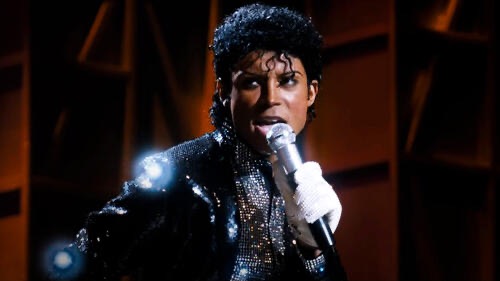
And then — against all of this — there is the Thriller sequence. Roughly an hour into the film, Fuqua slows the biographical machinery to a crawl and gives us, in something close to real time, the making of the Thriller album, the production of the “Beat It” video, and finally the long, unbroken set piece of the “Thriller” shoot itself. It is exceptional filmmaking. It is the only stretch of the movie where the camera seems to know what it loves and why. Watching it, I thought — and I mean this as the highest compliment I can give a director currently in this much trouble — that I would walk into the theater tomorrow for an Antoine Fuqua movie-musical, no questions asked. “Thriller,” the song and the video both, was a cherished piece of my own popular-cultural inheritance, encountered twenty and thirty years after its initial release, and to watch its making rendered with this much care and rhythm and craft was — pardon the pun — thrilling.
Which is the puzzle. I do not know what to do, finally, with a film this actively bad that is also capable of producing two or three sequences this good. Song Sung Blue could not get there. Most of the recent crop of musical biopics, with the exception of A Complete Unknown could not get there. Michael gets there, twice, maybe three times, in the middle of a movie that is otherwise lying to itself and to us. Three stars feels both too generous and too stingy, which is, I suppose, the only honest place to land. The film is a mess. The film is a marvel. The film is the year’s strangest argument for the proposition that craft, even in service of evasion, is still craft.
★★★
 Show Me Cinema
Leave a comment