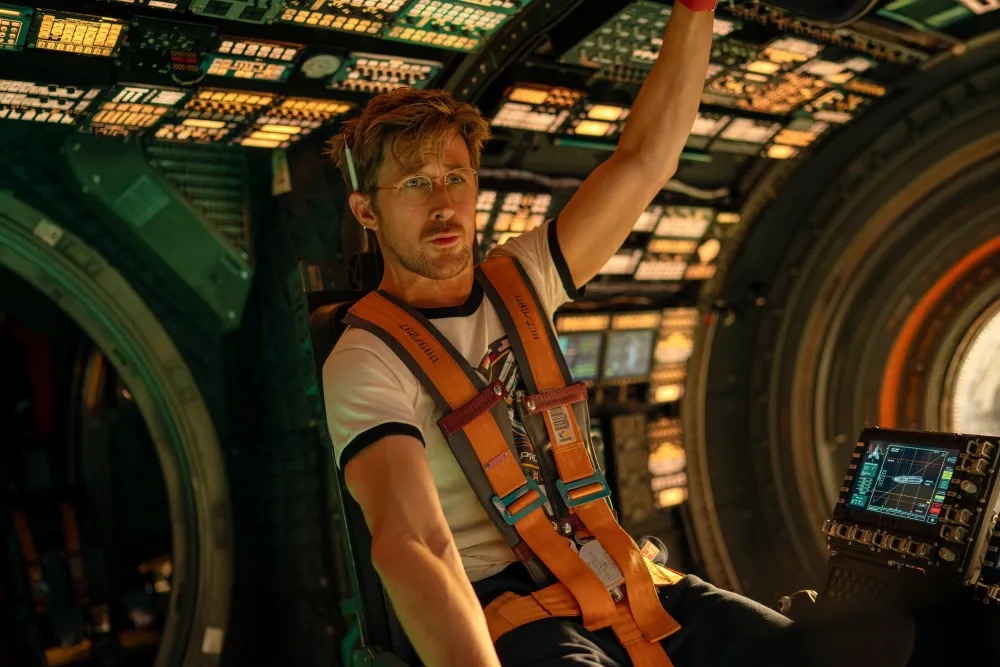
There’s a particular kind of science fiction that trusts you. Not the kind that stops the movie every twenty minutes to hand you a glossy explainer, but the kind that assumes you’re smart enough to sit with a problem, follow a mind at work, and feel the wonder of genuine discovery. Project Hail Mary, directed by Phil Lord and Christopher Miller, is emphatically that kind of science fiction — and it is, for most of its two hours and thirty-six minutes, exactly the film you were hoping it would be.
The premise, lifted faithfully from Andy Weir’s 2021 Hugo Award-winning novel, drops us into one of the more disorienting opening sequences in recent memory. Ryland Grace — a middle school science teacher, which is not the typical résumé line for the savior of the solar system — wakes up on a spacecraft with no memory of who he is, where he’s going, or why the rest of the crew is dead. What follows is a slow, methodical reconstruction of both his identity and the scale of the catastrophe he’s been sent to solve: the sun is dying, something called astrophage is to blame, and Grace is humanity’s last, rather improbable, Hail Mary. The film wisely mirrors the novel’s dual-timeline structure, weaving flashbacks of how Grace came to be on the ship with the terrifying reality of his present situation. It keeps the mystery taut without being coy about it, and when the film’s most extraordinary development arrives — and you’ll know it when it does — Lord and Miller handle it with a lightness of touch that keeps the wonder fully intact without sacrificing the science that earns it.
That science is, genuinely, one of the film’s great achievements. Weir’s novels are beloved in part because they do the math, and Drew Goddard’s screenplay — Goddard also adapted The Martian, which is now looking like a warm-up — preserves that rigor without letting it calcify into lecture. The astrophage biology, the orbital mechanics, the improvised translation work: it all hangs together with a convincing internal logic that makes the problem-solving feel earned rather than convenient. This is science fiction in the classic tradition, where the fiction serves as a delivery mechanism for actual scientific ideas, and the film honors that tradition completely.
The adaptation itself is close — closer, I suspect, than many readers dared hope. Certain structural compressions were inevitable, and a couple of supporting threads from the novel are slimmer on screen than on the page. But the emotional architecture of the story, the relationships and stakes and the particular strain of Weir’s optimism, all land intact. Goddard and the directors understand what the book is fundamentally about: the idea that curiosity might save us, and that cooperation across radical difference is not only possible but beautiful.
None of which works without Ryan Gosling, who is operating here at a level I’m not sure he’s reached before. This is as purely interior a performance as major studio filmmaking tends to allow — Grace spends a significant portion of the film alone, and Gosling has to make that aloneness feel like company. He does it with wit and melancholy in equal measure, cycling through panic and improvisation and hard-won hope in a way that never tips into actorly display. There’s a scene midway through the film, a quiet moment of scientific breakthrough, where the joy on his face is so unguarded it feels almost private. It’s the kind of performance that makes you reexamine what you thought you knew about a performer.
And then Rocky arrives, and the film becomes something else entirely.
Rocky — voiced and puppeteered by James Ortiz — is a five-limbed, rock-like alien from the 40 Eridani system, a mechanic on a solo mission of his own, and he is an absolute triumph of creature design, performance, and screenwriting in equal measure. The film earns every moment of their relationship by doing the hard work first: the language barrier, the atmospheric incompatibility, the painstaking construction of a shared vocabulary. When understanding finally breaks through, it feels genuinely earned, and the friendship that develops between Grace and Rocky is warm and funny and, eventually, devastating in the way that only great science fiction friendships manage to be. Ortiz gives Rocky a physical specificity and an emotional legibility that would be impressive in any performance and is remarkable given the constraints of the role. You forget, fairly quickly, that Rocky is not real. That’s the whole game, and the film wins it.
It’s also worth saying — because the marketing somewhat undersells this — that Project Hail Mary is frequently, genuinely funny. Lord and Miller are, after all, the directors of The LEGO Movie and the Jump Street films, and their comedic instincts are fully present here. Gosling’s Grace is an endearingly reluctant hero with a talent for muttering his way through catastrophe, and his early exchanges with Rocky, as two species attempt to bridge an impossible communication gap through increasingly inventive improvisation, have a screwball quality that sits surprisingly well alongside the film’s harder edges. It never tips into comedy-that-undercuts-the-stakes; it’s more that the humor is itself a form of intelligence, which is precisely what the film is about.
Sandra Hüller, as the formidable Eva Stratt, operates in the film’s flashback register — the bureaucratic architecture of the catastrophe, the cold calculus of a mission that asks everything of everyone. She is, as she always is, a standout. Stratt is not a warm character, and the film doesn’t ask Hüller to make her one; instead she makes her legible, even sympathetic, in her ruthlessness, which is a considerably harder task. Hüller does it in the margins — a glance here, a slight hesitation in the voice — and every scene she’s in carries extra weight for it.
The craft throughout is extraordinary. Greig Fraser, the cinematographer behind both Dune films, shoots the interior of the Hail Mary spacecraft with the same tactile specificity he brought to Arrakis — the ship feels real, which is essential, because the film asks you to live in it. Fraser also captures the void of deep space with a grandeur that never slides into the merely pretty. It’s a genuinely beautiful film to look at, one that earns its IMAX format rather than just filling it. Daniel Pemberton’s score does what the best film scores do: it vanishes when it should and swells when it has earned the right to. There is a theme that recurs across the film’s emotional peaks that I found myself humming on the way home. That’s the highest compliment I can give a film score.
Now, the asterisk, which I raise with genuine affection for what precedes it: the film is a tad slow in its early going. The methodical quality that makes the science feel earned also means that the first act asks for some patience it doesn’t always fully justify. The pace picks up, and picks up substantially, once the film’s central relationship is fully established — at which point Project Hail Mary becomes almost impossible to leave. But getting there requires some faith.
And then there’s the ending. The film has a perfect ending. A specific shot — you will know it when you see it, and if you have read the book you will especially know it — that would have landed as one of the most quietly devastating closing images in recent science fiction cinema. The film achieves it, and then continues for approximately two more minutes, which is two minutes longer than it needs. I understand the instinct. I suspect some test audience somewhere asked for it. But that shot, as a final frame, would have elevated this film from very good to something close to perfect. As it stands, the film closes on a note that is fine rather than indelible, which after two and a half hours of excellence is a more noticeable landing than it might otherwise be.
But I want to be clear: this is not a complaint about a bad film. This is a complaint about a great film that declined to be transcendent at the very last moment. Project Hail Mary is the best science fiction film in years — rigorous, funny, emotionally generous, and technically stunning. It is the rare blockbuster that treats wonder as something to be earned. I can’t believe I’m saying this with spring barely underway, but this will be a conversation in next year’s awards season, and I’m not sure that conversation will be short. See it on the biggest screen you can find.
★★★★½
 Show Me Cinema
Leave a comment