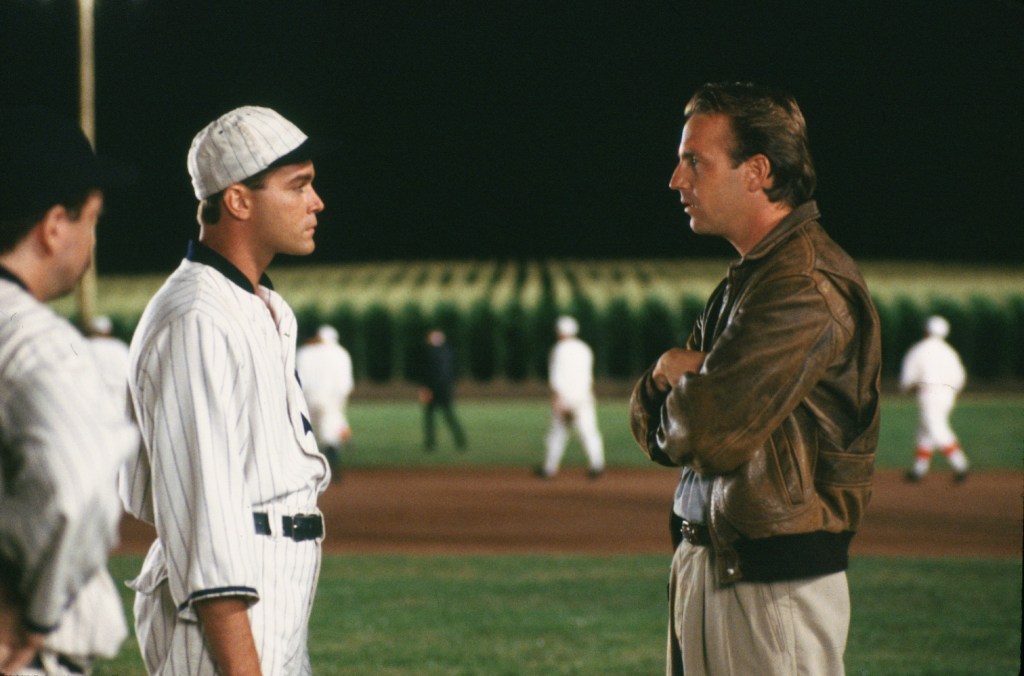
There is a moment near the end of Field of Dreams that undoes me completely, every single time. It is not the catch — though the catch will finish the job. It is Moonlight Graham walking off the field.
Doc Graham has just stepped across the white chalk line to save young Karen Kinsella from choking, sacrificing his place among the ghosts to become an old man again, to become mortal again, because a child needed him and he was a doctor long before he ever got his one half-inning in the majors — the single inning of major league baseball that defined him, or rather that he refused to let define him, building a life of quiet purpose in Chisholm, Minnesota instead. The players shake his hand. They congratulate him. They wish him well with the gentle formality of men who understand exactly what has just happened and what it cost. And then Ray Liotta’s Shoeless Joe, that luminous and ruined ghost, calls out across the field to him — full-voiced, the way you say the truest things when you want to make sure they land: hey rookie, you were good. And Burt Lancaster turns back around, and there it is: that sparkle, that particular light in his eyes that only Lancaster could produce, the light of a man who has made his peace with everything and found it sufficient. Win one for me, will you boys? And then he walks into the corn and he is gone.
The corn closes behind him and the field goes quiet and you feel the full weight of what just happened — which is nothing less than a man choosing mortality. Graham had his miracle. He was there, on that impossible field, playing the game he loved alongside men who should not exist. And he gave it up without hesitation the moment something more important required it. That is the sacrifice the film is asking you to sit with: not a dramatic one, not a violent one, but the quiet and irrevocable kind, the kind that most of us will face in smaller ways throughout our lives. The stepping across a line you cannot uncross. Lancaster plays it with such unshowy grace that the grief of it sneaks up on you completely. By the time you understand what you’ve just witnessed, he’s already gone.
What makes the moment even more beautiful — and more poignant — is what it does for the real Archibald “Moonlight” Graham, who before W.P. Kinsella’s novel and before this film was barely a footnote in the annals of baseball history. He appeared in one game for the New York Giants in 1905. He never got to bat. He went on to become a beloved small-town doctor in Minnesota, and he died in 1965, and the game largely forgot him. The kind of forgetting that happens to most people, most lives — absorbed quietly into the past without ceremony. And then Kinsella found him, and Robinson put Burt Lancaster in his shoes, and now Moonlight Graham walks off a magical baseball field in Iowa and into the corn with a sparkle in his eye and the whole audience weeping, and he is remembered. That is not nothing. That is, in its own way, exactly what the film is about.
I have never gotten through that scene without crying, it is one of the most beautiful moments in movie history.
I am not a particularly spiritual person. I don’t go to church anymore. I hold my metaphysics loosely and my skepticism close. But Field of Dreams does something to me that I cannot fully explain and have stopped trying to. It reaches into some chamber of the heart that I didn’t know needed reaching and opens it wide. Maybe that’s what great movies do. Maybe that’s what baseball does. Maybe they are, in the end, the same thing.
Baseball is a game that should not work. It is slow by design, resistant to the clock, unbothered by the impatience of the modern world. A game can last three hours or five. An at-bat can last thirty seconds or twelve pitches. There is no buzzer, no play clock, no mechanism by which time is forced to move, except for the cursed pitch clock in recent seasons. Yet baseball is the only sport that feels genuinely timeless, in the most literal sense of that word. When you are inside a baseball game, really inside it, something happens to your relationship with the hours. They loosen. The afternoon light sits differently. You are suddenly aware of the grass and the geometry of the diamond and the way a pitcher rocks back before delivering and you are ten years old again, or you are the age you are now, or you are both at once, and it doesn’t matter. Baseball has this power: it keeps people young not by pretending that age doesn’t exist but by creating a space in which it temporarily ceases to apply. The men on the field are the ages they are — some of them boys, some of them veterans with bad knees and institutional memory — and the game holds all of it without contradiction. There is something almost cruelly beautiful about the sport’s relationship with the arc of a life. Every season is born in spring, in Florida and Arizona sunshine, in the impossible annual renewal of hope that even the fans of the worst franchises in baseball feel in March, that irrational and gorgeous conviction that this year will be different. The season stretches through the long, unhurried days of summer, each game a small world unto itself, and then it begins to narrow into autumn, into the shortening afternoons and cooling nights of October, and it ends — for all but one lucky city — in cold and darkness and the particular silence of a season that is over. It dies, as all things do, and it is born again, as not all things are. That cycle — hope and summer and harvest and loss and hope again — is not a metaphor for something else. It is the thing itself. It is why we watch.
Phil Alden Robinson’s film, released in 1989 and adapted from W.P. Kinsella’s novel Shoeless Joe, is one of the genuine masterworks of American popular cinema — and I use that word with the full weight of its implications. Not “very good.” Not “beloved.” A masterwork: a film so precisely calibrated to its emotional and thematic ambitions that it achieves a kind of perfection that only a handful of movies in any era manage. It belongs in the same conversation as E.T. the Extra-Terrestrial — another film about a man-child who hears something impossible calling to him across a cornfield of everyday life. Like Spielberg’s 1982 film, Field of Dreams operates in that rare register where movie magic isn’t a trick or a spectacle but a feeling, a genuine and inexplicable opening up of the world. Both films make you believe in things you cannot see. Both films end with you crying in ways you aren’t entirely proud of. Both films are perfect.
What Robinson understood — and what separates Field of Dreams from the dozen lesser films it could have been — is that the magic only works if the mundane does. The film earns its miracles through the patient accumulation of ordinary life. Ray and Annie Kinsella are not archetypes; they are a couple. They bicker about money. They read to their daughter. They lie in bed talking in the low, half-finished sentences of people who have shared years together. Kevin Costner and Amy Madigan build a marriage onscreen with such quiet conviction that when the impossible arrives — when Shoeless Joe Jackson materializes out of the corn — we accept it because it feels continuous with everything that has come before. This is a household where love is real, where the rhythms of family life have weight. The baseball field that grows in the middle of that Iowa farm makes a strange kind of sense because the film has already established that this is a place where things are tended and believed in. The slow pace of family life in the heartland isn’t backdrop here. It’s the argument. The film is insisting that this — the farm, the daughter, the marriage, the catch at dusk — is what matters. Baseball is the language in which that insistence is made.
And what a language it is.
Baseball is the most literary of American sports because it is the most conscious of time. Football is about territory; basketball is about improvisation; baseball is about waiting, and repetition, and the long accumulation of a season, and the way a career arc looks like a life. It is a sport with a relationship to history that borders on the theological. Every at-bat carries the shadow of every at-bat that came before it. Every ballpark is a palimpsest. When a shortstop fields a grounder and throws to first, he does it in the long echo of every shortstop who ever threw to first on every diamond from Yankee Stadium to a sandlot in Utah to a backyard game in Dearborn, Missouri where the bases were dish towels or random objects found around the yard. Baseball is a haunted game. The players who take the field today play with the ghosts of the players who filled those positions before them — not as a metaphor but as a felt reality, present in the statistics and the records and the names that every serious fan carries around like a second vocabulary.
Field of Dreams knows this. It is built on it. The film is as full of ghosts as any horror movie, except these ghosts are longed for rather than feared. Shoeless Joe Jackson — played with mournful, otherworldly grace by Ray Liotta — is the film’s first and most luminous specter, a man condemned by the 1919 Black Sox scandal to a permanent exclusion from the game he loved. The scandal itself haunts the film the way original sin haunts a theology: as the moment when baseball’s innocence was corrupted, when money and cynicism and the grinding machinery of organized crime reached into the garden and left a stain. Eight players were banned from baseball for life for allegedly throwing the World Series. Whether Shoeless Joe Jackson — the great left fielder from South Carolina who hit .375 in that series and made no errors — was truly guilty is a question that baseball historians have argued ever since. The film takes his side, and in doing so, takes the side of the game itself: the beautiful, pure game that existed before and alongside the corruption, that survived it, that still exists in the late afternoon light whenever a ball finds a glove.
Burt Lancaster’s Moonlight Graham, as I have already confessed, is another ghost entirely — a man defined by the experience he didn’t quite have, and by the fullness of the life he built in its absence. That Lancaster died before the film was released lends his performance a double poignancy it wasn’t designed to carry and carries anyway, one more layer of haunting in a film that runs on them. And James Earl Jones, alive and thundering on-screen but absent from the final game, present and then suddenly gone the way that all important people eventually are, functions as the film’s conscience — a voice from the counter-culture, from the burned idealism of the 1960s, speaking about America’s relationship to baseball with the authority of someone who has earned his disillusionment and set it aside.
Because Field of Dreams is, among other things, a film about the 1960s — about what happened to the generation that came of age in that decade and the particular grief of people who believed the world was about to become something and watched it become something else instead. Terence Mann, James Earl Jones’s reclusive author, is the film’s most explicitly constructed figure of that era, a composite drawn unmistakably from the two great literary recluses of twentieth-century American letters: J.D. Salinger, who wrote one of the defining novels of postwar American adolescence and then disappeared from public life entirely, and Norman Mailer, who spent decades as the country’s most combative public intellectual before the culture moved on without him. Mann carries both men inside him — Salinger’s principled withdrawal, Mailer’s furious engagement with the political life of the nation — and what Robinson’s film does with that composite is quietly devastating. Here is a man who was present at the creation of something, who believed in the capacity of American culture to tell the truth about itself, and who retreated into silence when that belief became untenable. The 1960s made him. The failure of the 1960s unmade him. Baseball, in the film’s moral economy, is what brings him back.
The decade’s idealism runs through every frame of Field of Dreams like an underground river. It surfaces in Mann’s biography, in the folk music on the soundtrack, in Ray’s own history — his estrangement from his father rooted partly in the political arguments that tore families apart during Vietnam, the generational fissure that the era opened and never fully closed. The film is saturated with the specific texture of what it felt like to believe, in the late 1960s, that America was on the verge of becoming honest with itself — and with the specific grief of what it felt like when that belief was defeated. The optimism of that decade, battered but not extinguished, is what the baseball field represents. A thing tended in faith, against all reasonable expectation, in the hope that something will come.
Which brings us to Annie Kinsella, and to a scene that in 1989 read as charming period nostalgia and in 2026 reads as something considerably more urgent. The community meeting at which a group of local parents attempts to have Terence Mann’s books removed from school curricula is played partly for comedy — Amy Madigan’s Annie is so magnificently indignant that it’s impossible not to laugh — but Robinson is not kidding around. The scene is a direct confrontation with the impulse to curate the past, to decide that certain truths are too dangerous for young people to encounter in a classroom. Annie’s response — furious, specific, personal, refusing to be reasonable about something she finds unreasonable — is the film taking a side. It is not a both-sides scene. The book-banners are wrong, and the film knows it, and it says so through the most alive and specific character it has.
That the scene resonates so sharply in 2026, when books are still being challenged and removed from school libraries and curricula at startling rates and for reasons that would be farcical if their consequences weren’t so serious, is not a coincidence. It is the film being right in a way that good films sometimes are: not prescient exactly, but honest about something permanent in American life, something that keeps returning. The same anxiety about what stories children are allowed to encounter, the same reflexive suspicion of complexity and discomfort, the same impulse to protect the young from the very literature that might most help them understand their world — it was there in 1989 and it is here now. Annie’s fury is not dated. It is completely contemporary. And Amy Madigan plays it with such full-bodied conviction — the irritation and the passion and the slight disbelief that she is having to make this argument again, still, in public — that it lands every time as both comic and completely serious. It is the performance of someone who knows exactly what is at stake.
Mann’s speech about baseball — about the game’s capacity to remind Americans of what they once believed about themselves — is the film’s thesis statement delivered as pure incantation. “The one constant through all the years, Ray, has been baseball.” He is talking about baseball. He is talking about something else. And Jones delivers it with the full authority of a man who has thought long and hard about what it means to love a country that keeps disappointing you and to love it anyway.
The film is ageless because it has found the permanent within the period. The specificity of its 1989 Iowa setting gives it texture, but its real subject — fathers and sons, the things we inherit and the things we fail to inherit, the grief that outlasts its occasion and the grace that sometimes answers it — belongs to no particular era. Every generation has its lost fathers and its unlived summers and its fields of possibility that it watched turn to corn. The film speaks to that universally. It speaks to it in a way that gets inside me every time, without diminishment.
James Horner’s score is as good as film scoring gets. It is patient where other scores would push, restrained where others would swell, finding the emotional temperature of each scene rather than dictating it. The main theme has the quality of something remembered rather than composed — music that sounds like it has always existed, like it was waiting to be found. It makes the corn look golden. It makes the catch at the end feel like the resolution of something that has been unresolved your whole life.
Costner is doing some of the best work of his career in this film, which tends to be underappreciated because the performance is so undemonstrative. He is playing an ordinary man in an extraordinary situation, and his great skill is in conveying the specific texture of ordinary conviction — the way a person looks when he is doing something unreasonable and knows it and is going to do it anyway. He gives Ray a stubborn, embarrassed sincerity that makes the character enormously sympathetic. But the film belongs to Amy Madigan. Her Annie is the movie’s actual heart: practical, funny, fierce, fully alive, and in love with her husband in the exact way that a person in love with a dreamer manages to be — knowing exactly who he is and loving that specifically rather than in spite of it. She is doing the film’s emotional work in the margins of scenes that are ostensibly about other things, and the film would be half of what it is without her.
And then there is the ending, which is one of the best in the history of American cinema. The camera pulling back from Ray and his father playing catch to reveal the long line of headlights coming down that dark road — all those people driving toward the field because something in them needed to, because something was calling — is an image that operates beyond argument. It is not making a point. It is not resolving a thesis. It is doing what only the best cinematic endings do: expanding the meaning of everything that preceded it until the personal becomes the communal becomes something that feels, against all your resistance, like the sacred. I dare you to watch it dry-eyed. I have never managed.
I watch this film every year. I watched it with my grandfather, a proud son of Iowa who passed his love of baseball to me the way some people pass a faith — gradually, by example, through shared practice of how to watch games, and how to appreciate the sport and its history. Sometimes we’d text each other names of old players — obscure names, loved names, the kind of names that only people who have really given themselves over to a sport carry around — Johnny King, Orval Overall from the 1908 Cubs championship team, George Giles, who played outfield for the Kansas City Monarchs. One February we spent an entire day in downtown Weston waiting for Salvador Perez and Brett Saberhagen to show up for a Ford F-150 commercial. They never came. We waited anyway. That was its own kind of baseball.
I was with my grandparents in 2015 when our Kansas City Royals, the team I would ride or die for every season, and the team I have loved since attending my first game at Kauffman Stadium in 2012, won the World Series. I thought in that moment that I had witnessed the greatest thing I would ever see. The next year, in Game 7 of the World Series — the Cubs against the Cleveland Indians — my grandfather came and woke me up after the rain delay. Seventeen minutes, the game stopped. Seventeen minutes in which anything could still happen, in which 108 years of waiting hung in the air over Progressive Field. He wanted me to see what was about to happen. And the three of us sat together and watched the Chicago Cubs win.
To this day, I cannot come across footage of Chicago fans gathered outside an empty Wrigley Field that night — the game was in Cleveland, the stadium dark, and still they came — without tearing up. Thousands of people standing outside a ballpark that wasn’t even hosting the game, because where else would you go? Because the building meant something, because the ground meant something, because that is what baseball does to you. It makes you show up for things that don’t require your presence. It makes you stand in the cold outside a dark stadium and weep for joy over something that happened 350 miles away, and it makes perfect sense. That is the religion of baseball. That is what Field of Dreams understands in its bones.
My grandfather is gone now. I watch the film every year and he is in it somehow — not literally, not magically, but in the way that the things we love come to carry the people who loved them alongside us. When Ray asks his father if he wants to have a catch, I hear something I never got to say directly, and something I hope was understood without saying. I think that is what the film is ultimately about: not baseball, not ghosts, not even fathers, but the persistence of connection across the distances that life puts between people. The field keeps the faith. The game goes on. The lights come on in the dark.
I am not a spiritual person. But there is something that happens to me every time I watch Field of Dreams that I don’t have another word for. Call it the religion of baseball. Call it cinema at its most unembarrassed and most true. Call it a perfect movie, because it is.
★★★★★
 Show Me Cinema
Leave a comment