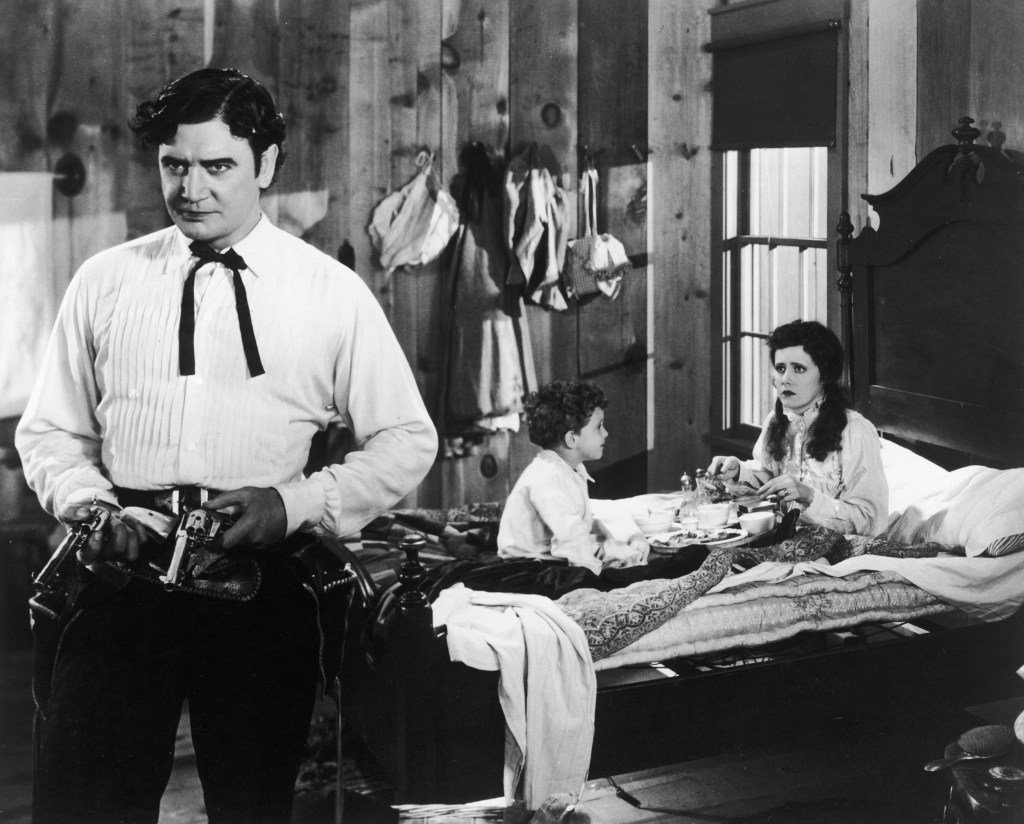
In a year following All Quiet on the Western Front, it makes complete sense that Cimarron was the next Best Picture winner. Aside from some interesting performances, primarily by Richard Dix, and some truly remarkable riding and action sequences, I couldn’t help but feel that I was watching a prolonged episode of Bonanza. The story itself is somewhat interesting, but unfortunately does not age well given the issue with race — which is a condemnation on American history as much as it is on film. Cimarron overall is a slow-burning film, and I found myself wondering several times throughout how it might have been different if John Ford had taken the helm. The story would likely still have had its issues, yet Ford was a master at creating tension in the classic western, so it would have been a faster-paced adaptation of history, and one, I must confess, I would like to have seen. Still, Cimarron is an extremely interesting film, and an artifact of America’s relationship with its own history — good and bad.
The Academy of Motion Picture Arts and Sciences that gave Cimarron its Best Picture award at the 4th ceremony, held on November 10, 1931, was a very different institution from the cultural monolith it would eventually become — and that difference matters. In 1931, the Academy was still a fairly intimate guild organization, not even five years old, operating in a Hollywood that was itself in the throes of a seismic identity crisis. The transition to sound had upended everything. Studios were scrambling. Directors were re-learning their craft. Actors trained in silence were suddenly being asked to speak. The whole enterprise of moviemaking had been essentially reinvented in the span of three years, and the Academy Awards, still in their nascent and somewhat chaotic form, reflected that turbulence.
The voting rules were looser, the eligibility windows were stranger, and the politics of the ceremony were far more nakedly industrial than they would later become. The Academy functioned, in part, as a company union — a body designed to mediate labor disputes between studios and their employees, and its awards were partly a vehicle for studio prestige, for promoting the product. RKO Radio Pictures had a great deal invested in Cimarron. It was, at the time of its release, the most expensive film in the studio’s history, a massive gamble, a prestige play on a grand scale. When it swept the major awards, it was not merely an artistic judgment; it was the Academy sending a signal about the kind of cinema that the industry wanted to endorse — big, expensive, American, and sweeping.
There was also, it must be said, an element of momentum. All Quiet on the Western Front had won the previous year, and that film’s enormous critical stature and its deeply serious subject matter — the futility of war, the waste of youth, the lie of glory — had set a tone of gravity. Hollywood wanted to follow that act with something equally grand in scale, if not in moral complexity. Cimarron, adapted from Edna Ferber’s bestselling 1929 novel of the same name, seemed tailor-made to answer that call. It was a prestige adaptation of a prestige text. It covered fifty years of American history. It was enormous in its ambitions. And in 1931, enormous ambitions counted for a great deal at the Academy, perhaps more than the execution that followed.
To watch Cimarron without understanding the America that received it is to miss half the picture. The film was released in January 1931, with the Academy recognition coming in late November of that year, and the America of that moment was in a condition of profound and bewildering distress. The Great Depression had been grinding its way through the country for over a year. The stock market crash of October 1929 had detonated shockwaves that were still rippling through every corner of the economy and every stratum of society. Unemployment was climbing toward the catastrophic figures that would define the decade — by 1932, roughly one in four American workers was without a job. Banks were failing. Farms were failing. The Hoover administration, ideologically committed to voluntary action and horrified by the specter of direct federal relief, seemed paralyzed in the face of a calamity it could not adequately name, let alone solve.
Into this atmosphere of dislocation and anxiety came a film about the Oklahoma Land Rush of 1889 — about a nation that once had endless open land, that once had a frontier to escape to, that once had a myth of perpetual beginning. The appeal was not accidental, and it was not simply escapism, though it was certainly that too. Cimarron spoke directly to a particular strain of American self-mythology that was under enormous pressure in 1932: the belief in expansion, in the heroic individual who could ride out into open country and carve something from nothing. The western as a genre had always served this mythological function, but in the Depression, it carried an extra charge of longing. When audiences watched the Oklahoma Land Rush in the film’s extraordinary opening sequence — and it is extraordinary, a genuinely breathtaking piece of filmmaking that still holds up nearly a century later — they were not simply watching a historical spectacle. They were watching a version of America that felt, in 1931, almost impossibly remote.
The western had been in a complicated place throughout the 1920s. Silent westerns had been enormously popular, and figures like Tom Mix and William S. Hart had defined a certain American mythology on screen. But with the coming of sound, the genre had struggled. Early sound technology was cumbersome, ill-suited to outdoor shooting, and the western’s essentially spatial and physical grammar — landscape, movement, chase — was difficult to translate into the new medium’s requirements. By 1931, the prestige western was essentially a category that did not yet exist. John Ford was making westerns, but Stagecoach, the film that would define the genre for the sound era, was still eight years away. Cimarron arrived in this vacuum as something genuinely unusual: a western that aspired to be an epic, that took seriously the idea that the story of the American frontier was a story worth telling with the full resources of a major studio and a major director’s vision. It was a western for people who thought they didn’t like westerns. It was, in that sense, the prestige western before the prestige western existed as a category — and that novelty was a significant part of its appeal.
The plot of Cimarron follows Yancey Cravat (Richard Dix), a flamboyant, charismatic, impossibly romantic frontiersman whose appetite for adventure is perpetually at war with his capacity for domestic stability. When we first meet him, he is a newspaper editor and man of considerable local reputation, and when Oklahoma Territory is opened for settlement in 1889, he is among the thousands who line up at the starting gun and race across the plains to stake their claim. The Land Rush sequence that opens the film is, to put it plainly, one of the great set pieces in early Hollywood cinema. Director Wesley Ruggles and cinematographer Edward Cronjager managed to capture a genuine sense of mass human movement, of history in its raw, chaotic, exhilarating form — thousands of extras, hundreds of horses, dust and noise and desperate velocity. It is the film at its absolute best, and it sets a standard that nothing in the subsequent two-plus hours quite manages to match.
Yancey, accompanied by his wife Sabra (Irene Dunne), settles in the fictional town of Osage and founds a newspaper, the Oklahoma Wigwam. From here, the film becomes essentially episodic: a series of set pieces and encounters that carry us across fifty years of Oklahoma history, from territorial days through statehood and into the 1920s oil boom. Yancey fights a gunfighter. Yancey defends a prostitute in court. Yancey stands up for the rights of the Osage Nation. Yancey disappears for years at a time, always drawn back to the frontier’s receding edge. Sabra, meanwhile, raises their children, runs the newspaper, rises to local prominence, and eventually becomes a congresswoman — though this arc, which is in some ways the more interesting story, is treated as essentially secondary, a B-plot running alongside the legend of her incandescent, impossible husband.
This is one of the film’s structural problems, and it is a significant one. Yancey is written and performed as a figure of mythological proportion, a man so large in his appetites and his virtues that he strains the credulity of any realistic portraiture. He is brave, eloquent, principled, magnanimous, wildly handsome, lethal with a gun, and possessed of a theatrical flair that would shame a Shakespearean actor. He is also, in purely narrative terms, unreliable — a man who abandons his family repeatedly, who disappears into the vanishing frontier like a figure in a dream, who cannot be contained by the domestic civilization he has supposedly come to build. The film seems to want us to admire this quality in him without quite interrogating it, to read his restlessness as a symptom of greatness rather than a failure of responsibility. This works better in Ferber’s novel, where there is more room for ambivalence, than it does on screen, where the sheer physical presence of Richard Dix tends to overwhelm any critical distance the script might otherwise establish.
The story’s episodic structure — which reflects Ferber’s source material, itself a sweeping multi-decade chronicle in the manner of Edith Wharton or Willa Cather — creates a peculiar rhythm on screen, one that alternates between genuine excitement and long stretches of theatrical dialogue and domestic drama. Scenes that feel as though they belong on a stage follow sequences of genuine cinematic invention. The tonal range is extremely wide, wider perhaps than any single film can comfortably accommodate, and Ruggles is not always equal to the challenge of moving between registers without losing the thread. There are stretches of Cimarron — particularly in its middle section, when the Land Rush is long past and the oil boom has not yet arrived — that genuinely test the patience. One begins to understand what a director of Ford’s caliber might have done with this material: found the spine beneath the episodic sprawl, imposed a visual grammar on the landscape that tied the human drama to the physical world, made us feel the passage of time as something other than a costume change.
The acting in Cimarron is, to put it charitably, of its moment. And its moment was a very particular one in the history of Hollywood performance — the early sound era, when the stage traditions that most actors had trained in were colliding awkwardly with the newly intimate demands of the microphone, and no one had quite worked out the correct calibration between theatrical projection and cinematic naturalism. What resulted, in many early sound films, was a style of performance that reads today as theatrical to a degree just short of camp: voices modulated for the back row of a thousand-seat house, emotions telegraphed with facial expressions legible from the street, gestures that belong more to nineteenth-century melodrama than to anything we would recognize as realistic.
Richard Dix is an interesting case. He was a legitimate star of the silent era who had made the transition to sound with reasonable success, and in Cimarron he brings to the role of Yancey Cravat a quality of physical magnetism that the camera genuinely captures. When he is in motion — riding, shooting, striding into a courtroom — he is compelling. He has a quality that we would now simply call screen presence: something in his bearing and his eyes that makes you want to watch him, that fills the frame with purpose and energy. The Land Rush sequence, in which he is only one figure among thousands, nevertheless keeps drawing the eye back to him. This is the essence of movie stardom, and Dix had it.
Where he struggles — and where the film struggles along with him — is in the quieter, more intimate scenes that constitute the majority of the running time. The dialogue of Cimarron is frequently purple to the point of self-parody, and Dix delivers it with a commitment that is admirable and occasionally risible in equal measure. Yancey’s speeches — and there are many speeches, long ringing declamations about liberty, about the frontier, about the dignity of the dispossessed — are performed with the full force of a man who knows he is playing a legend. When Dix defends a local prostitute before a hostile congregation, he is less a character in a realistic drama than a figure in a morality play, a symbolic embodiment of frontier justice and progressive principle. It works, sort of, in the way that a certain tradition of theatrical acting works — on its own terms, with its own internal logic — but it sits uneasily in a medium that was already, in 1931, moving toward something more behavioral and subtle.
Irene Dunne received an Academy Award nomination for Best Actress, and her performance is, in certain respects, the more interesting of the two. She has less latitude — Sabra is given less to do, and what she is given is largely reactive — but she manages within those constraints to sketch a character of greater psychological complexity than the script quite deserves. There is a particular scene in the latter portion of the film, when Sabra has grown into a figure of community authority and Yancey has long since disappeared again, in which Dunne’s face registers a whole history of accommodation and suppressed grief that is genuinely moving. She had trained in musical theater, and the control she exercises over her instrument — voice, posture, the precise angle of the head — reflects that training in ways that serve her better on screen than Dix’s more declamatory approach serves him.
The supporting cast is largely competent in the manner of studio character players of the period — solid, functional, occasionally vivid — with one notable and deeply unfortunate exception, to which we will return.
Cimarron won three Academy Awards at the 4th ceremony: Best Picture, Best Writing (Adaptation), and Best Art Direction. It remains, to this day, one of only three westerns ever to win Best Picture, the others being Dances with Wolvesin 1990 and Unforgiven in 1992 — a fact that says something significant both about the Academy’s historical relationship with the western as a genre and about the extraordinary anomaly that Cimarron represented in its own time. To win Best Picture in 1931 was to occupy a peculiar position: the Academy’s premier honor, voted upon by industry members, conferred upon a film that was simultaneously a box office success and a critical talking point, and yet one whose artistic achievement was, even at the time, not universally acclaimed.
The Best Adaptation award went to Howard Estabrook’s screenplay, which faithfully (perhaps too faithfully) transposed the sprawling episodic structure of Ferber’s novel to the screen. The Art Direction award, going to Max Ré, is more straightforwardly deserved — the production design of Cimarron, particularly in the recreation of the Oklahoma township in its various stages of development, is genuinely impressive, the kind of deep-background environmental detail that creates the texture of historical specificity. The sets feel inhabited. The town of Osage changes across the film’s decades in ways that feel materially true, accumulating the accretions of a real place that has grown and changed over time.
What the film did not win — and this is telling — were the more performative awards. Richard Dix’s nomination for Best Actor did not yield a win; Fredric March took the award that year for Dr. Jekyll and Mr. Hyde. Irene Dunne did not win for Best Actress. Wesley Ruggles was not recognized for direction. These omissions are significant because they suggest that even in 1931, the film’s total achievement was understood to be something other than the sum of its performances or its direction — that it was, rather, an event, a spectacle, an industry achievement of a kind that the Academy felt compelled to honor at the highest level while quietly acknowledging the limitations of its individual components.
This is where the review must slow down and linger, because to discuss Cimarron without discussing the racial politics embedded in it is to discuss the film dishonestly, and the film does not deserve that kind of protective silence. Cimarron‘s failures on this front are not incidental to the film; they are structural, woven into its conception of what America is and who belongs in the story of American civilization.
The most immediately egregious element is the portrayal of Isaiah (Eugene Jackson), a young Black servant who travels with Yancey and Sabra as essentially comic relief — a minstrel figure, bug-eyed and terrified, who exists at the film’s margins as a source of gags about cowardice and ignorance. This was not unusual for Hollywood cinema of 1931; it was, in fact, entirely standard. The minstrel figure was a fixture of American popular entertainment going back to the nineteenth century, and early Hollywood had absorbed and perpetuated it without meaningful reflection. What the film does with Isaiah is what Hollywood did with Black characters routinely during this period: it renders them as caricatures of subservience and foolishness, objects of condescension rather than subjects of human experience. To watch these scenes now is to feel the full weight of what it meant that American cinema, for most of its first half-century, treated Black people as legitimate objects of ridicule, and that audiences laughed.
The film’s treatment of Native Americans — the Osage Nation in particular — is more ambivalent and in some ways more interesting as an artifact of its period’s ideological confusions. Yancey is presented as an advocate for Native rights, a progressive voice who speaks up for the dispossessed against the rapacity of white settlers and oil interests. This is, in the context of 1931 Hollywood, genuinely unusual; the western genre in this era was largely content to treat Native peoples as obstacles to civilization, as threats to be defeated, as savages in the specifically racist meaning of that term. That Cimarron gestures toward something more complicated — that Yancey’s sympathy for Native people is presented as part of his moral stature rather than his eccentricity — is worth acknowledging.
But acknowledging it doesn’t mean it’s sufficient. The film’s Native characters are still largely passive — objects of the white protagonist’s advocacy rather than agents of their own historical experience. The camera doesn’t grant them interiority; they exist to illuminate Yancey’s virtue. This is the paternalism that lies beneath the apparent progressivism, the same structure that would characterize Hollywood’s “sympathetic” portrayals of marginalized peoples for decades to come: you are worthy of advocacy, but you remain someone else’s subject. Yancey’s defense of Native dignity is, in the final analysis, another of his legendary qualities, another feather in the cap of the Great American Man. The Osage themselves remain at the picture’s periphery, beautiful and wronged and voiceless.
It is important, when discussing this, not to fall into the trap of simple anachronism — of holding 1931 Hollywood to the standards of 2025 critical discourse as though those standards were always available and merely ignored. Historical context matters. These failures were the failures of a culture, not merely a film, and Cimarron was in several respects more progressive than its contemporaries on racial questions. But historical context does not require us to be incurious about these failures or to treat them as irrelevant to the film’s meaning and legacy. The racial politics of Cimarron tell us something important about what the western as a genre has historically encoded — about whose heroism counts, whose suffering registers, whose story is understood as the story of America — and that encoding is part of the film’s identity as a cultural document, for better and worse.
One of the genuinely interesting things about Cimarron — and perhaps its most significant contribution to film history, however unintentional — is what it represents as a generic experiment that Hollywood chose, for the most part, not to repeat. The prestige western: big-budget, serious in intent, adapted from literary fiction, aimed at adult audiences who would not ordinarily think of the western as their form of entertainment. In 1931, Cimarron was this thing, alone, at enormous expense, with the Academy’s highest honor behind it.
And then, for decades, Hollywood more or less abandoned the idea.
The western survived and thrived in the 1930s and 1940s, but largely in cheaper forms: the B-western, the serial, the Saturday matinee picture. John Ford was doing remarkable work — Stagecoach in 1939, My Darling Clementine in 1946 — but these were not, initially, understood as prestige pictures in the way that Cimarron had been. They were genre pictures that happened to be made by a great director. The prestige western, the western as a serious adult entertainment worthy of the Academy’s most elevated attention, would not return in force until the genre’s great renaissance in the late 1960s and 1970s, and its occasional late-career appearances in the work of Clint Eastwood. Cimarron‘s Best Picture win did not launch a movement; it was, instead, an outlier so extreme that the Academy would not come close to repeating it for nearly sixty years.
Why? Part of the answer is simply that the Academy’s bias against genre cinema is long and well-documented, its suspicion of the popular, the commercial, the plot-driven deep and consistent. But part of the answer is also that Cimarronitself, whatever its ambitions, didn’t quite prove what it was trying to prove. It did not demonstrate that the western could reliably sustain the weight of serious artistic purpose; it demonstrated, instead, that a very expensive western could be a very expensive western — spectacular in moments, impressive in scale, fundamentally limited in the ways that the genre’s conventions and Hollywood’s racial assumptions constrained it. The road to the prestige western had to be rebuilt from scratch, by different people, under different cultural conditions, and it ran not through the legacy of Cimarron but around it.
The field of Best Picture nominees at the 4th Academy Awards is, by any serious measure, one of the more interesting lineups in the award’s history, and understanding what Cimarron defeated makes the win simultaneously more comprehensible and more frustrating. The nominees were: Cimarron, East Lynne, The Front Page, Skippy, Trader Horn, An American Tragedy, The Guardsman, La Smiling Lieutenant, and Five Star Final.
The Front Page, directed by Lewis Milestone fresh off his All Quiet triumph, is a rapid-fire screwball comedy about journalism that crackles with the kind of kinetic verbal energy that the best of early sound cinema could achieve. It is, by any standard, a better-directed film than Cimarron, and its influence on the newspaper comedy as a genre — a line that runs directly to His Girl Friday — is incalculable. Five Star Final, a dark and disturbing drama about tabloid journalism starring Edward G. Robinson at the height of his early-career magnetism, is a film that has been criminally undervalued in the historical record, a genuinely brave piece of work about media ethics that still carries a punch. An American Tragedy, Josef von Sternberg’s adaptation of Theodore Dreiser’s great novel, is uneven but haunted, the kind of serious literary adaptation that the Academy was supposedly looking to honor.
But it is Skippy that deserves the most sustained attention as the film that the Academy arguably got most wrong in not choosing. Norman Taurog’s adaptation of Percy Crosby’s comic strip is, on its surface, a children’s picture — the story of a young boy’s friendship across economic lines and his desperate attempt to save the life of a friend’s dog. But what Taurog does with that material is quietly extraordinary. Skippy is a film of enormous emotional intelligence, one that takes childhood experience with complete seriousness, that refuses to condescend to its young protagonists or to sentimentalize the poverty that constrains their world. Jackie Cooper’s performance — he was nine years old — is one of the most remarkable child performances in film history, a performance of such raw, unguarded emotion that it remains deeply affecting in a way that the grand theatrical gestures of Cimarron frequently are not.
Taurog won Best Director for Skippy — one of the clearest cases in Oscar history where the directing prize and the Best Picture prize pointed in different directions and the directing prize pointed more truthfully. Skippy is a film in full command of its medium, one that knows exactly what it is trying to do and does it with a precision and an emotional honesty that Cimarron, for all its scale, never quite achieves. That the Academy gave the top prize to the epic western rather than the small, devastating children’s film tells us something about what the Academy, in 1931, understood prestige to mean: size, scope, historical grandeur, the apparatus of Big Cinema. Skippy had none of these things. It had only the smaller, harder, more durable virtues of a film that genuinely understands human experience and renders it with care. In a just world, it is the Best Picture of 1931. That it is remembered primarily as a footnote to Cimarron is one of the minor injustices of the historical record.
There is a peculiar experience involved in watching Cimarron in 2026, ninety-four years after its initial release. You watch it with at least three different critical lenses simultaneously: through the eyes of what cinema has since become, which makes its techniques seem alternately primitive and surprisingly accomplished; through the eyes of its historical moment, which makes its ambitions comprehensible and its failures explicable; and through the eyes of the America it was made in and made for, which makes the whole enterprise feel like a dream that a frightened country was dreaming about itself.
The film is not great. It is not even very good, by the standards that we have since developed for what a great film can be and do. Its best sequence — and I will say again that the Land Rush is genuinely one of the great sequences in early American cinema, a feat of logistical and visual invention that would be impressive in any era — exists in a film that cannot quite build on the energy it generates. Its hero is a myth dressed in a man’s clothing, its politics are a tangle of genuine decency and ugly assumption, and its director, however competent, was not equal to the demands of the material he had been given.
And yet. There is something in Cimarron that resists easy dismissal, something that keeps pulling the critical attention back even as the melodrama and the racial discomfort push it away. It is, as I said at the outset, an artifact — and artifacts have a particular kind of interest that great art sometimes doesn’t. A great film shows you something true about human experience in ways that transcend their moment; an artifact shows you the moment itself, in all its confusion and contradiction and self-deception, with a clarity that the moment itself could not have achieved. Cimarron shows you an America in desperate need of its own myth, trying to reconstruct its frontier identity in the shadow of economic collapse, willing to overlook enormous injustices in the service of a story about heroic white masculinity riding across an open plain. That it is a beautiful myth, thrillingly filmed in its best passages, makes it more rather than less instructive.
John Ford, had he made it, might have made a better film and a less interesting artifact. He might have imposed on the material his characteristic visual intelligence, his understanding of landscape as moral grammar, his capacity to find within the western’s conventions a genuine critique of the American legend even as he celebrated it. The Searchers — which Ford would make twenty-five years later and which in many ways is Cimarron‘s shadow self, the film that reckons honestly with the violence and racism that Cimarron can only gesture at — is one of the most complex meditations on American identity ever put on screen, and you can imagine a version of Cimarron that aspired to something similar. We didn’t get that film. We got the one that Wesley Ruggles made, in 1931, for an industry and an audience that were not yet ready for the reckoning that The Searchers would eventually demand.
The prairie in Cimarron is enormous, beautiful, and empty. What fills it is not quite history and not quite myth, but something hovering uneasily between the two — an America looking back at a frontier it had already lost and forward at a decade it was not yet equipped to survive. For that reason alone, and despite all its considerable limitations, Cimarron repays the watching. Just don’t expect it to satisfy.
★★★
 Show Me Cinema
Leave a comment