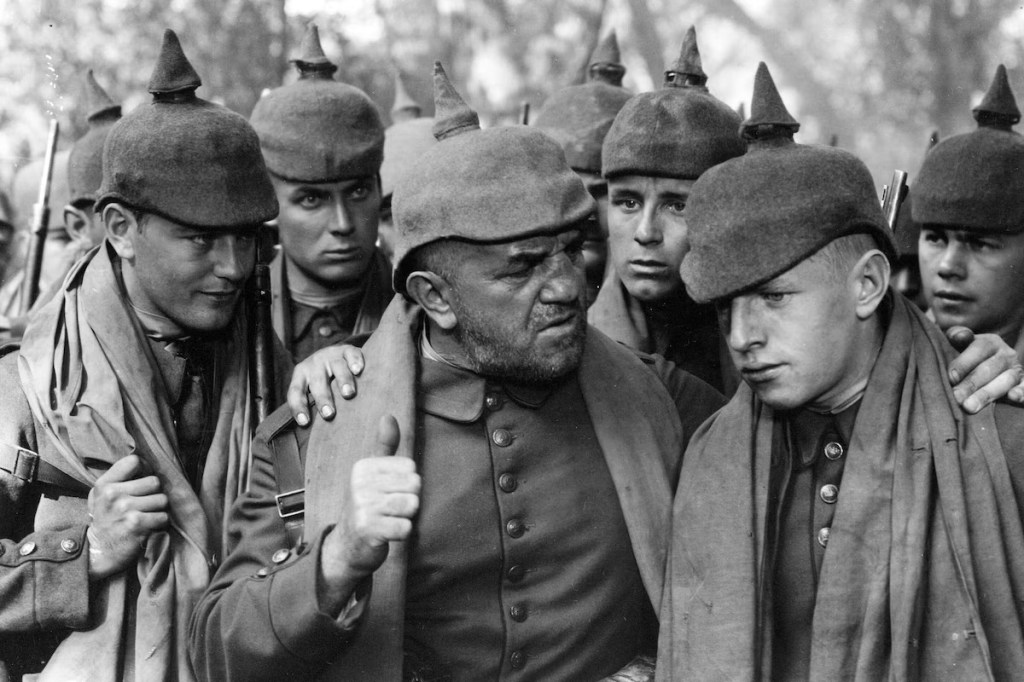
To understand what All Quiet on the Western Front meant in 1930 — and what it still means — you have to understand the climate in which it arrived. The Academy Awards were, at that point, barely more than a novelty. The third ceremony, honoring films from 1929 and 1930, was a different beast from what we know today: a quiet industry dinner rather than a global spectacle, governed by a small guild of insiders still figuring out what the awards were even supposed to celebrate. Best Picture was called “Outstanding Production.” The ceremony lasted minutes, not hours. In this atmosphere, the selection of All Quiet as the year’s finest film feels less like institutional bravery than like a moment when the right film arrived at exactly the right time — when even a fledgling awards body couldn’t look away.
That time was genuinely turbulent. Erich Maria Remarque’s source novel, published in Germany in January 1929, had detonated across Europe with the force of something long suppressed finally breaking through. It sold over one million copies within months, was translated into two dozen languages, and caused immediate controversy in Germany — not because it was poorly written, but because it told the truth. It depicted the First World War not as a theater of glory but as a machine for destroying young men. By the time Universal Pictures released the film adaptation in April 1930, that controversy had curdled into something uglier. In December 1930, the Nazi Party — still years from power but aggressively consolidating its street-level presence — organized coordinated disruptions at screenings across Germany. Joseph Goebbels orchestrated the release of white mice and stink bombs into theaters, incited audiences to riot, and ultimately pressured German authorities into banning the film outright. What they were trying to suppress was not obscenity or foreign propaganda. It was the simple, devastating argument that war is not heroic. That the young men sent to die for their country are owed something the country never pays back.
In America, the film landed differently — as a sensation, a critical triumph, a box office success. Audiences lined up. Reviewers reached for superlatives. It was the kind of reception that suggests a culture momentarily willing to look honestly at something it usually prefers to mythologize. One year into the Great Depression, with the optimism of the prior decade fully collapsed, perhaps Americans in 1930 were more receptive than usual to a story about promises that turn to ash.
The story follows Paul Bäumer — played, unforgettably, by Lew Ayres — a young German student swept up in the nationalist fervor of 1914 by a bellowing, chest-swelling schoolteacher who sends his class straight from the classroom to the recruitment office. Paul enlists alongside his friends, a group of bright-eyed boys barely old enough to shave, each of them convinced they are marching toward something honorable. The film then does what Remarque’s novel does: it methodically disabuses them of that conviction, one death at a time.
There is something peculiar about watching these particular soldiers, though — something that registers as a strange note even if you cannot immediately place it. Strip away the German uniforms and the occasional invocation of the Fatherland, and these boys look and behave like good American boys. They joke in the idiom of American youth. Their mannerisms, their rhythms, their easy camaraderie — it all reads as thoroughly domestic. The effect is disorienting in a way that is probably unintentional. Milestone was making a film for American audiences in 1930, and the calculus is understandable: cast recognizable American actors, let them play themselves, trust that the emotional identification will follow. And it does follow, to his credit. But it comes at a cost. Compare Paul and his friends to the German soldiers in Edward Berger’s 2022 adaptation — men whose cultural specificity is rendered with genuine texture — and the gap is stark. Milestone’s Germans are placeholders, archetypes rather than people from a particular place and time. The film gets away with it because its argument is universal enough to survive the abstraction, but the strangeness lingers. You are watching a German story told in a thoroughly American register, and no amount of field-gray costuming quite closes the distance.
At 152 minutes, All Quiet is a long film — and deliberately, rightly so. Its length is not indulgence; it is argument. We need the time it takes to know these boys as boys before the war makes them into something else, to feel the accumulation of loss as each familiar face disappears from the screen. By the film’s final act, the men who remain — Paul chief among them — are unrecognizable from the students we met at the start. That transformation requires duration. Milestone earns nearly every minute of it. The exception is Paul’s home leave, following a serious injury at the front. He returns to find the civilian world has become alien to him — his family doesn’t understand, the town is full of armchair strategists, the old schoolteacher is still sending new boys to their deaths. It is a thematically essential passage, and Remarque handles it brilliantly on the page. On screen, it drags. The sequence overstays its welcome by roughly fifteen minutes, circling the same note of disconnection and disillusionment until the film begins to feel static. It recovers when Paul returns to the front, but the damage to the rhythm is noticeable.
Ayres was twenty-one years old when he made this film, and his performance as Paul is one of the most criminally overlooked in Oscar history. He was not nominated for Best Actor. The Academy instead recognized George Arliss for Disraeli — a performance of a certain kind of theatrical prestige, competent and largely forgotten. Ayres gives something harder and rarer: a young man watching his capacity for feeling slowly drain away, his eyes growing quieter and more frightened as the film goes on, until the final scene, in which he reaches for something small and beautiful and the film delivers its devastating last word. It is a performance built on subtraction rather than display, and it is extraordinary. The supporting cast holds up admirably around him. Louis Wolheim, as the grizzled veteran Katczinsky, brings a weathered tenderness to what could easily have been a stock role — the wise old soldier who teaches the young ones how to survive. Wolheim makes Kat genuinely warm, almost fatherly, which is precisely what makes his fate so gutting. Slim Summerville, as the hapless and good-natured Tjaden, provides the film with some of its few moments of genuine levity without undercutting the surrounding grief. These are small roles, but they are inhabited with care.
Lewis Milestone won the Best Director Oscar for this film, and the award is deserved. His handling of the battle sequences is, for 1930, nothing short of remarkable — and holds up under scrutiny from our own era of digitally enhanced spectacle. The trench warfare is shot with kinetic, almost chaotic energy, the camera tracking through mud and barbed wire in ways that feel disorienting and immediate. There are no glamorous charges, no noble last stands. Men go over the top and they die in unglamorous, horrifying ways. The editing is brutal in its efficiency. Milestone does not let the camera linger, but he does not look away either. Beyond the battle scenes, he proves equally skilled at the quieter registers the material demands. There are extended passages of soldiers simply waiting — talking, arguing, sharing food — and Milestone films them with patience, letting the audience understand what is at stake in these friendships before the war begins dismantling them. His compositions are thoughtful without being ostentatious. He trusts his material, trusts his performers, and largely stays out of their way.
All Quiet on the Western Front is not a perfect film, but it is an important one — and, perhaps more surprisingly for its age, a genuinely moving one. The home leave section remains a structural problem that a tighter edit might have solved. The nomination committee that overlooked Lew Ayres committed a quiet injustice. And those suspiciously American German soldiers remain a curiosity that no amount of historical context quite dissolves. But these are the cavils of a reviewer trying to be honest rather than reverential. The film itself earns reverence. In 1930, with Europe already beginning to slide toward the war it would take another decade to arrive at, a Hollywood studio released a Best Picture winner that argued, plainly and at length, that war destroys the people it claims to be defending. The Nazis burned it. The Academy crowned it. History, in this case, sided correctly.
★★★★
 Show Me Cinema
Leave a comment