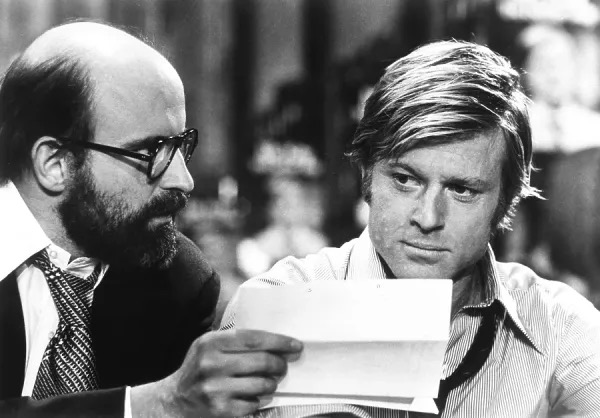
There is a scene about two-thirds of the way through The Candidate in which Bill McKay, California senatorial hopeful and reluctant celebrity, sits alone in the back of a moving car and rehearses the stump speech he has given a thousand times. He recites his positions on housing, healthcare, and the environment the way a child recites a poem learned by rote — and then, after each polished sound bite, purposefully flubs his words, as though his own words have become physically repellent to him. Not because he does not believe it anymore, but because he has seen the ridiculousness of making these important issues focus of a political circus. Then, almost involuntarily, the mangled phrases start bleeding into each other, and he produces a kind of accidental parody of everything he has been saying for months — a slurry of campaign language that, stripped of its careful packaging, sounds like: the basic indifference that made this country great. Robert Redford plays the moment with a vacancy that is almost unbearable to watch, because everything you need to understand about American politics is contained within it, and not a single word of it is Vietnam, and not a single word of it is Watergate. The year is 1972. The country is coming apart at the seams. The movie never once tells you so. It doesn’t have to.
To watch The Candidate in 2026 is to be reminded, with a force that borders on melancholy, that there was simply nobody in the world like Robert Redford. This is not a nostalgic claim or a matter of generational taste. It is a fact, the way it is a fact that there was nobody like Cary Grant or nobody like Montgomery Clift or in today’s terms nobody like Brad Pitt — a specific confluence of gifts that the cinema has never quite managed to replicate, and which this film understands so completely that it essentially builds its entire architecture around the problem of what to do with a face like that.
Redford was, by 1972, already in possession of perhaps the most democratically appealing face in Hollywood history: open, symmetrical, golden in a way that suggested sun-warmed California afternoons rather than artifice, and capable of expressing, simultaneously, genuine warmth and a kind of privately held irony. He was handsome in a way that did not exclude you. This matters enormously for The Candidate, because Bill McKay must be the sort of man you vote for before he has finished his first sentence. The film’s entire logic depends on it. There is that sequence in the car — that same back-seat scene — where McKay clowns around between recitations, flashing a peace sign at nobody, mugging for an absent audience, the gesture landing somewhere between Nixonian affect and Kennedy-esque glamour. It is funny and then immediately not funny, because you realize the candidate himself can no longer tell the difference.
Redford was also something rarer in the grand scope of Hollywood history. He was politically serious, and he was not afraid to let that seriousness bleed directly into the characters he chose and the performances he gave. His off-screen commitments — environmental activism, resistance to the more cynical machinery of the industry, a genuine and vocal engagement with the political questions of his era — were not kept at a careful remove from his work. The Candidate is, in many respects, a film that could only have been made with Redford’s full ideological participation, and it shows. When McKay answers debate questions on busing that is just fractionally more honest than his handlers want it to be, Redford does not play the moment as an actor performing courage. He plays it as a man who still recognizes the sound of a true thing, even when he is no longer entirely certain he believes it. And then, after the debate with his Republican opponent, McKay blurts out to the assembled press that the whole exchange failed to address poverty or race relations — an outburst that horrifies his campaign manager but is clearly the first genuinely spontaneous thing McKay has said in weeks.
What makes the performance great — and it is, quietly, one of the great American performances of that decade — is the precision with which Redford traces McKay’s erosion. He begins the film as a legal aid attorney running a grassroots practice, a man of genuine conviction who agrees to run for Senate against an entrenched Republican incumbent only because everyone has already decided he cannot win. The freedom of certain defeat is the freedom to say what you actually think. And then the polls move. And then the consultants arrive. And then the face — that remarkable, traitorous, perfect face — becomes the whole campaign, and the man inside it starts to disappear. By the film’s final third, McKay’s speeches have become interchangeable with his opponent’s, down to the same vaguely patriotic music swelling underneath both of them. Redford plays every stage of this without melodrama, without a single scene of explicit self-reckoning, which is the right choice, because men like McKay do not reckon with themselves. They simply become.
What director Michael Ritchie and screenwriter Jeremy Larner — who won the Academy Award for his script, and deserved it — understood is that the most brilliant thing you can do with a political film in 1972 is to refuse to say 1972. The Candidate never mentions Vietnam. It never mentions Watergate, which was then still barely a flicker at the edge of the national consciousness (the film was released barely two months after the burglary). It is not coy about this omission. It is surgical. Because the film’s argument is not about those specific catastrophes — it is about the conditions that produce them and that survive them, the permanent American machinery of image-management, strategic vagueness, and the grinding down of genuine conviction into something palatable enough for a thirty-second spot.
And yet the film is saturated, absolutely saturated, with the texture of its exact moment. Every other question tearing through American political life in 1972 is here, tackled with a directness that is almost startling. Busing — the explosive, racially charged debate over mandatory school integration — is handled not as background noise but as one of the issues on which McKay’s authenticity is publicly tested. The legalization of abortion appears, briefly but pointedly, as exactly the kind of position a candidate must have and must hedge simultaneously. Labor unions arrive in the form of a late-campaign endorsement negotiation, in which McKay signals his position through such careful non-commitment that it constitutes its own form of answer. Environmentalism, unemployment, urban poverty, fire hazard, healthcare — the film moves through the full catalogue of 1970s political anxiety with the efficiency of a campaign itinerary.
There is also a telling sequence in which McKay’s team sits down with a media consultant to review campaign television spots. The footage has been assembled to maximize McKay’s assets and minimize his liabilities — his genuine concern for working people distilled into a marketable cliché about “caring,” his campaign reduced to the slogan McKay: The Better Way. The scene plays without comment or editorial scoring. Ritchie simply lets it run, which is the most damning thing he could do.
The effect is paradoxical and marvelous: a film that captures a specific moment in American political history with photographic fidelity while never naming the two events that, to historical memory, define that moment most completely. It is the equivalent of painting a perfect portrait of a man by refusing to paint his eyes. What you end up with is somehow more revealing than the obvious approach could ever be.
As Marvin Lucas, the political operative who recruits and ultimately constructs Bill McKay, Peter Boyle gives one of the great supporting performances in American cinema, and it is almost entirely without sympathy and almost entirely without villainy. This is the achievement. Boyle was, in 1972, in the midst of a remarkable run — Joe, released two years earlier had established him as one of the most interesting character actors in the country — and here he is given the rare opportunity to play a smart man doing a morally compromised thing for reasons that are never entirely ignoble.
Marvin Lucas believes in Bill McKay, at least at the start. He believes in him the way political professionals sometimes genuinely believe in a candidate — not as a person with a program, but as a vessel with a particular quality of light. Boyle plays the character with a watchfulness that never tips into menace, a patience that registers as professional competence rather than manipulation. There is a moment late in the film where McKay, clocking his own moral slide in real time, looks to Lucas for some acknowledgment of what they are both doing — and Boyle returns his gaze with an expression of such serene practicality that it constitutes the film’s most chilling beat. There is also, quietly handled, a moment where a female political groupie is seen leaving McKay’s hotel room moments before he emerges, with Lucas watching on from across the corridor. Not a word is exchanged. Not a look is shared. The machine processes it and moves on.
His scenes with Redford are the film’s best — two men who have made an implicit agreement about what they are doing and who observe, with different degrees of equanimity, the process by which the agreement reshapes them both. Boyle makes Marvin Lucas interesting precisely because the character does not suffer, does not doubt, and does not apologize. He is the system, and the system is not cruel. It is simply efficient.
The Candidate employs a quasi-documentary visual style — handheld cameras, available light, the crowded and slightly chaotic mise-en-scène of cinéma vérité — that Ritchie uses to strip political theater of its theatrical pretense. This approach is, for the most part, enormously effective. The campaign rallies feel like campaign rallies, not least because many of them were shot at actual California Democratic events, with real figures like Hubert Humphrey and George McGovern appearing in the margins, shaking hands with the fictional McKay as though he were simply another candidate in the room. The press scrums feel like press scrums. There is a scene of McKay being prepped before an appearance — lighting adjusted, tie selected, hair considered — that has the clinical intimacy of actual documentary footage, and it is more damning than any overtly satirical scene the film could have staged. Another sequence, in which McKay speaks to a near-empty hall of disinterested listeners, lands with particular cruelty, the camera holding steady on an audience that cannot be bothered to perform attention.
But the aesthetic is not without its limitations, and The Candidate is honest enough to reveal them. The documentary mode works least well in the domestic scenes between McKay and his wife, played by Karen Carlson. These scenes — meant to suggest the private cost of the public performance — feel instead like the film’s most underdeveloped register, a series of terse and visually unremarkable exchanges that carry less emotional weight than the surrounding material demands. The handheld camera, so propulsive in the rally sequences, has nowhere interesting to go in a kitchen, and the result is a flatness that works against the film’s otherwise immaculate control of tone. Carlson does what the script allows her to do, which is not enough, and this is one of The Candidate‘s few genuine failures — a domestic life rendered as mere negative space against the appetite of political life, when it might have been something sharper.
The home scenes excepted, the visual grammar is superb. Ritchie keeps the camera in the uncomfortable position throughout — too close for comfort, never quite centered, the way actual events resist the composed shot. The film looks like something real, which is how it earns the right to say something true.
The Candidate is, fifty-some years later, simultaneously a perfect artifact of its moment and a film that has refused, stubbornly and somewhat eerily, to age into irrelevance. As a historical document, it is invaluable — there is no better single film for understanding the texture of 1970s American political life, the specific anxieties about race and labor and reproductive rights and environmental destruction that were reorganizing the electorate into shapes it is still, in many respects, inhabiting today. The clothes are dated. The campaign technology is antique. The cultural references have calcified. None of this matters.
Because the film is also a warning, and warnings have no expiration date. The divisions that The Candidate diagnoses — between authenticity and electability, between policy and performance, between the governed and the governing — have not narrowed in the five decades since McKay won his Senate race and turned to his handler and asked, quietly and in total sincerity, what happens now. They have, by most measures, deepened considerably. The political consultant class that Marvin Lucas represents has become a multi-billion dollar industry. The thirty-second spot that forces McKay to compress a genuine position into an inoffensive sound bite has been replaced by the fifteen-second clip, and then by something shorter still. The candidate as product is, if anything, more dominant a model than it was in 1972. The slogan McKay: The Better Way has simply been re-skinned ten thousand times over.
There is something almost cruel about how well The Candidate has held up. It wanted to be a diagnosis. It has become a chronicle.
It remains one of the most intelligent and yet least celebrated films about American political life ever made: sharp without being cynical, critical without being contemptuous, and anchored by a Robert Redford performance of such precise, disciplined brilliance that it makes you miss not just him, but the particular kind of movie star — politically engaged, aesthetically serious, unwilling to fully separate the work from the world — that he so completely and irreplaceably embodied. The Candidate does what only the rarest political films manage: it tells you exactly how the machine works, makes you laugh at it, makes you mourn it makes you understand what it costs.
★★★★1/2
 Show Me Cinema
Leave a comment