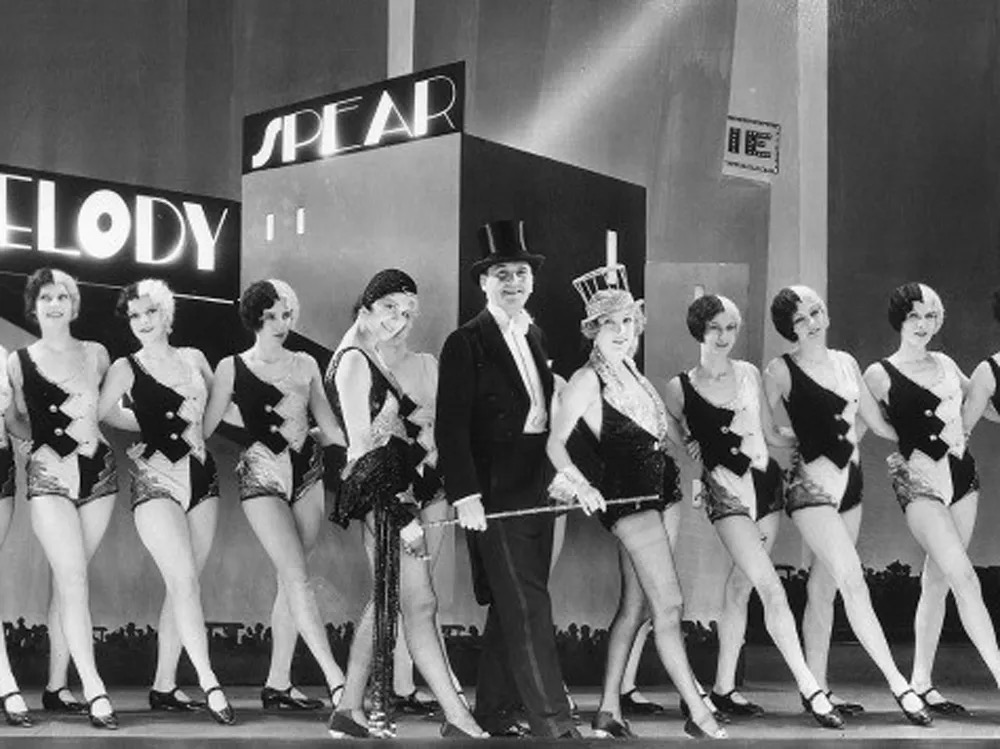
The second Academy Awards ceremony, held in April 1930, was a quieter, more perfunctory affair than even its already modest inaugural predecessor. The Academy was still working out what it was for, what it was rewarding, and why anyone should care. Somewhere in that institutional uncertainty, The Broadway Melody slipped through — the first sound film to win Best Picture, and, one suspects, a winner chosen more for what it represented than for what it actually was.
What it represented was the talkie. MGM had poured money into the production precisely because synchronized sound was still something audiences would pay to witness as spectacle in itself, the novelty of hearing voices from a screen not yet fully worn off. In that context, The Broadway Melody was less a film than a demonstration: proof of concept in two reels. The Academy, apparently, was in the same audience, just as susceptible to the thrill of the new.
But here is the problem with rewarding novelty: novelty expires. Strip away the wonder of spoken dialogue and synchronized song, and what remains is a backstage melodrama so formulaic it would have felt stale to audiences who had been watching stage plays since the Greeks. Two sisters — one sweet, one brassy — arrive in New York to break into showbiz. A love triangle forms with a charming songwriter. Sacrifices are made, tears are shed, and the curtain falls on an arrangement that satisfies narrative convention without troubling anyone’s emotions. This was not fresh in 1929. It was not fresh in 1899. The wonder is not that the plot is thin; the wonder is that no one, at any point in production, seems to have noticed or cared.
Director Harry Beaumont stages scenes with the dutiful efficiency of a man completing a task rather than making a film. The camera is largely static — partly a technical constraint of early sound recording, partly an apparent lack of interest in doing anything about it. Performers are positioned in front of it and allowed to perform. The performances are not without life: Bessie Love, as the self-sacrificing older sister Hank, brings a ragged emotional truth to the film’s better moments and earned her Academy Award nomination on merit. But the material keeps letting her down, resolving her arc with the brisk, almost cheerful fatalism that the era’s melodramas mistook for profundity.
The more damning comparison is not to other Best Picture winners but to a film made the same year by the same studio. The Hollywood Revue of 1929 — also MGM, also nominated for Best Picture at the same ceremony — is everything The Broadway Melody pretends to be. Where The Broadway Melody treats sound as backdrop, The Hollywood Revue treats it as its entire reason for being, assembling nearly every major MGM star — Buster Keaton, Joan Crawford, John Gilbert, Norma Shearer, Lionel Barrymore — in an exuberant, anarchic showcase that embraces the absurdity and possibility of its moment with genuine wit and invention. It features the first sound recording of ‘Singin’ in the Rain.’ It is not a great film in any traditional sense, but it understands exactly what it is and commits to it with energy and craft. Beside it, The Broadway Melody looks not merely conventional but timid.
There is one further indignity, though one for which the film and its makers bear no responsibility: The Broadway Melodysurvives today in a state of poor preservation. The print is damaged, the image frequently degraded, and a complete restoration to anything approaching its original condition has not been achieved. This is not unusual for films of the period — nitrate stock decomposed, studios were negligent, fires destroyed archives — but it is telling that the film has not attracted the preservation resources and scholarly attention lavished on other titles of the era. No one has fought especially hard for it. Compare the fate of Sunrise: A Song of Two Humans (1927), or even The General (1926), both subjects of sustained archival effort — and you begin to understand where The Broadway Melody sits in the esteem of those who care about this period most.
Which brings us to the canon, and the particular disappointment that this film represents within it. The Best Picture lineage begins with Wings (1927/28) — a film that has no business being as good as it is. William Wellman’s aerial war epic is spectacular in every sense: technically audacious, emotionally generous, genuinely thrilling, and anchored by a central relationship between two men whose affection for each other registers with an unguarded tenderness that the film never condescends to explain away. It is a picture made with ambition and executed with craft, and it holds up.
The Broadway Melody does not hold up. It arrives one ceremony later as a demonstration that the Academy’s early instincts were already unreliable — that prestige and innovation could be confused for quality, that a studio’s marketing of its own technical achievement could be mistaken for artistic merit. It is not an unwatchable film. It is a minor film, a disposable film, a film that history has quietly but firmly demoted to footnote status despite the gold statuette on its shelf.
The Best Picture canon is long and uneven, full of films rewarded for the wrong reasons and films overlooked for no good reason at all. The Broadway Melody is among the most honest examples of the former: a winner that tells you more about its moment of winning than about any lasting quality worth preserving. After Wings, it is a dip — and not a shallow one.
★★
 Show Me Cinema
Leave a comment