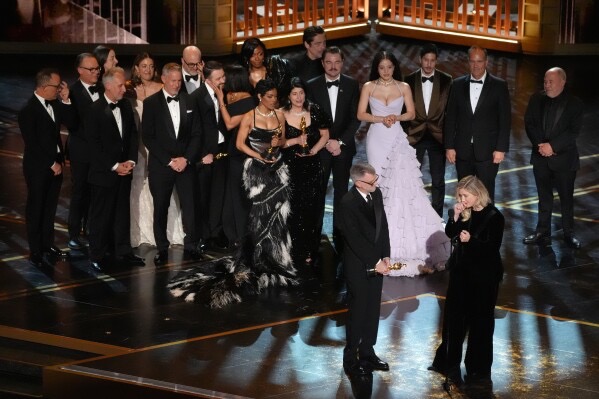
There is a version of this piece that opens with a complaint. A lament about the speeches getting cut off, about a bit that went nowhere, about Sean Penn winning an acting prize for playing a racist and not bothering to show up. That version exists. But I don’t think it is the right one, because to write only about what went wrong at the 98th Academy Awards would be to mistake the weather for the landscape.
So let us begin with what the Oscars actually are — or at least, what they can be when they are at their best. The ceremony is not, as its detractors love to say, merely a night for the wealthy of Hollywood to drape themselves in couture and hand each other trophies. That criticism contains a grain of truth and a bushel of cynicism. The Academy Awards are, at their most fundamental, a recognition that cinema matters. That the moving image — less than one hundred and thirty years old, still an infant among the great art forms — has changed how human beings see themselves, understand each other, process grief and joy and rage and wonder. To sit through four hours of a Hollywood awards show and find it beneath you is to confuse the ceremony with the thing the ceremony is about. The thing the ceremony is about is one of the most profound inventions in the history of human culture. A little patience for the commercials seems reasonable.
This year, Conan O’Brien returned as host for the second consecutive year — a decision the Academy should feel very good about. He is, in many ways, a throwback host: committed to the bit, genuinely in love with movies, possessed of a comedic sensibility that is deeply absurd without ever being mean-spirited. And on Sunday night, he opened the show in a manner that will be talked about for years.
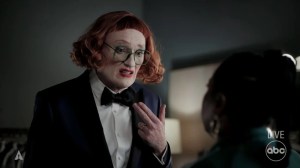
The cold open was not warm, and I want to be precise about that — because warmth would have been the wrong instrument entirely. What it was, was funny. Specifically, viscerally, slapstick-in-a-tuxedo funny. Conan appeared done up in the clownish, unsettling makeup worn by Amy Madigan in Weapons, and then proceeded to get chased — to the Beastie Boys’ “Sabotage” — from one nominated film’s world into another. Hamnet, Sinners, Sentimental Value: each one penetrated by this rubber-faced, white-painted lunatic careening through prestige cinema like a Looney Tune who wandered onto the wrong lot. It was absurd in the best possible sense, and in its absurdity it captured something true about Conan as a host. Here is a man who does not condescend to the ceremony by being too cool for the bit. Here is a man who will put on clown makeup and sprint into the Globe Theater, or a Mississippi juke joint, or a family crisis in Norway, in front of sixty million people and commit completely. The sight of a clownish, panicking Conan being chased by hordes of children out of one film and into the next had a quality that I can only describe as oddly innocent and youthful. There was something almost pure about it — a man who loves movies, dressed as a monster, being pursued by children, tumbling headlong into a night of great cinema. It was the right beginning. It set the tone not as a stuffy tribute but as a genuine, joyful, slightly unhinged party.
It also, in its own sideways fashion, evoked the Billy Crystal tradition — not in tone, but in spirit. Crystal’s genius was committing fully to the opening as its own art form, treating it as a standalone comedic work rather than a perfunctory warm-up. Conan did the same thing here, with completely different instruments, and it worked in a completely different register. Crystal gave you warmth and wit. Conan gave you chaos and joy. Both are valid. Both are, in their respective ways, perfect.
Anyone who watched the ceremony without acknowledging the atmosphere was not really watching. There was a weight in the Dolby Theatre on Sunday that is difficult to quantify but impossible to ignore. The world outside has been difficult. There are wars. There are displacements. There is suffering of a scale and visibility that makes the business of celebrating movies feel, at certain moments, slightly surreal..
The ceremony did not ignore this weight, but it did not drown in it either. That is probably the right balance. Film is allowed to be a place of joy even when the world is not. In fact, it may need to be. One of the things cinema has always offered — one of the things the Academy, at its best, is implicitly arguing for — is the necessity of storytelling in precisely those moments when the world makes storytelling feel indulgent. The ceremony was fun. It was moving. It was occasionally exasperating. But the gravity was there, and it was not dishonest.
The bits, as always, were uneven. The Jane Lynch YouTube ad parodies worked well — dry, self-aware, genuinely funny, and well-suited to a room that knows exactly how the media landscape has shifted around them, and how it will impact the Oscars themselves (the ceremony will air exclusively on YouTube in just two years).
The Casablanca bit with Sterling K. Brown did not work. I want to be fair here, because Brown is a tremendous talent and clearly game for almost anything. But the conceit — using Casablanca as a vehicle to satirize Hollywood over-writing — collapsed under its own irony. A joke about over-writing that is itself tremendously under-written is not meta, it is just ironic in the bad way. The premise existed. The execution did not.
The speech cutoffs were, I’m sorry to say, egregious. There is no diplomatic way to frame what happened. When human beings are standing on a stage holding the most significant professional recognition of their lives and an orchestra begins to swell them off of it after ninety seconds, something has gone wrong with our priorities. The show can be long. The show is allowed to be long. A film acceptance speech is not a TED Talk — it is a moment of genuine, unscripted human emotion, and the Academy’s insistence on jamming it into a rigid time slot reads as exactly the kind of corporate efficiency instinct that makes people distrust Hollywood in the first place. Let people speak.
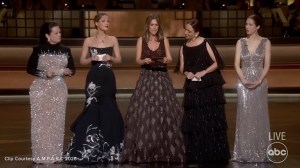
The Bridesmaids reunion, by contrast, was a genuine delight. Rose Byrne, Ellie Kemper, Kristen Wiig, Maya Rudolph, and Melissa McCarthy all took the stage together. There was audible joy in that room, the specific joy of seeing people who made something beloved together, standing in the same place again. Whatever the bit was, it was almost secondary to the image itself: five women who were funny then and are funny now, still clearly happy to be in each other’s lives. That is what presenter moments can be when they work.
I have seen a lot In Memoriam segments on these broadcasts. Most of them follow a reliable formula: a montage of faces and names, a musical choice that tells you how to feel, a moment of respectful applause, and then onward to the next award. They are necessary and they are almost always a little insufficient. The 98th ceremony’s In Memoriam was different. It was the best I have seen in years — and the gravity of why it had to be extended, why it required tributes rather than a montage, is not lost on me. We lost a lot of giants this year. People who shaped this industry and this culture at the level of foundation. The segment felt proportionate to the actual loss, which means it felt enormous.
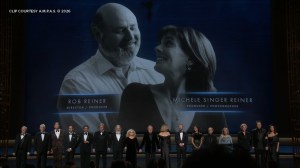
Billy Crystal led the tribute to Rob Reiner and his wife, Michele Singer Reiner. Crystal chose, wisely and humanely, to say nothing about the circumstances of their deaths — a devastating story that does not belong in this space either. What he did instead was give a portrait of a friendship and a filmography. He remembered meeting Reiner when he was cast as the best friend of Reiner’s character on All in the Family, and recalled watching him evolve from a great comic actor into a master storyteller. He walked through the films — This Is Spinal Tap, Stand by Me, The Princess Bride, When Harry Met Sally, Misery, A Few Good Men — with the ease of a man who had watched them being made and loved them as his own. He closed with a line that was clearly personal: “Buddy, what fun we had storming the castle.” And then the curtain behind him lifted — and out walked the actors. Michael McKean, Christopher Guest, Jerry O’Connell, Wil Wheaton, Fred Savage, Cary Elwes, Mandy Patinkin, Carol Kane, Meg Ryan, Kiefer Sutherland, Demi Moore, Kevin Pollak, Kathy Bates, Annette Bening, John Cusack, and Daphne Zuniga — a cavalcade of beloved faces, each one representing a film, each one representing something Rob Reiner made that people have carried with them for decades. The room broke open. It was one of the most visually overwhelming tributes I can remember — not because it was showy, but because it was true. Here, physically assembled on one stage, was the evidence of what one filmmaker’s work had meant.
Rachel McAdams then took the stage to pay tribute to Diane Keaton and Catherine O’Hara — two Canadians, two legends, two losses that the industry is still reckoning with. She described Keaton as an icon and a legend with no end, and told the room that there is not an actress of her generation who was not inspired by and enthralled with Keaton’s absolute singularity. That is not hyperbole. That is just true. And then McAdams recited a Girl Scout song she said Keaton used to sing on movie sets. Make new friends, but keep the old. One is silver, the other is gold. It was the moment the tears really began to flow. Not because of the song itself, or the fact that I was caught up in the moment – okay that could be part of it, but really because of what it implied — that Diane Keaton, on a film set, in between takes, was teaching people Girl Scout songs, and that it fit our perception of her so well. That she was, in addition to everything else, warm and funny and slightly, beautifully eccentric in a way that the people who knew her will carry forever.
Finally, Barbra Streisand made a surprise appearance to say some heartfelt words about Robert Redford. “I miss him now more than ever,” she said, “even though he loved teasing me.” And then she sang an excerpt from “The Way We Were,” and the room went very quiet, the way rooms go quiet when something is happening that everyone present knows they will remember for the rest of their lives. Streisand is eighty-three years old. She walked out onto that stage and sang for her friend, and it was one of those moments that reminds you why live television, for all its faults and awkwardnesses, is still capable of something no other medium can replicate: the unrepeatable present tense.
The In Memoriam was the best it has been in years, and the reason it had to be so expansive and so personal is a reason to mourn. But I am grateful the Academy rose to meet it. These were people who deserved to be remembered fully, and on Sunday night, they were.
Now let us not bury the historical significance of the night – of which there was much. Amy Madigan won Best Supporting Actress – her first Oscar – for her role as Aunt Gladys in Weapons, and Michael B. Jordan took Best Actor for Sinners. Two acting awards for horror films in the same year? The last time that happened was 1992, when Anthony Hopkins and Jodie Foster went home with Best Actor and Best Actress for The Silence of the Lambs. Thirty-four years of horror being treated as a genre beneath serious recognition, with only a few moments of genuine celebration (the 2017 Jordan Peele win for Get Out’s screenplay) and then, in a single night, the dam broke twice.
This is worth pausing on. Horror, as a form, has long been where filmmakers go when they want to say something true about the world that the world is not quite ready to hear said plainly. The Silence of the Lambs was about gender and institutional failure among other things. Sinners is about history and mythology and the cost of belonging and not belonging in America. Weapons is about something I suspect most people who saw it are still trying to describe…I can’t. The Academy’s recognition of these performances is a recognition that the genre has always been capable of serious art. It took them thirty-four years to remember.
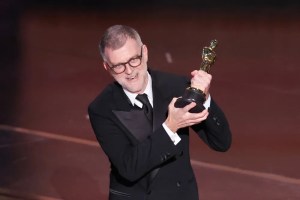
There are filmmakers you love for what they make, and then there are filmmakers you love for what they are — the totality of their obsession, their seriousness, their refusal to make anything less than exactly the film they intend to make. Paul Thomas Anderson is the second kind. Sunday night marked his first-ever Oscar wins, taking home Best Director and Best Adapted Screenplay for One Battle After Another.
The thing about watching a filmmaker of PTA’s stature finally win — and I do not use “finally” casually, because his career stretches from Boogie Nights through Magnolia through There Will Be Blood through The Master through Phantom Thread, a body of work that already belongs in any serious conversation about American cinema — is that it is humbling in the truest sense of that word. Here is a man who does not need the Academy’s validation to know that his work matters. He knows what he has made. We know what he has made. His films will outlast the ceremony that just recognized him. And yet, watching him receive that award, you could see — you could genuinely see — the gratitude and relief of a craftsman being told by his peers that they see him. That they have always seen him. The emotions on his face were not the emotions of a man surprised by his own talent. They were the emotions of a man who has spent thirty years loving something more than almost anything and being told, finally, formally, that the love was returned. That is moving. That is what the Oscars are for.
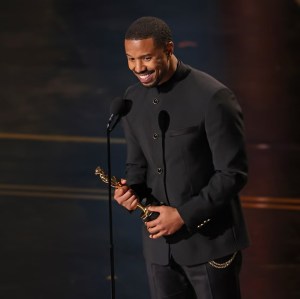
In Michael B. Jordan’s acceptance speech, he gave shout-outs to his parents, who were both in the room. “You all know how I feel about my mama,” he said, before asking, “Pops, where you at?” His father had flown in from Ghana to attend. Jordan then named many of the Black actors who came before him. “I stand here because of the people who came before me,” he said.
That is a speech. That is what acceptance speeches are supposed to be. Not a list of agents and attorneys, but a genuine act of acknowledgment — of parents, of predecessors, of the chain of labor and love and sacrifice that produces any artist worth recognizing. Jordan’s work in Sinners is extraordinary. I will say honestly that I would have been pleased to see Timothée Chalamet win for Marty Supreme — his performance is unlike anything he has done before, and unlike almost anything an actor so early in their career has done in recent memory — but Jordan’s win is not a consolation prize. It is a completely correct outcome. His performance in Sinners is the kind of work that people will be studying in thirty years. And his speech, in its warmth and specificity and gratitude, was exactly the kind of moment that justifies the evening.
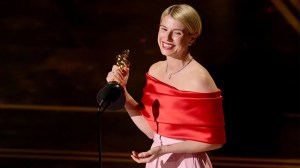
What more can you say about Jessie Buckley? The answer, it turns out, is quite a bit.
Throughout the entire award season, her gratitude for the film has been one of the most genuinely moving things about the whole campaign. She has spoken about the character, the material, the people she made it with, with the particular love of an actor who knows — really knows — that she has been given something rare. It is not the performed enthusiasm of an awards circuit. It is the real thing. You can tell the difference.
And then there is this: the ceremony fell on March 15th. In the United Kingdom and in Ireland, that is Mother’s Day. Jessie Buckley — Irish, beloved, playing a mother consumed by grief and love and the terrifying persistence of both — won Best Actress on Mother’s Day. You could not write it better if you tried. It is the kind of coincidence that makes you feel, briefly and against your better instincts, that the universe has a sense of occasion. It is one of the most deserved wins of the entire awards season, and it belongs on the short list of the best acting victories of the twenty-first century.
And here is the strange thought that kept occurring to me as the evening wound toward its conclusion: I am glad Hamnet did not win Best Picture. Not because it was undeserving. It was deserving. But there is something almost protective about the way the evening unfolded. If Hamnet had won Best Picture, it would spend the next several decades as “that Shakespeare movie that beat Sinners or One Battle After Another.” It would become a talking point, a fulcrum of revisionist criticism, a film that was forever defined by what it defeated rather than by what it was. Instead, it goes forward as what it actually is: a film with one of the great performances of the twenty-first century, a meditation on love and loss and the communal, healing power of art, and a work that will be studied and loved and returned to by generations of people who were not yet born when Buckley stood on that stage. Some films are too good to need the Best Picture trophy, and this may be one of them.
One Battle After Another was the big winner of the evening, taking home six Oscars in total, including Best Picture, Best Director, Best Adapted Screenplay, Best Film Editing, Best Supporting Actor, and the inaugural Best Casting award. And it deserved all of them.
I understand that the film is not for everyone. It is long, it is dense, it is deeply uncomfortable in ways that feel entirely intentional and do not resolve neatly. It makes demands of its audience that not every audience wants made of it. These are features, not bugs, but they are also genuinely polarizing.
What it is, though, is a major American film. A feat of adaptation. Sean Penn won Best Supporting Actor for the film, despite not attending the ceremony. And here I will register a small, complicated ambivalence: there is something slightly uncomfortable about the fact that of an enormous, extraordinary ensemble, it was Penn — playing a racist, sexist maniac — who received the individual acting recognition. We have no shortage of such men in the real world at present. Perhaps that is precisely the point of the film. Perhaps the discomfort is the point. But it sits with me nonetheless. A little annoyance seems permissible.
The film as a whole, though, will go down as one of the great Best Picture winners. Not the most beloved, perhaps not even the most immediately embraced. But one that will grow in stature as the years pass and the world it was made about comes into clearer focus. The best films do that. They know what time it is before the rest of us figure it out.
In two years, we will arrive at the 100th Academy Awards ceremony. That is not just a round number. It is a threshold. One century of the film industry formally recognizing its own best work — one century of an art form young enough that we can trace its entire history, name most of its great practitioners, watch the evolution in real time. It is an occasion that deserves to be treated as the genuine cultural milestone it is.
The anticipation is already something. The question of what film will win the 100th Best Picture Oscar — what work the Academy will choose to stand at the symbolic apex of cinema’s first century — is not a trivial one. It is the kind of question that makes you feel the weight of history in a way that is, if you let it be, genuinely thrilling.
I want to end on something that the Oscars, at their best, remind me of every year, and that I think we are collectively in danger of forgetting.
Film is young. I mean this literally, in a way that should stagger us. Literature has existed for thousands of years. Painting, theater, music — they were ancient before anyone who looks like you or me was born. And here is cinema: barely past its first century, still figuring out what it is and what it can do, still surprising us, still producing works of such startling originality that they rewrite our understanding of what the form is capable of.
Imagine living in the first century of theater. Imagine watching the art form develop in real time, from ritual to spectacle to tragedy to comedy to something that didn’t have a name yet. Imagine being present for that. The people who were there did not know they were witnessing something that would last forever. They could not have known.
We know. Or at least, we can know if we choose to pay attention. We are living in the first century of an art form that will likely outlast most of what we currently value, and will almost certainly change in ways we cannot predict, and is already producing work — this year’s work, the films celebrated on Sunday night — that future generations will study the way we study the great works of any discipline.
Sinners. One Battle After Another. Hamnet. Marty Supreme. These are not just movies from 2025. They are dispatches from a civilization in the process of understanding itself, expressed in a language that is still, in historical terms, being invented.
The 98th Academy Awards were imperfect, occasionally frustrating, and frequently moving. They honored some great work and probably overlooked some other great work and cut off some speeches that deserved to breathe and staged some bits that fell flat and produced several moments that will stay with people for years. They were, in other words, exactly what the Oscars usually are: a very human ceremony in honor of something larger than the ceremony itself.
We are very lucky to be here for it.
 Show Me Cinema
Leave a comment