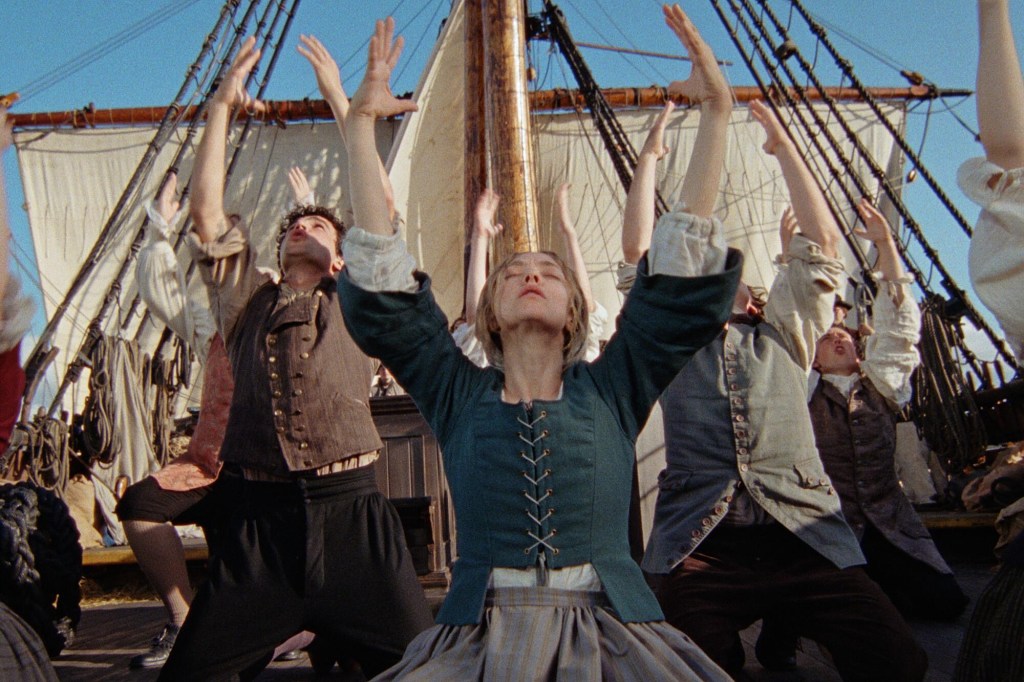
There is a moment roughly midway through The Testament of Ann Lee when Amanda Seyfried, playing the titular role, locked in close-up, opens her mouth and sings. The camera does not cut away. It does not search the room for reaction shots or retreat to a respectful medium shot. It simply stays, for what feels like a very long time, on that face — transfigured, trembling, entirely given over. It is the kind of moment that reminds you why cinema exists, and it is, frustratingly, also a reminder of how much the film surrounding it occasionally squanders its own gifts.
Directed by Mona Fastvold from a script she co-wrote with Brady Corbet, The Testament of Ann Lee chronicles the life of Ann Lee, the Manchester-born founder of the religious movement that came to be called the Shakers. The score is the work of Daniel Blumberg — the Oscar-winning composer behind The Brutalist, another Corbet-Fastvold collaboration — and his presence here is apt: like that film, this one has serious formal ambitions and a taste for the monumental. The Shakers — properly, the United Society of Believers in Christ’s Second Appearing — emerged from the radical fringes of English Quakerism in the mid-eighteenth century, distinguished by their ecstatic, physically convulsive style of worship, their insistence on celibacy, their radical (for the age) doctrine of gender equality, and their communal way of life. Ann Lee, a mill worker’s daughter who had survived the deaths of four infant children and a deeply unhappy marriage, gradually became the movement’s spiritual center, believed by her followers to be nothing less than the female manifestation of Christ. In 1774, she led a small band of believers across the Atlantic to Albany, New York, where the Shakers would eventually establish a series of thriving communities and produce, among other things, some of the most exquisitely crafted furniture in American history. By the time of her death in 1784, she had transformed an obscure English sect into a genuine American religious phenomenon. By 2025, only two Shakers remain.
It is Fastvold’s genius — and it is a genuine, audacious genius — to have conceived this story as a musical. The Shakers were, at their core, a singing and dancing people; their worship was inseparable from their music, and music was inseparable from their theology. Central to that worship was movement itself — the trembling, convulsive, full-body agitation that gave the sect its name — and one of the film’s most inspired formal decisions is to take those ecstatic physical outbursts and transform them, through Celia Rowlson-Hall’s choreography, into something that reads unmistakably as dance. The line between seizure and celebration was always thin for the Shakers; the film honors that ambiguity without resolving it. To tell Ann Lee’s story through song and movement is not mere stylistic provocation but a kind of structural argument about what Shakerism was and why it moved people. Blumberg’s score, incorporating and reimagining traditional Shaker hymns, is a haunting, percussive, cellar-damp thing — a world away from Broadway gloss — and in its best moments it gives the film a genuinely spiritual charge. The sequences where it works are unforgettable. The early scene depicting the first formal gatherings of the Shakers in England has a raw, communal electricity; watching ordinary working people give themselves over to something so strange and so obviously sincere, the film briefly convinces you of the same thing it is asking you to believe Ann Lee herself felt: that something real was happening. The sequence aboard the ship crossing the Atlantic, built around the hymn “All Is Summer,” is the film’s most purely cinematic achievement — shot on a fully operational period vessel, Seyfried and the company singing into the open sea while the camera captures the terrifying smallness of human faith against the immensity of the ocean. It is beautiful in a way that earns the word. And the finale, which I will not detail beyond saying that it earns its solemnity, brings the film to a close with a gravity commensurate with its subject.
But the musical conceit does not always hold. There are stretches in the long, sagging middle section where the songs feel less like spiritual expression and more like theatrical interruption — moments where the music arrives not because the drama demands it but because the film has committed to a format it cannot always honor. The Shakers’ faith was, by any measure, extreme; it could lead its adherents into beauty and community but also into suffering, fanaticism, and the particular cruelty of prophecy unfulfilled. When the musical frame is working, it illuminates this paradox. When it is not, it has the unfortunate effect of softening edges that should draw blood, lending a kind of reverent pageantry to events that deserve a harder look.
Those harder edges are most legible, appropriately enough, on Seyfried’s face. This is, without meaningful qualification, the performance of her career. Seyfried has always been a more technically accomplished actress than her commercial work has suggested, but nothing in her filmography prepared one for the sheer physical and emotional commitment she brings to Ann Lee — a woman simultaneously visionary and blinkered, charismatic and suffering, genuinely touched by something and perhaps genuinely dangerous. She shakes and sings and weeps and exhorts without a single moment of self-congratulation. She makes you feel the pull of Ann Lee even as she makes you uneasy about it. That unease — that sense that we are watching a woman whose gifts and whose certainties are leading her people somewhere complicated — is the film’s most honest and most important achievement, and it belongs entirely to Seyfried.
The supporting cast is more variable. Lewis Pullman, as Ann’s brother William, brings a quiet, watchful intelligence to a role that could easily have been mere furniture; his scenes with Seyfried have a genuine sibling texture, a shorthand warmth that makes his eventual fate register as it should. Thomasin McKenzie, as Ann’s associate Mary Partington, serves largely as the film’s narrator, and McKenzie’s particular gift — a kind of intimate directness that suggests she is speaking only to you — makes the narration feel less like a dramaturgical crutch than it might otherwise. But the rest of the supporting cast is considerably thinner, never more so than in Christopher Abbott’s performance as Ann’s husband Abraham. Abbott is a fine actor, but he has been written and directed here into something approaching broad villainy — a sneering, carnal obstacle rather than a fully imagined human being whose own pain and bewilderment might have deepened the film considerably. He plays the role with such unambiguous menace that the scenes involving him tip, at moments, toward unintentional comedy. The film’s antagonists are, in general, drawn without the complexity that would give Ann Lee’s suffering its fullest moral weight.
The production design deserves its own paragraph, because it is remarkable. Shot on 70mm film, with cinematography by William Rexer in an idiom clearly indebted to Barry Lyndon — candlelit interiors, natural light, a palette of ocher and ash — the film has an unimpeachable visual authority. The period detail is exhaustive without ever feeling museological; these are lived-in spaces, worn clothes, hands that have done actual work. The attention to historical accuracy extends to Rowlson-Hall’s choreography, which performs a quietly remarkable act of translation: the Shakers’ notorious shaking and trembling — involuntary, frightening to outsiders, ecstatic to believers — is rendered here as formalized movement, ritualistic and strange and oddly beautiful, neither mocking nor sanctifying what it depicts.
What she has not entirely solved is the problem of pacing. At two hours and seventeen minutes, The Testament of Ann Leeis perhaps a quarter-hour too long, and the excess falls almost entirely in the middle act. The film’s first section, establishing Ann’s origins and the gathering of her flock, moves with appropriate deliberation; its finale earns its length through cumulative emotional weight. But the middle section, tracking the Shakers’ difficult early years in America, frequently stalls. Without Seyfried onscreen — and there are stretches where she is absent — the film loses a great deal of its animating force. The surrounding characters, insufficiently developed, cannot carry the dramatic weight that is temporarily placed upon them.
What the film does carry, and carry well, is a willingness to reckon honestly with the costs of prophetic religion. The Testament of Ann Lee does not traffic in easy sanctification. It shows us what a genuine faith community can build — beauty, solidarity, a way of life of genuine moral seriousness — and it shows us what false certainty can destroy. Ann Lee believed she was the Second Coming of Christ. Her followers believed it too. The film does not ask us to decide whether she was right; it asks us to understand what that belief cost, what it gave, and what it looked like in a human body making its way through a brutal and indifferent world. In its best moments, it answers that question with real power. That those moments are not sustained across its full length is a real limitation — but it does not diminish what has been achieved when Fastvold and Seyfried are operating at the height of their considerable capabilities, which is often enough.
★★★½
 Show Me Cinema
Leave a comment