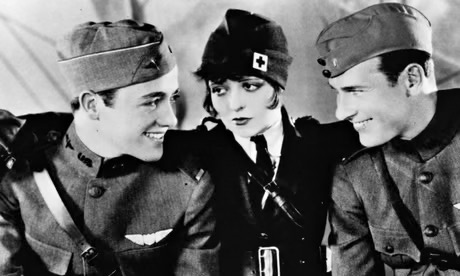
There is a peculiar injustice that history has visited upon Wings. The film is well-documented, widely available, yet it lives in the shadow of a movie it technically predates. Wings premiered in New York in August 1927, two months before The Jazz Singer arrived in October like a thunderclap and rendered almost everything that preceded it invisible. It is the film that won the very first Academy Award for Best Picture, a war epic of staggering ambition and genuine emotional depth, and it deserves to be seen on its own terms rather than as a footnote to the sound revolution.
Directed by William A. Wellman — a World War I aviator himself, which explains everything about how the film feels — Wings is a sweeping, romantic, technically ferocious piece of filmmaking that holds up with a force that might surprise anyone approaching it as a museum piece. It is not a relic. It is a film. And it is, on balance, a very good one.
One of Wings‘ most underappreciated achievements is how efficiently it establishes emotional stakes through character types that are immediately legible to any American audience — and yet makes those types feel inhabited rather than hollow. The film opens not in the trenches or the cockpit but in small-town America, amid the sun-soaked lawns and white picket fences of Midwest domesticity.
Clara Bow plays Mary Preston — the girl next door in the most literal possible sense — pining for Jack Powell (Charles “Buddy” Rogers) with an ardor that is wholly unrequited. It is a performance of considerable warmth and, at moments, real heartbreak. Bow was frequently condescended to by critics of her era, her intelligence underestimated in inverse proportion to her charisma, but watch her in the early scenes of Wings — the way her face shifts between brightness and private sorrow — and it becomes impossible to dismiss her as mere spectacle.
Against her stands the film’s male dyad: Jack Powell and David Armstrong (Richard Arlen). Jack is middle-class, exuberant, impulsive; David is wealthy, more reserved, educated in the manner of someone who has never had to think hard about money. The film is alert to this class distinction without being heavy-handed about it, because what matters is where it leads: two representatives of different Americas who will, through the crucible of war, become brothers. Arlen — who learned to fly for the role and performed many of his own aerial sequences — brought a quietly complex interior life to David, whose devotion to Jack becomes the film’s true emotional center.
Wings is sometimes categorized, lazily, as a war film. At its core it is a love story — several love stories, braided together with varying degrees of reciprocity. There is Mary’s love for Jack, patient and total and largely unreturned. There is Jack’s infatuation with Sylvia (Jobyna Ralston), shallow and doomed. And then there is the love between Jack and David, which is the deepest thing in the film: a bond that begins in rivalry and transforms, through shared danger and the daily proximity of mortality, into something the era could not quite name but that Wellman renders with unmistakable emotional clarity.
Mary follows Jack to France as an ambulance driver — establishing her as something more than a passive object of longing — and finds him in a Paris café at a moment of perfect narrative timing. Bow plays the reunion with a heartbreaking combination of relief and dread, understanding before Jack does what he is about to lose. The scene that could have been a love scene is instead a parting: Jack, drunk and uncomprehending; Mary, sober and loving him anyway. It is the film’s most purely romantic passage, constructed entirely around an absence.
Let us speak plainly about what Wellman and his collaborators accomplished in 1927. Wings was filmed with real aircraft performing real maneuvers, with cameras mounted in positions that had never been attempted before, by a director who had flown in combat and knew not just what aerial warfare looked like but what it felt like in the body. The aerial photography remains, nearly a century later, some of the most viscerally compelling footage of flight ever committed to film. When a plane spirals downward in Wings, something in the viewer’s body responds differently than it would to a digital equivalent, because the body knows the difference between a representation of danger and danger itself.
But the sequence most often cited by film scholars does not take place in the air at all. It takes place in a Paris café called the Folies, and it is a tracking shot of such fluidity and confidence that it would be remarkable in any era: a single continuous movement gliding past tables and dancers and soldiers on leave until it finds Jack at the center of the swirling tableau, surrounded by people but essentially alone. The shot required an overhead rig of considerable ingenuity and a degree of choreographic precision that makes one’s head swim when one remembers it was achieved without electronic stabilization of any kind. It is cinema doing what only cinema can do, capturing an era of exuberance and freedom – in a similar era of exuberance and freedom of the 1920s.
Wings was made in the pre-Hays Code era — that brief, bracingly candid window before the Motion Picture Production Code was enforced with genuine rigor in 1934. Most famously, there is a brief sequence in which Clara Bow is glimpsed topless, presented matter-of-factly rather than lasciviously: she has been ordered to remove her uniform to prove to a suspicious officer that she is not a soldier out of bounds. It is a small moment, but it gives the film a quality of lived reality — a sense that the bodies in this story are actual bodies, subject to actual vulnerability — that later war films, made under the Code, often conspicuously lack.
More remarkable is the scene near the film’s end in which Jack cradles the dying David and kisses him. Wellman films it straight, as a simple act of love between two people one of whom is leaving the world. Post-Code Hollywood would not have permitted this, or would have hedged it with enough dramatic distancing to drain it of meaning. Wellman does not hedge. The pre-Code freedom to show this is not a titillating footnote; it is load-bearing. The grief at the end of Wings is not polished or sanctioned — it reaches for the body of the beloved because there is nothing else to reach for.
Wings is largely exempt from the pitfalls that make many silent films difficult for modern viewers. The aerial sequences have lost none of their physical impact. The love story works. The ending still ambushes the unprepared viewer. Bow ages extraordinarily well — her face in close-up is a remarkably transparent instrument, and her performance translates without loss across the century between her audience and ours.
The injustice of Wings‘ reputation comes down to calendar. The Jazz Singer is an historically important film, but it is not, on its own terms, a particularly good one — creaky in structure, troubling in its racial politics, held aloft almost entirely by Jolson’s irresistible energy. Wings is better directed, better acted, better structured, and more emotionally complex. But The Jazz Singer changed the medium, and Wings merely perfected a version of it. History has an understandable bias toward transformation over perfection, and Wings has paid the price.
The Academy of Motion Picture Arts and Sciences gave Wings its first Outstanding Picture prize at the inaugural ceremony in 1929 — alongside a special artistic award to F.W. Murnau’s Sunrise, a film many scholars consider the finer achievement, which is a debate worth having over a very long dinner. (I should state here that I adore Sunrise. It is a magnificent combination of peak German expressionism that rendered Murnau’s earlier films masterpieces, combined with the melodrama and narrative tropes of the Golden Age of Hollywood.) Wings was added to the National Film Registry in 1997, and the Paramount restoration makes a persuasive case for it as a complete cinematic experience. It deserves to be seen not as a prelude to the sound era but as the apotheosis of what silent cinema had become in its final, most sophisticated years.
Wings is exactly what the best popular cinema has always been: a film that gives you something to look at and something to feel, that earns its spectacle by grounding it in human consequence. Clara Bow is magnetic and real. Richard Arlen is heartbreaking in the quietly stoic way that costs the most. Wellman directs with the confidence of someone who knows what he’s doing and the rare good sense not to do more than he needs to. The Paris café tracking shot is one of the great shots in the history of cinema. And the ending — that kiss, that grief — is the real thing.
Wings is ninety-nine years old. It does not feel it. That is not nothing. That is, in fact, quite a lot.
★★★★1/2
Wings won the Outstanding Picture Prize at the inaugural Academy Awards ceremony on May 16, 1929.
 Show Me Cinema
Leave a comment