There is a moment, fairly early in Maggie Gyllenhaal’s audacious and maddening The Bride!, where the film seems to dare you to keep up with it. Mary Shelley — speaking from the afterlife, played with electric, aristocratic menace by Jessie Buckley — leans into the camera and announces that she has a story she never got to finish. Then she possesses the body of a 1930s Chicago party girl named Ida, and the whole strange contraption lurches forward. It’s the kind of opening that tells you exactly what kind of movie you’re in for: messy, bold, genuinely exciting in places, and utterly convinced of its own importance. For most of its running time, that conviction is earned.
The Bride! draws its inspiration from the 1935 James Whale film Bride of Frankenstein, but it is far more interested in the second half of Shelley’s original novel than in anything Universal Pictures ever put on screen. Where Whale’s classic treated the Bride as a shock device — a creature conjured in the final reel, hissing and recoiling before the whole laboratory comes crashing down — Gyllenhaal asks a far more provocative question: what if we gave her the whole movie? Gyllenhaal has spoken about her frustration that the bride appears only in the final scene of the 1935 film and has no spoken lines, and in creating her own version, she sought to liberate the character, giving her free rein to express herself and voice her rage at the cruelty of men and the world. The result is a film that reclaims the “monster” narrative from the hands of the scientists and detectives and men of industry who have always framed it, and places it squarely in the grip of the creatures themselves.
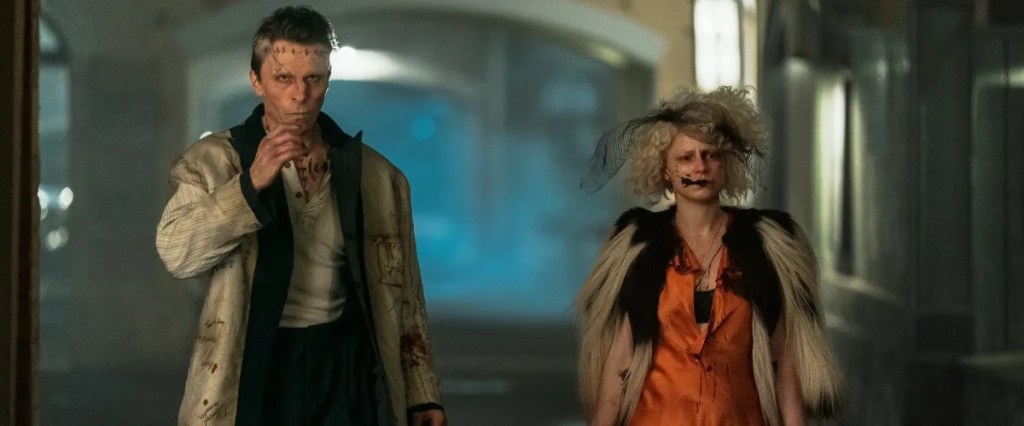
The story is set in 1930s Chicago, where Frankenstein’s monster — going simply and somewhat oddly by Frank — comes to the city to ask the scientist Dr. Euphronius to help him create a companion. A young woman, Ida, is murdered by small-time criminals, and Frank and Dr. Euphronius reanimate her corpse. She becomes the Bride but resists merely being Frank’s companion and asserts her independence. From there, the film pivots into something that feels less like a horror movie and more like a feminist fugue state — part screwball comedy, part outlaw romance, part political manifesto. Betty Friedan and Gloria Steinem would find a great deal to love here. The Bride, slowly piecing together who she is and what she is capable of, becomes a walking embodiment of feminine self-determination. She did not ask to be made. She does not owe her creator her obedience. And she will not be contained by the men — whether monsters, scientists, or mob bosses — who believe they have some claim on her existence. That the film wraps this thesis in the aesthetics of a Universal monster movie, rather than a contemporary drama, is precisely what makes it so effective. Gyllenhaal is using the genre’s own bones to argue against everything the genre has historically stood for.
This is what a modern remake should look like. Rather than simply updating the setting while preserving the original’s power structures, The Bride! inverts them. The “monsters” are the protagonists. Their interiority — their longing, their rage, their bewilderment at a world that finds them repulsive — is the engine of the story. The grotesque figures who populated the margins of the Universal monster cycle, used for decades as instruments of shock and spectacle while the real drama played out among the humans trying to destroy them, are finally centered. It’s a corrective that feels both obvious in retrospect and genuinely overdue.
Much of the film’s power rests on the shoulders of Jessie Buckley, who delivers a performance of almost reckless bravery. Let’s be clear: this is not the Buckley of Hamnet — restrained, luminous, interior. This is Buckley fully unleashed, playing three iterations of the same woman (Shelley, Ida, and the Bride herself) across wildly different registers, swinging from manic giddiness to cold fury to something approaching spiritual transcendence. The Bride is a wise angel and full-tilt loon — alive, but not quite sure who she is — and Buckley plays her in a magnetic daze of innocence and anger. It is a deeply showy performance — theatrical, physical, deliberately abrasive at times — and it will strongly divide audiences. Those expecting the quiet precision of her more naturalistic work may find it alienating. But to dismiss it as mere showboating would be to miss the point. Buckley is doing something genuinely difficult: she is making us believe in a creature who is simultaneously ancient and newborn, human and inhuman, furious and tender. That she manages to pull it off as often as she does is a testament to her extraordinary range.
Christian Bale, meanwhile, gives what might be the most quietly effective performance of the film. His Frank is shy and soft-spoken, a lumbering giant who moves through the world with the careful, wounded deference of someone who has been punished for existing. Bale strips away all vanity — physically transformed, scarred, hunched — and finds the genuine pathos at the center of the character. It’s telling that Frank’s great romantic ideal is Fred Astaire and Ginger Rogers — that his vision of love is built around grace, partnership, and mutual adoration. That a creature so grotesque should nurse so tender a dream is both funny and genuinely heartbreaking, and Bale plays that contradiction with remarkable precision. In one of the film’s most affecting moments, Frank urges the Bride to flee a crime scene rather than be killed again: “I’ve been through this before. It’s terrible.” For a satirical adaptation that could easily have played Frankenstein’s monster as pure symbol, Bale insists on his humanity. He is the ideal Frankenstein for this particular project — grounding the film’s more operatic conceits in something recognizably, achingly real.
The supporting cast is more of a mixed bag. Peter Sarsgaard brings a weary, world-worn quality to Detective Wiles that suits the film’s period atmosphere, and Penélope Cruz brings her usual luminous presence to Myrna Mallow. Both, however, are given remarkably little to do. Characters who feel, in the film’s first act, like they are being carefully set up for something significant are ultimately deployed as window dressing, their story threads left frustratingly unresolved. It’s a genuine waste of two substantial talents.
More problematic is the casting of Annette Bening as Dr. Euphronius. The role’s central conceit is elegant — the doctor publishes under the androgynous initial “C. Euphronius,” a quiet nod to Shelley herself, who originally published Frankenstein anonymously at age 20. But the part as written — sardonic, imperious, with a grandly theatrical scientific authority — seems designed for someone with a more commanding physical presence and a sharper edge of danger. Bening is, as ever, a gifted actress, but she feels miscast here in a way that no amount of skill can fully overcome. The role cries out for a Sigourney Weaver — someone whose very physicality carries the weight of decades of earned authority, who can be simultaneously intimidating and warmly absurd. Every scene with Bening is watchable; none of them quite crackle the way they should.
Where The Bride! most triumphantly transcends its source material is in its engagement with Hollywood history beyond the Universal back lot. The film’s climactic sequence — Frank and the Bride taking to the road in a blaze of violence and desperate freedom — is staged as a direct homage to Arthur Penn’s 1967 masterpiece Bonnie and Clyde, right down to the choreography of violence and the strange, elegiac beauty Gyllenhaal brings to images of pursuit. It’s a thrilling sequence, and it reframes the entire film: this is not just a story about monsters, but about the mythologizing of outlaws, and the way American culture has always been half in love with the figures it officially condemns.
The film is not without its frustrations. Gyllenhaal has a tendency to let the thematic argument override the dramatic momentum, and there are stretches — particularly in the third act — where The Bride! begins to lecture rather than dramatize. The points being made are not wrong; they simply stop being made through story and start being made through speeches. By the time the film reaches its final reel, it has stated its thesis so many times and in so many registers that it has, somewhat paradoxically, begun to undermine it.
There is also the matter of the film’s occasional stylistic lurches. The Bride! is set, faithfully and atmospherically, in 1936 Chicago — all shadows and jazz clubs and Depression-era grime. And then, periodically, it detonates a strobe-lit musical sequence backed by music that sounds more contemporary than period-appropriate, as if a different, more self-consciously transgressive film is trying to break through the surface of this one. The impulse is understandable — Gyllenhaal wants to signal that this story’s concerns are urgently present-tense — but the execution jars. These moments pull you briefly but forcefully out of the world the film has otherwise constructed with such care.
None of which is fatal. The Bride! is a genuinely ambitious piece of filmmaking — messy and occasionally self-defeating, yes, but propelled by real ideas and anchored by two performances that are impossible to look away from. It takes seriously the proposition that monsters deserve their own story, told on their own terms, and it tells that story with enough wit and fury and visual invention to make the whole strange experiment worthwhile.
Imperfect, occasionally infuriating, and absolutely worth seeing. Maggie Gyllenhaal didn’t just give the Bride a voice — she gave her the whole dang movie.
★★★1/2
 Show Me Cinema
Leave a comment