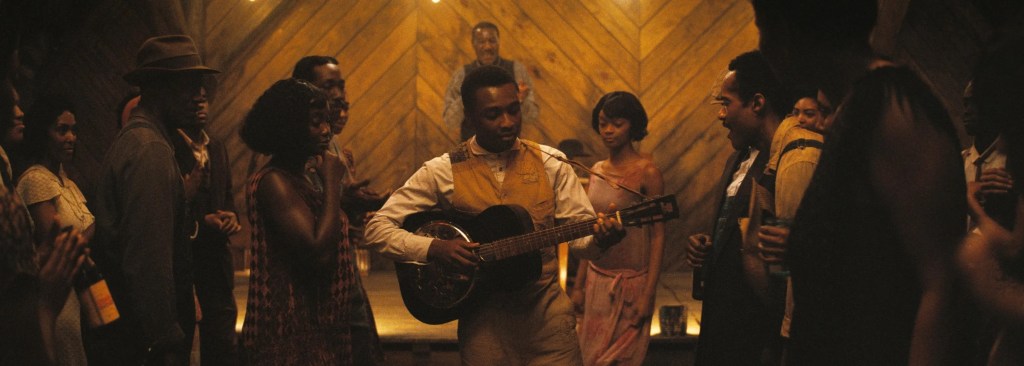
Ryan Coogler’s Sinners arrives as something genuinely rare: an original studio film with the ambition, scale, and soul to match its budget. Set in the Mississippi Delta of 1932, it is at once a horror movie, a blues musical, a Jim Crow-era family drama, and a meditation on what happens when a culture creates something so transcendently alive that the forces of death — literal and figurative — come clawing for it. It is the kind of film that reminds you what cinema is actually for.
Part of what makes Sinners so effective in its first two acts is the patience with which Coogler builds his world. This is not a film in a hurry. It takes its time in the Delta heat, in the negotiations and preparations for opening night at Club Juke, in the careful choreography of community. Coogler understands that horror is only as powerful as the life it threatens, and so he spends a generous portion of the film simply letting us live inside this world — its music, its laughter, its hierarchies, its tenderness. By the time the vampires arrive, we are invested not in plot mechanics but in people.
The dread, when it comes, is the creeping, folk-horror kind rather than anything cheap or sudden. It seeps into the frame the way cold air comes under a door: you notice it first in the corners of things, in a sound slightly too far off, a face held a beat too long. Coogler and cinematographer Autumn Durald Arkapaw conjure a Delta night that feels ancient and alive with menace, a landscape in which the supernatural does not seem at all out of place because the natural world here has always been terrifying enough.
And yet — Sinners is funnier than you expect. Genuinely, warmly, specifically funny, in the way that real communities are funny; the humor of people who know each other well enough to needle, to tease, to undercut a moment of danger with a perfectly timed aside. The film never uses comedy as a relief valve or a crutch. Instead, the humor deepens the world, makes it breathe. It is the laughter of people who have survived enough to find the absurdity in everything, and it makes the horror, when it comes in full, all the more devastating.
At its core, Sinners is a film about music as the only truly universal language — the one human invention that transcends geography, era, and even mortality. Coogler argues this not abstractly but viscerally, in the film’s extraordinary centrepiece sequence: a breathtaking, seemingly single take in which the young blues prodigy Sammie’s guitar begins to pull threads from across the entire diaspora — blues bleeding into rock and roll bleeding into hip-hop and back again — collapsing time into a single ecstatic vision. It is one of the most remarkable sequences in American cinema this decade, and it makes the film’s central thesis undeniable. This music is not merely entertainment. It is sacred. It is a wound and a gift simultaneously. It is the thing that cannot be killed, and therefore the thing every vampire in every mythology most desperately wants to consume.
Michael B. Jordan is fine. More than fine, really. His dual turn as twins Smoke and Stack is technically impressive, and he brings enough distinguishing texture to each brother that you rarely feel the seams of the conceit. But here is the truth the film’s marketing will not tell you: Jordan is not the most compelling presence on screen, and Sinners is better for it.
It is Delroy Lindo who commands the soul of the picture. As Delta Slim, the veteran bluesman hired to play Club Juke’s opening night, Lindo embodies a very specific kind of Southern Black manhood — weathered, witty, deeply rooted — that the movies have rarely had the patience or wisdom to portray with this much dignity. Slim is funny and self-deprecating and clearly acquainted with his own limitations, and in quieter moments he carries the full, accumulated weight of a life lived in a country that wanted his music but not his freedom. Lindo, who prepared for the role by immersing himself in Son House, Muddy Waters, and Howlin’ Wolf, brings a musicality to the character that goes far beyond technique. Every scene he inhabits feels anchored to something true. His final act of selfless sacrifice is genuinely moving, and the fear in his eyes as he commits to it — the mix of bravery and terrible knowledge — is among the most human things you will see on a screen this year. That the Academy has finally, belatedly, recognized Lindo with an Oscar nomination for this performance feels less like a triumph than a long-overdue correction.
Then there is Miles Caton, making his film debut as Sammie, and delivering what may be the most startling screen arrival in years. Caton is luminous. There is no other word for what he does when he plays, when the camera finds his face mid-song and simply stays there while the world rearranges itself around him. He carries the film’s thesis in his body — the idea that some people are born carrying something larger than themselves, something that the world will always try to take.
Jack O’Connell’s Remmick is the vampire the genre has been waiting for: not brooding, not romantic, but folk-horror terrifying, with the grinning, folksy menace of someone who has been on the wrong side of history for centuries and found it suits him perfectly. He is the film’s thesis made flesh — the bloodsucker as cultural appropriator, the pale interloper who needs to be invited in before he can take everything. O’Connell plays him with a horrible warmth, a gregarious false kinship, and when the mask finally drops, it is genuinely chilling. And Hailee Steinfeld, too often criminally underused, brings a specificity and warmth here that reminds you she has always been one of the best actors of her generation. Her scenes have a grounded sensuality and emotional precision that keeps the film tethered to its human heart even as the supernatural elements escalate.
It is worth noting that Sinners is a film unafraid of the body. The characters are sexy in the way people are sexy when the world might end — openly, urgently, without apology. Coogler does not sanitize or shy away from the physical lives of his characters, and this frankness is important. It is part of the film’s insistence that these people be seen whole: not as symbols, not as victims, not as noble archetypes, but as human beings with desires and appetites and beauty. The sexualization of the characters is never exploitative; it is humanizing. It is part of the same project as the music — an insistence that this culture, this community, this specific moment in African American history be celebrated in its fullness.
What Coogler has achieved, with meticulous craft, is a portrait of a very specific and irreplaceable cultural moment: the cradle of the Delta blues, the juke joint as sacred space, the particular freedom and peril of Black life in the Jim Crow South. The film understands that these communities created something immortal — a music that pierced the veil, as a character says early on — and it understands, with burning clarity, why that would attract monsters. The vampire mythology here is not borrowed. It grows directly from the soil of American folk terror, from the crossroads legends, from the very real horror of a society that wanted to consume Black genius while destroying Black people. The white interloper who arrives smiling at the door, who needs permission to enter, who will drain you dry if you let him in: this is not a metaphor that requires explanation.
Which makes it all the more frustrating when the film’s final act partially loses its footing. After such magnificent tonal architecture — after a first two-thirds that builds dread and joy and grief into something close to symphonic — the climactic battle inside Club Juke arrives with all the obligatory chaos of a studio horror finale and rather less of the feeling that preceded it. The fighting is frenetic, the special effects occasionally uneven, and some of the hard-won emotional coherence of the film’s quieter moments dissipates in the carnage. It is not a bad ending, exactly. But after what Coogler has constructed in the preceding hour and forty minutes, it feels like a concession to genre expectations that the rest of the film had transcended so beautifully. The extraordinary thing is that even this relative stumble cannot undo the film’s power. The scenes that preceded it are too vivid, too real, too alive in the memory.
Sinners is not a flawless film. Occasionally it strains under its own epic ambitions, and its reach exceeds its grasp in the final reel. But its imperfections feel like the edges of something genuinely alive, and the best of it — Caton’s incandescent presence, Lindo’s hard-won grace, O’Connell’s grinning malevolence, Steinfeld’s quiet precision, that astonishing musical vision of time collapsing — belongs with the finest American cinema of this decade. It is a film that loves what it is documenting: a culture, a sound, a community, a moment. And it understands, as only the best art does, that music is not something a people makes — it is something a people is.
★★★★1/2
 Show Me Cinema
Leave a comment