In the summer of 1816, the sky over Europe dimmed.
Mount Tambora had erupted the year before, scattering ash across the atmosphere and lowering global temperatures. The result was what contemporaries would call “the year without a summer”—a season of relentless rain, failed crops, and unseasonable cold. On the shores of Lake Geneva, confined indoors by storms, a group of young writers entertained themselves with a ghost story competition. Among them was an eighteen-year-old Mary Wollstonecraft Godwin—more famously known to history by her married name, Mary Shelley. The story she began there—born of thunder, philosophical debate, and a waking nightmare—would become Frankenstein; or, The Modern Prometheus, first published in 1818.
But Mary Shelley’s novel did not emerge merely from bad weather and Romantic imagination. Britain in the early nineteenth century was preoccupied—obsessed, even—with the porous boundary between science and death. The age of galvanism had arrived. Public demonstrations of electricity coursing through the bodies of executed criminals were common enough to draw crowds. Luigi Galvani’s experiments on frog legs and Giovanni Aldini’s electrified cadavers suggested that life might be a matter of charge and spark rather than divine breath. Meanwhile, anatomy schools relied on corpses procured from grave robbers; the “resurrection men” became figures of lurid fascination. The line between scientific inquiry and desecration seemed perilously thin. To read Frankenstein in 1818 was to feel that the novel had seized upon the central anxiety of its age: what if human beings, armed with new tools and unchecked ambition, presumed to trespass upon the territory of death itself?
Shelley’s novel has endured not because it is a mere horror tale, but because it understands the moral gravity of that trespass. Its terror is ethical before it is physical. It asks not simply can we create life? but what do we owe the life we create? It is a story about abandonment, about the hunger for love, about the consequences of a creator who recoils from his creation.
It is therefore no small thing to adapt Frankenstein faithfully.
For two centuries, the novel has been reinterpreted, streamlined, distorted, and mythologized. The flat-headed creature with neck bolts owes more to Universal Studios than to Mary Shelley. And yet Guillermo del Toro’s Frankenstein—long gestating in the director’s imagination—arrives as something remarkable: a near-flawless adaptation that feels as though it has reached back through cinematic history to reclaim Shelley’s original moral vision.
Del Toro does not merely retell the story. He restores its soul.
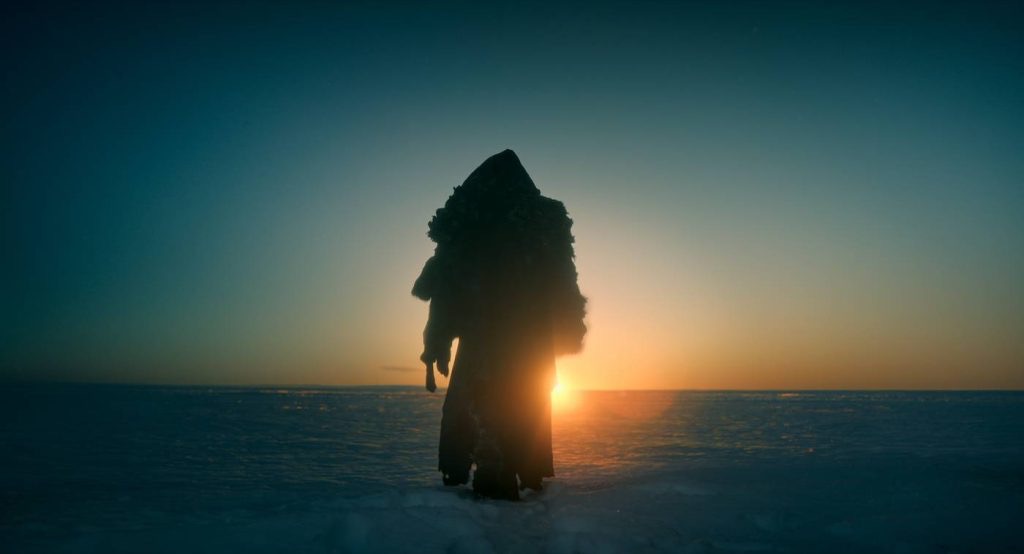
From its opening frames—a ship trapped in Arctic ice, timbers groaning against a frozen horizon—the film announces its fidelity to Shelley’s structure. The framing device of Captain Walton’s expedition, so often excised from adaptations, is here rendered with austere grandeur. Snow lashes the screen. Lantern light flickers across frostbitten faces. The sound design—howling wind, cracking ice—establishes a world that feels both immense and claustrophobic. This is not a laboratory-bound horror story; it is an epic of ambition and isolation.
Guillermo del Toro, who has long proven himself a master of Gothic romanticism in films like Pan’s Labyrinth and Crimson Peak, understands that Frankenstein is fundamentally about mood. The nineteenth century is not an aesthetic backdrop; it is a moral landscape. The production design is staggering in its detail. Victor’s laboratory is not a sterile, metallic chamber of lightning rods (as in James Whale’s 1931 classic), but a damp cathedral of ambition—wooden scaffolding, anatomical sketches pinned in obsessive clusters, jars of tissue suspended in amber light. The instruments look handmade, experimental, dangerous.
The ship sequences, in particular, are extraordinary. Del Toro lingers on the groan of ice against hull, on frost creeping across rope and canvas. The Arctic becomes a metaphor for Victor’s interior desolation. It is astonishing to think that such grandeur will live primarily on streaming screens; this is filmmaking that begs for theatrical scale. The laboratory scenes alone—lit by oil lamps and shadow—are symphonies of texture and darkness. It feels almost criminal that millions will not encounter these images in communal darkness.
It is impossible to approach any Frankenstein adaptation without invoking James Whale’s 1931 masterpiece, starring Boris Karloff. Whale’s film remains a foundational work of cinematic horror. Its expressionist angles, crackling electricity, and Karloff’s deeply sympathetic performance created the iconography that would define the monster for generations. The horror there is visual, visceral, and mythic.
Del Toro’s horror is something else entirely.
There are no villagers with torches dominating the film’s emotional core. There are no exaggerated thunderclaps designed to jolt the audience. Instead, the terror creeps from within human relationships. The horror of this Frankenstein is the breakdown of empathy that curdles into cruelty.
Oscar Isaac’s Victor Frankenstein is not a cackling madman. He is brilliant, charismatic, and devastatingly hollow. Isaac plays Victor with a restless intensity that never quite resolves into self-awareness. His eyes flicker constantly, as though calculating possibilities invisible to others. In early scenes, he is almost charming—driven by grief over his mother’s death, speaking earnestly of conquering mortality. But Isaac allows the audience to see the rot beneath that rhetoric. Victor’s pursuit of knowledge is less about love and more about conquest. He speaks of eliminating death as though it were a puzzle to be solved rather than a boundary to be respected.
The moment of creation—mercifully free of bombast—is filmed with restrained dread. There is no triumphant cry of “It’s alive!” Instead, there is silence. The creature’s chest rises. Its eyes open. And Isaac’s Victor recoils.
The recoil is everything.
The film understands what many adaptations have softened: the monster’s first experience is abandonment. Victor’s failure is not that he dared to create life. It is that he fled from responsibility the moment that life did not conform to his aesthetic expectations.
In that recoil lies the film’s deepest horror.
Jacob Elordi’s performance as the Creature is nothing short of astonishing. The makeup design honors Shelley’s description—yellowed skin, visible musculature, unnatural proportions—without sliding into caricature. Elordi uses his height and physicality to convey both menace and fragility. His movements are initially awkward, newborn-like. He studies light and shadow with cautious wonder. When he speaks—haltingly at first, then with growing eloquence—the film reveals its greatest fidelity to the novel.
Shelley’s Creature is articulate, philosophical, wounded. Del Toro preserves this. Elordi’s voice carries a deep, resonant sorrow. When he recounts learning language by observing a family from afar, his performance is suffused with longing. There is a sequence in which the Creature watches the De Lacey family share bread by candlelight; the camera lingers on his face as warmth flickers across features deemed monstrous. The audience sees what Victor refuses to see: a being capable of tenderness.
And when cruelty meets that tenderness, something breaks.
The murders in this film are not sensationalized. They feel inevitable, tragic. Each act of violence emerges from rejection, humiliation, or despair. Elordi ensures that the Creature never becomes merely an instrument of horror. He remains, painfully, human in his need for love.
In one of the film’s most devastating scenes, the Creature confronts Victor in the at the wedding of Victor’s brother and Elizabeth (played by Mia Goth), one of the only souls to show pure empathy. It is in this moment when the Creature demands a companion. Elordi’s delivery of Shelley’s language—adapted with care—turns accusation into plea. “I ought to be thy Adam,” he says, voice trembling, “but I am rather the fallen angel.” It is not a threat. It is a lament.
Mia Goth’s Elizabeth is given more interiority than in many prior adaptations. Rather than serving solely as a symbol of domestic purity, Goth’s Elizabeth is perceptive and increasingly wary of Victor’s obsession. Her performance is restrained but piercing. She sees the cost of Victor’s ambition long before he does. In a particularly effective scene, she wanders into the laboratory and studies the grotesque remains of failed experiments. Goth’s expression—revulsion mixed with dawning horror—mirrors the audience’s recognition that Victor has crossed an irreversible threshold.
Christoph Waltz’s Harlander is an invention of the screenplay, a financial patron whose investments underwrite Victor’s research. The character could easily have become a thin caricature of capitalist villainy, but Waltz imbues him with unsettling ambiguity. Harlander is not mad; he is pragmatic. He sees in Victor’s experiments the possibility of profit, of prestige, of industrial application. Through Harlander, the film quietly updates Shelley’s themes for the twenty-first century. Science untethered from ethics is dangerous; science tethered to profit may be catastrophic.
Harlander’s presence reframes Victor’s ambition. No longer is he merely a solitary genius; he is enmeshed in systems of funding and expectation. Del Toro thereby expands Shelley’s critique into a broader indictment of modernity’s appetite for innovation without responsibility.
One of the film’s most extraordinary achievements is its commitment to practical set pieces. In an era saturated with digital spectacle, del Toro insists on texture. The ship is real enough to creak. The laboratory hums with tangible machinery. Bodies have weight. Blood has thickness.
The Arctic sequences, filmed with astonishing realism, create a sense of scale that dwarfs the human figures. Ice becomes both prison and mirror. The practical effects in the Creature’s design—subtle animatronics beneath prosthetics—allow Elordi’s performance to register in minute detail. You can see the strain in stitched skin when he smiles. You can see the tremor when he clenches his jaw.
Del Toro has always understood that monsters are most powerful when they feel touchable. Here, that philosophy elevates the film into something immersive and visceral. It is difficult not to imagine how these sequences would have overwhelmed audiences in IMAX projection. Streaming may democratize access, but it cannot replicate the cathedral-like hush of a theater when snow fills an enormous screen.
Perhaps the film’s boldest move lies in its ending.
Shelley’s novel concludes in bleak grandeur. The Creature, having lost his maker, disappears into the Arctic wasteland, vowing to immolate himself. It is a fittingly tragic close—an extinguishing of both creator and creation.
Del Toro chooses a different path.
Without betraying the moral core of the story, he crafts an ending that gestures toward hope. The Creature, confronted with the consequences of vengeance, does not vanish into nihilism. Instead, he performs an act of mercy—an unexpected refusal to perpetuate the cycle of abandonment and violence that defined his existence. The specifics are best experienced unspoiled, but the effect is undeniable. In a year crowded with cynical blockbusters and dystopian finales, Frankensteinoffers something rare: the possibility that empathy, once rediscovered, can interrupt destruction.
It is not a saccharine hope. It is fragile, hard-won. But it lingers.
Guillermo del Toro’s Frankenstein stands as one of the most accomplished literary adaptations in recent memory. It honors Mary Shelley’s original philosophical depth, restores the Creature’s eloquence, and reframes horror as an ethical failure rather than a spectacle of shock.
Oscar Isaac delivers a chilling portrait of ambition devoid of empathy. Jacob Elordi gives the Creature a heartbreaking humanity that will linger long after the credits roll. Mia Goth and Christoph Waltz enrich the narrative with performances that deepen its thematic reach.
Most of all, the film reminds us why Frankenstein endures. In an age still grappling with artificial intelligence, genetic engineering, and the commodification of life, Shelley’s questions remain urgent. What do we owe what we create? Where does responsibility begin and end? And what happens when we turn away from our own handiwork?
Two centuries ago, a young woman imagined a scientist who conquered death but could not master compassion. Guillermo del Toro has taken that story and given it new resonance, new texture, and new moral clarity.
If the nineteenth century feared that science might trespass upon death, the twenty-first fears that empathy might erode under ambition. This Frankenstein insists that the true monster is not stitched flesh or galvanic spark, but the failure to love what we have brought into the world.
It is a haunting, humane, and—against all odds—hopeful masterpiece.
★★★★1/2
 Show Me Cinema
Leave a comment