Zodiac is a film that unfolds less like a conventional narrative than like a slow infection. It seeps in quietly, with one of the most disturbing opening scenes, before taking up permanent residence in the mind. On first encounter, it can even feel withholding—cool, procedural, resistant to the familiar beats we expect from true-crime cinema. But patience is not merely rewarded here; it is weaponized. About forty minutes in, the film finds its terrible equilibrium and becomes something rare and unsettling: a crime thriller fused with a procedural, a newsroom drama, and a horror film about the banality of evil in late-1960s and 1970s America. From that point forward, Zodiac does not escalate in the usual way. Instead, it tightens, clarifies, and drains the color from everything around it, until obsession itself becomes the dominant atmosphere.
The early stretch is deliberately modest. Director David Fincher establishes systems—police departments, newspapers, bureaucratic hierarchies—before showing how easily those systems fracture under pressure. Murders occur, but they are presented without sensationalism. The violence is brief, blunt, and horrifying precisely because of its ordinariness. There is no operatic flair, no cinematic release. The killer’s presence feels less like a character than a disturbance in the natural order, something that slips into lovers’ lanes, parked cars, and public spaces with terrifying ease. This is where Zodiacquietly begins to declare its intentions. It is not interested in mythologizing its antagonist. Instead, it is fascinated by the collateral damage left behind when certainty collapses.
Once the film settles into its central rhythm, it becomes almost hypnotic. Fincher’s camera is steady, patient, observant. Scenes stretch just long enough to make you aware of time passing. Conversations are repetitive by design, filled with restated facts, half-remembered details, and tentative theories. This repetition is not redundancy; it is erosion. Each new lead promises resolution, only to dissolve under scrutiny. The film’s greatest strength lies in how it dramatizes the labor of looking—of reading handwriting samples, aligning timelines, comparing eyewitness accounts, and waiting for phone calls that never come. Truth is not discovered in epiphanies but chased through filing cabinets, microfilm, and cluttered desks.
Fincher’s approach to Zodiac is defined by an almost obsessive commitment to research and factual fidelity, a rigor that mirrors the very fixation the film depicts. Police reports, court transcripts, letters, timelines, and even the precise geography of crime scenes were exhaustively consulted, resulting in a film that reconstructs events with forensic care while remaining honest about where the historical record fractures or fails entirely. Crucially, Fincher resists the temptation to “solve” the case for dramatic satisfaction; instead, he treats the Zodiac investigation as an open wound in American history, shaping the film around uncertainty, contradiction, and incomplete knowledge. The result is not a definitive account, but a deeply ethical one—an acknowledgment that respecting the truth sometimes means refusing to impose clarity where none exists.
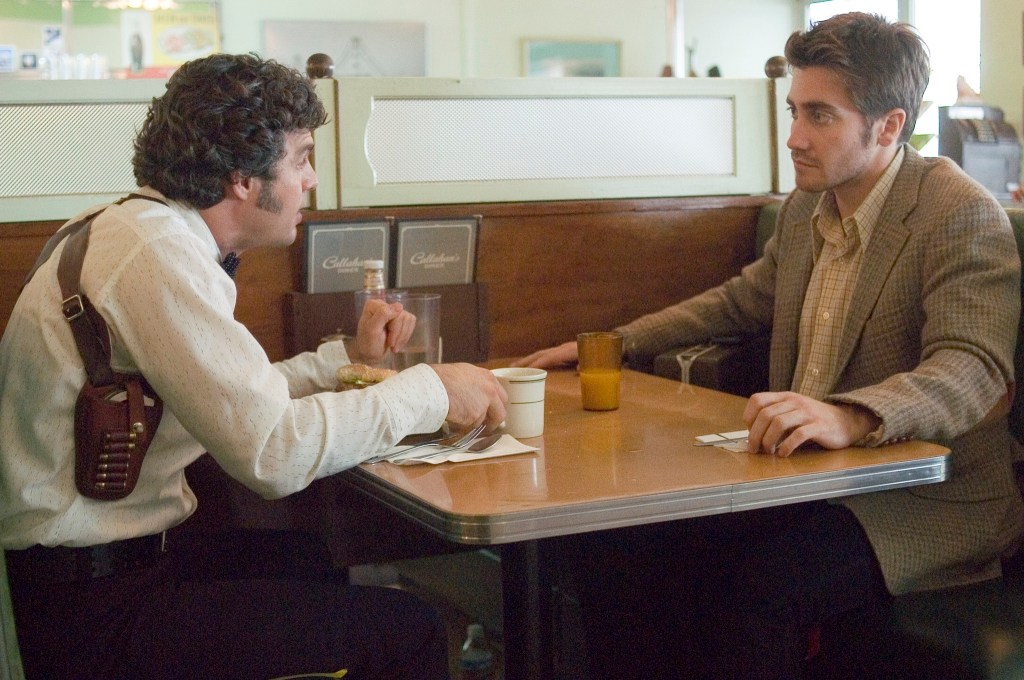
The performances at the center of this pursuit are crucial, and this is where Zodiac achieves its most human and most devastating register. Jake Gyllenhaal, as San Francisco Chronicle cartoonist Robert Graysmith, begins the film as a figure of almost comic innocence. He is soft-spoken, eager, slightly out of step with the hardened professionals around him. Gyllenhaal plays him not as a genius waiting to be unleashed, but as a man whose curiosity gradually metastasizes into fixation. What starts as interest becomes responsibility; responsibility becomes obsession. His posture changes. His voice firms. His life narrows. By the end of the film, Graysmith is not triumphant but hollowed out, defined almost entirely by the question that refuses to be answered.
Opposite him is Mark Ruffalo, whose performance as Inspector David Toschi is one of the film’s great achievements. Ruffalo brings a weary intelligence to the role, grounding the film in lived experience rather than cinematic bravado. Toschi is not a maverick cop or a tortured genius; he is a professional doing his job within a system that increasingly betrays him. Ruffalo excels at conveying how cynicism is not an initial condition but a learned one. You can see it accumulate in small gestures—longer silences, tightened expressions, the subtle resignation in his posture. His performance charts the emotional cost of sustained uncertainty, the slow realization that effort does not guarantee closure.
The interplay between Gyllenhaal and Ruffalo is where Zodiac finds its emotional spine. Their characters operate from different positions—one an amateur driven by curiosity, the other a seasoned detective constrained by institutional limits—but they are united by the same gravitational pull. Together, they embody the film’s central tension: the clash between belief and proof. Graysmith believes, fiercely and increasingly desperately. Toschi needs evidence. Watching them work off each other, sometimes in harmony and sometimes in quiet opposition, is to watch the film’s philosophical argument take shape. Obsession without authority is fragile; authority without certainty is paralyzing. Neither man “wins,” and that is precisely the point.
The film’s journalistic dimension further complicates this dynamic. The newsroom is portrayed as both a crucible of public accountability and a site of personal vulnerability. Deadlines loom. Editors demand clarity. The pressure to publish intersects uneasily with the moral responsibility to avoid speculation. Fincher captures the intoxicating rush of being close to a story that feels historic, even as he exposes the psychological toll of living inside it. Information becomes currency, then burden, then curse. The newsroom scenes are alive with overlapping dialogue and mundane detail, grounding the film in a specific professional culture that feels authentic rather than romanticized.
Visually, Zodiac is Fincher at his most restrained and precise. The period detail is immaculate without calling attention to itself. Cars, offices, clothes, and interiors do not announce “the past” so much as quietly situate us within it. California, so often photographed as a place of brightness and possibility, becomes something colder here—a landscape of flat light and moral ambiguity. Sunlit scenes are not comforting; they are exposing. Fincher repeatedly places acts of terror in broad daylight, stripping away the illusion that darkness is a prerequisite for horror. This is one of the film’s most disturbing strategies. The threat is not hidden in shadows; it operates in plain sight. In Zodiac, the streets of California feel faintly haunted—not by ghosts, but by absences—by the sense that something terrible has passed through and left no clear trace behind. Fincher turns freeways, neighborhoods, and sunlit parks into a metaphor for a nation losing its grip on trust, where paranoia seeps into everyday life and the unknown becomes a permanent, unsettling presence rather than a mystery to be solved.
And yet, for all its discipline, Zodiac is not immune to miscalculation. The casting of Robert Downey Jr. as journalist Paul Avery remains baffling, given that he is surrounded by spectacular performances. Downey is undeniably compelling, but his performance carries a self-awareness that occasionally clashes with the film’s rigorously controlled tone. Avery’s arc—from confident reporter to unraveling casualty of the case—is essential, but Downey’s charisma sometimes pulls focus away from the film’s central meditation on attrition. Where other performances recede into the machinery of obsession, his threatens to step outside it. The result is not disastrous, but it is discordant, a reminder of stardom intruding on a film otherwise committed to anonymity and process.
The pacing of the third act also tests the viewer’s endurance. Fincher’s refusal to compress time or simplify procedure is intellectually admirable, but dramatically uneven. The film continues to circle its remaining possibilities with an insistence that borders on stasis. What once felt hypnotic can begin to feel inert, not because the material lacks weight, but because the rhythm no longer evolves. The repetition that earlier communicated erosion now risks dulling the film’s edge. It is here that Zodiac comes closest to alienating its audience—not by being too bleak, but by being too faithful to the grinding reality of unresolved investigation.
Yet even these shortcomings feel bound up with the film’s larger purpose. Zodiac denies us the satisfaction of a conclusion not out of perversity, but out of ethical commitment. The absence of resolution is not a narrative failure; it is the story. Fincher understands that to impose closure where none exists would be a betrayal—not only of history, but of the people whose lives were permanently altered by uncertainty. The film’s final movements do not crescendo; they recede. They leave us with a sense of something unfinished, uncontained, and unresolved.
That lack of catharsis is what ultimately makes Zodiac so chilling. Most true-crime films offer a moral ledger: the guilty are named, the innocent vindicated, the chaos organized into meaning. Zodiac refuses this comfort. Instead, it leaves us with the unsettling recognition that some evils are not conquered but endured, that some stories end not with answers but with exhaustion. The true horror of the film lies not in the murders themselves, but in the realization that decades of effort, intelligence, and dedication may still fail to produce certainty.
In this way, Zodiac is less about a killer than about the cost of searching for one. It is a film about time—how it stretches, distorts, and consumes. Careers stall. Relationships fracture. Identity becomes subsumed by a single, unanswerable question. By the end, the audience shares in that burden. We are denied the relief of resolution, forced instead to sit with ambiguity, to feel its weight rather than escape it.
Nearly two decades after its release, Zodiac remains one of the most compelling—and yet undeniably the most unsettling American films of the twenty-first century—not because it shocks, but because it refuses to reassure. It insists that the banality of evil is not merely a historical concept, but a lived reality, one that unfolds slowly, bureaucratically, and without narrative grace. In denying us closure, Fincher offers something far more disturbing: an honest reckoning with the limits of knowledge and the enduring consequences of obsession.
★★★★
 Show Me Cinema
Leave a comment