Pauline Kael’s reputation as a revered film critic rests not merely on taste but on nerve. Her refusal to bow before Citizen Kane—a film embalmed by decades of reverence—remains one of the most liberating gestures in American criticism. Kael reminds us that criticism is not a moral obligation to admire greatness but an honest reckoning with how a work actually functions, moment by moment, image by image, line by line. It is that permission—permission to trust one’s own resistance—that makes me comfortable publishing a review like this. And yet even invoking Kane alongside Song Sung Blue feels almost grotesque. Where Orson Welles’s 1941 debut still crackles with invention, curiosity, and formal daring, Song Sung Blue is its inverse: a film so inert, so poorly written and performed, that it actively resists the very emotions it is engineered to provoke. The two films share hardly anything in common, in fact, even Kael would be offended that i am categorizing them together. But for all who love Song Sung Blue when reading this review, just remember, that there were people years ago who were bold enugh to publicly state their disdain for one of the greatest films ever made.
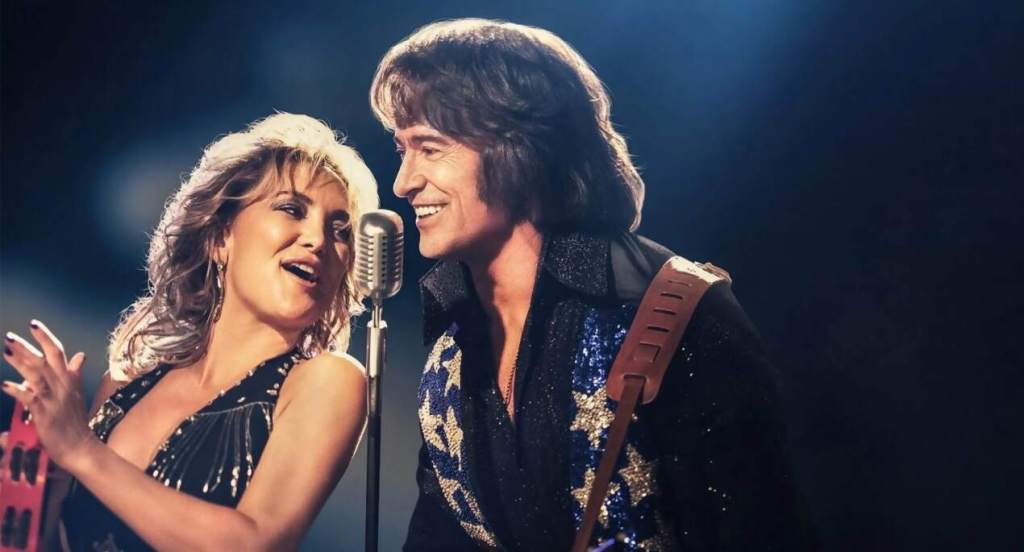
Craig Brewer’s film, based on the real-life story of Mike and Claire Sardina, should by all rights be small, gentle, and observant. A middle-aged couple in Milwaukee, stuck in economic and emotional stasis, find renewed purpose through their shared love of Neil Diamond, eventually forming a tribute act that gives them community, dignity, and a sense of voice. It is a story about amateur art, about late-blooming courage, about the quiet thrill of being seen. Instead, Song Sung Blue is swollen with false significance, its every scene straining to announce importance rather than earn it.
The problem begins almost immediately with Hugh Jackman. His character Mike is written as a man eroded by disappointment—laid off from auto work, embarrassed by financial dependence, quietly fearful that his best years are behind him, and yet celebrating 20 years of sobriety. These are intimate anxieties, the kind that live in posture and silence. Jackman, however, plays Mike as if subtlety were a foreign language. Every emotion is projected outward, magnified, italicized. When Mike struggles, he struggles loudly; when he hopes, he hopes theatrically. That is not what happens in life. The performance feels calibrated for applause and tears rather than observation and that sacred connection between the story and the audience.
Jackman’s sheer size as a persona overwhelms the film. Instead of watching a man tentatively rediscovering joy through music, we are watching Hugh Jackman perform rediscovery. This has been a recurring issue in his career, and my resistance to him here is inseparable from my lingering frustration with his turn in Les Misérables, where suffering became spectacle and emotional rawness was mistaken for extremity. In Les Mis, he completely discarded the complexities of one of the greatest characters ever written. Song Sung Blue repeats that error. Mike’s journey is not allowed to unfold naturally; it is constantly pushed toward inspirational climax, leaving no room for doubt, ambivalence, or quiet failure.
Yet it is Claire’s trajectory—played by Kate Hudson—that should have anchored the film in something raw and unmanageable. Claire’s story is not one of mild dissatisfaction or delayed fulfillment; it is one of rupture. Her life is not gently interrupted but violently reordered. What the film gestures toward, but never truly engages with, is the way trauma fractures identity—not just physically, but psychologically, relationally, and spiritually.
Claire’s world is altered in an instant, and the aftermath is not inspirational but destabilizing. She is forced into a new relationship with her own body, one defined by pain, dependency, and profound loss of autonomy. The film acknowledges this disruption only superficially, using it as narrative fuel rather than emotional terrain. Claire’s anger, suspicion, and volatility are framed as obstacles to be overcome rather than symptoms of a psyche struggling to survive unbearable change.
Her descent into isolation and mistrust—lashing out at Mike, questioning his fidelity, retreating inward—is presented without patience or curiosity. These moments should feel disorienting, frightening, even alienating. Instead, they are treated as temporary narrative detours on the way to uplift. The film rushes through Claire’s emotional fragmentation, unwilling to linger in the discomfort of watching a woman unravel in ways that cannot be neatly resolved.
What further undermines the film is its insistence on selling the love story as something epic, salvific, and unquestionable, when it never feels emotionally credible on its own terms. Mike and Claire’s relationship is presented less as a lived marriage than as an abstract ideal—love as endurance test, love as proof of virtue. Conflict is not allowed to exist organically; it is either inflated into melodrama or smoothed over in service of reaffirmation. Their arguments feel schematic, their reconciliations preordained. We are told repeatedly that this is a great love, forged by loyalty and music and mutual survival, yet the film rarely shows us the quiet negotiations, the mundane intimacies, or the shared humor that make long-term love convincing. Instead, devotion is announced rather than demonstrated, dramatized through speeches and grand gestures rather than accumulated through time. The result is a romance that feels less like a marriage under strain than a narrative obligation—overwritten, overperformed, and ultimately impossible to believe.
Most troubling is the way the film handles Claire’s relationship to pain—both physical and emotional. Her reliance on medication is framed less as a coping mechanism than as a moral problem, a deviation from the inspirational arc the film is so eager to maintain. Her despair is pathologized rather than understood. When her behavior becomes erratic, when she drifts from reality, when fear and grief overwhelm her sense of self, the film responds not with empathy but with urgency to correct her trajectory.
Hudson’s performance is boxed in by this framing. She plays Claire with strained sincerity, but the screenplay affords her no interior life. Her suffering is externalized through arguments, declarations, and breakdowns, never through silence or ambiguity. The film seems terrified of allowing Claire to remain unresolved, of letting her pain exist without immediate explanation or redemption.
Even the decision to seek institutional care—a moment that should register as both devastating and necessary—is handled with astonishing emotional thinness. Rather than exploring the terror, relief, and grief bound up in acknowledging the need for help, the film treats it as a plot mechanism, a way station en route to recovery. Claire’s psychological crisis is not interrogated; it is processed. And it is processed in a way films have done in much better taste (see the past two versions of A Star Is Born, for example).
This flattening becomes especially egregious when contrasted with how insistently the film celebrates performance as salvation. Music, we are told, restores Claire. Singing returns her to herself. But the film never reconciles this claim with the reality of what she has endured. Art does not erase trauma; it coexists with it. Song Sung Blue has no interest in that coexistence. It wants music to function as cure, not companion.
The is a line of dialogue in the third act, in which Claire articulates her emotional breakthrough in clinical language—naming catharsis as though diagnosing herself—perfectly encapsulates the film’s misunderstanding of healing. Catharsis is not something one announces; it is something one stumbles into, often without recognition. By scripting Claire’s recovery as verbalized enlightenment, the film drains it of authenticity.
The film is equally incurious about why Neil Diamond’s music resonates with Claire in particular. Why does this music speak to a woman whose life has been violently reordered? What about its sentimentality, its theatrical vulnerability, its unapologetic emotion cuts through her guardedness? The film never asks. Diamond’s songs are treated as universal balm rather than specific expression. They could be swapped out for any number of artists—Bruce Springsteen, for instance—without altering the film’s emotional logic, which is precisely the problem.
Claire’s eventual return to performance is framed as triumph, but it feels hollow because the film has not earned it. She has not been allowed to fail meaningfully, to resist fully, to remain broken longer than is narratively convenient. The applause comes too easily. The community embraces too readily. The cost of being seen is never truly felt.
In contrast, John Carney’s 2007 Irish independent film, Once understands that music does not rescue people so much as reveal them. Once allows its characters to remain incomplete, its songs to exist without justification, its healing to be partial and provisional. Song Sung Blue refuses such modesty. It wants recovery to be legible, applause to equal absolution, performance to stand in for reconciliation with loss.
What ultimately sinks Song Sung Blue is not its sentimentality, but its fear of letting suffering remain unresolved. Claire’s arc—one of the most difficult and potentially profound stories the film contains—is reduced to a problem that must be managed rather than a reality that must be lived with. The film insists on hope without reckoning, uplift without excavation.
By the end, the cumulative effect is not inspiration but emotional exhaustion. Song Sung Blue does not trust pain, silence, or ambiguity. It explains when it should observe, reassures when it should tremble, and performs empathy rather than practicing it. And in doing so—quietly, persistently—it earns its place at the very bottom of the scale of films from 2025.
In the end, what lingers about Song Sung Blue is not anger so much as disappointment—the sense of a film that mistakes emotional instruction for emotional truth. Its failures are not accidental but philosophical: a belief that pain must be resolved, that art must heal, that suffering is only worthwhile insofar as it leads to applause. Kael understood that cinema lives in resistance as much as reverence, in the awkward spaces where feeling has not yet learned how to speak. Song Sung Blue refuses those spaces. It rushes to meaning, narrates its own emotions, and confuses reassurance for insight. To say so is not cruelty; it is fidelity to what movies can be when they are brave enough to let experience remain unsettled. If this review seems severe, it is only because the film asks so insistently to be felt—and gives so little in return outside of hearing Neil Diamond songs.
★
 Show Me Cinema
Leave a comment