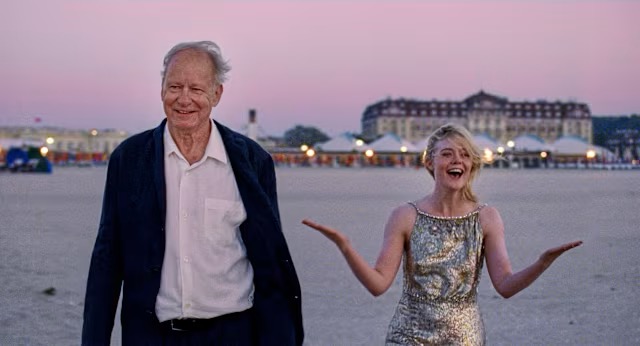
There is a particular stillness that defines Sentimental Value—a stillness that does not signal emptiness, but accumulation. This is a film made of layers: of time pressing down on space, of memory embedded in architecture, of emotion stored rather than expressed. From its opening moments, it announces itself as a work uninterested in urgency. Instead, it asks the viewer to settle in, to attune themselves to quiet shifts in tone and gesture, to accept that the most consequential moments in a family’s life often arrive without ceremony.
Directed by Joachim Trier, the film centers on the return of Gustav Borg, a once-celebrated Norwegian film director played with devastating subtlety by Stellan Skarsgård. Gustav has been absent for much of his daughters’ lives, his creative ambition and emotional evasiveness leaving behind a residue of hurt that no amount of belated sincerity can easily erase. His return is prompted by both personal loss—his own mother’s suicide—and professional impulse: he wants to make a film based on his family’s history, set in the very house where so much of that history unfolded.
This premise could easily tip into melodrama or self-referential indulgence. Instead, Sentimental Value treats it as an opportunity to examine how art, memory, and family intertwine in ways that are rarely clean or redemptive. The film is not interested in whether Gustav’s project is justified so much as what it reveals: about his limitations, about his daughters’ emotional boundaries, and about the uneasy ethics of transforming lived pain into aesthetic material.
Skarsgård’s performance is the film’s gravitational center. His Gustav is neither tyrant nor tragic hero. He is, more unsettlingly, familiar: a man who believes deeply in the importance of art, who can articulate regret fluently, and who nevertheless remains emotionally illiterate when it comes to the people closest to him. Skarsgård plays him with a soft-spoken authority that never quite tips into warmth. His gestures are careful, his apologies measured, as if he has learned the language of remorse without fully internalizing its demands.
What makes the performance so compelling is its refusal to seek absolution. Gustav does not ask to be forgiven; he behaves as though recognition might be enough. In scene after scene, Skarsgård allows us to feel the gap between intention and impact—the tragic space where many family relationships deteriorate. His presence changes the temperature of every room he enters, not because he dominates it, but because of what he brings with him: unresolved history, deferred responsibility, and the quiet arrogance of someone who still believes his version of events deserves to be told.
If Gustav represents the burden of legacy, Elle Fanning’s Rachel Kemp embodies the ambiguity of interpretation. Rachel, an American movie star cast in Gustav’s autobiographical film after one of his daughters refuses the role, arrives as an outsider—someone without direct access to the family’s emotional history, yet tasked with embodying it. Fanning plays Rachel with striking humility. She is curious, attentive, and notably hesitant, aware that she is stepping into emotional territory that does not belong to her.
Rather than positioning Rachel as a disruptive force, the film uses her as a mirror. Through her questions, her quiet observations, and her tentative attempts at understanding, we see how strange and opaque the Borg family’s emotional logic appears from the outside. Fanning’s performance avoids irony or detachment. Instead, she brings a genuine desire to understand, even as she recognizes the limits of that understanding. In doing so, she becomes a living embodiment of the film’s central tension: the difference between experiencing something and representing it.
Yet as strong as Skarsgård and Fanning are, Sentimental Value ultimately belongs to the sisters at its center, portrayed with extraordinary depth by Renate Reinsve and Inga Ibsdotter Lilleaas. Their relationship forms the emotional backbone of the film, grounding its larger questions about art and memory in something far more elemental: the love siblings share when they have survived the same emotional landscape.
Reinsve’s Nora is volatile, brilliant, and visibly wounded. A successful actress who suffers from debilitating stage fright, she carries her father’s absence like an open nerve. Reinsve plays her with a restless intensity, allowing anger and vulnerability to coexist without resolution. Nora’s refusal to participate in Gustav’s film is not simply a professional decision; it is an act of self-preservation. She understands, perhaps more clearly than anyone, the cost of allowing her father to frame her pain as narrative material.
Opposite her, Lilleaas’s Agnes offers a quieter presence. A historian by profession, Agnes approaches the past with structure and restraint, yet her emotional life is no less complex. Lilleaas plays her with remarkable subtlety, allowing affection, frustration, and exhaustion to surface in fleeting expressions rather than overt confrontation. Agnes’s love for her sister is steadfast and unspectacular, expressed through attentiveness rather than reassurance.
What the film captures so beautifully is the specific texture of sisterly love: not idealized or endlessly nurturing, but grounded in shared endurance. These women know each other’s wounds because they were formed in the same environment. Their bond is not forged through dramatic reconciliation but through daily proximity, through the quiet understanding that comes from having witnessed the same failures and survived them differently. In their scenes together, Reinsve and Lilleaas communicate volumes with minimal dialogue—a glance held a fraction too long, a sentence left unfinished, a silence that feels protective rather than awkward.
This emphasis on quiet connection extends to the film’s overall aesthetic. Sentimental Value is a study in restraint. Trier’s direction favors long takes and controlled compositions, allowing scenes to unfold without editorial insistence. Silence is not treated as absence but as narrative substance. The camera often lingers after dialogue ends, granting space for emotion to register in the body rather than the script. This approach requires patience, but it rewards attention.
The film’s quietness also reflects its philosophy of art. Art, Sentimental Value suggests, rarely announces itself as meaningful. It often begins as something foreign, even slightly uncomfortable—something we do not yet know how to place in our emotional lives. Over time, through repetition and association, it embeds itself in memory. Eventually, it becomes inseparable from lived experience. The film mirrors this process formally: its images and rhythms accrue meaning gradually, revealing their emotional weight only after they have settled.
In this sense, Sentimental Value feels like a modern conversation with the late Sweedish director, Ingmar Bergman, particularly his semi-autobiographical sketches of his family, Wild Strawberries and Cries and Whispers. Like Wild Strawberries, Trier’s film treats memory as porous and nonlinear, allowing the past to intrude gently but persistently into the present. And like Cries and Whispers, it situates familial relationships—especially between women—as sites of profound intimacy and unresolved pain.
Yet Sentimental Value is not an exercise in homage. Where Bergman often pursued metaphysical confrontation, Trier remains committed to emotional realism. He is less interested in revelation than in residue—what remains after conversations end, after apologies are offered but not fully received. The result is a film that feels deeply contemporary in its refusal to resolve emotional complexity into moral clarity.
Still, for all its accomplishments, Sentimental Value does not fully release the emotional pressure it so carefully builds. The film circles catharsis with great sensitivity, approaching moments that feel poised for rupture—a confrontation that might finally break open years of silence, a gesture that could reconfigure the family’s emotional geometry—only to pull back. This restraint is intellectually admirable and consistent with the film’s commitment to realism. Families rarely experience clean emotional climaxes, and the film honors that truth.
Yet the absence of a full emotional release lingers, and in such its commentary on the power of art as a method for communication does not fully land. The film earns the right to let its emotions break free—and then declines to do so, leaving the final moments ambiguous when they could—and should be an emotional release, if for no one else in the film itself, then the audience. For this viewer, that choice registers less as failure than as longing. One senses the film reaching for a catharsis that would not betray its realism, a moment of openness that might coexist with ambiguity. That it comes so close is deeply moving. The restraint feels intentional, even principled, but it also leaves a quiet ache in its wake.
There are other minor limitations. Certain secondary threads—particularly those surrounding Gustav’s film project—remain lightly sketched, their thematic implications hinted at rather than fully explored. The pacing, so often a strength, occasionally drifts into inertia, asking patience without always offering new emotional insight. These moments do not undermine the film, but they prevent it from achieving complete cohesion.
This is a film that understands art not as explanation, but as companionship. It begins as something foreign and strange, and slowly, almost imperceptibly, becomes something intimate—woven into the viewer’s own emotional archive, although in the final moments is still held somewhat at arm’s length. Nevertheless, in an era of cinematic excess, Sentimental Value reminds us that quiet can be profound, that restraint can be brave, and that some of the most meaningful experiences are the ones that do not resolve, but remain with us, unresolved and alive.
★★★★
 Show Me Cinema
Leave a comment