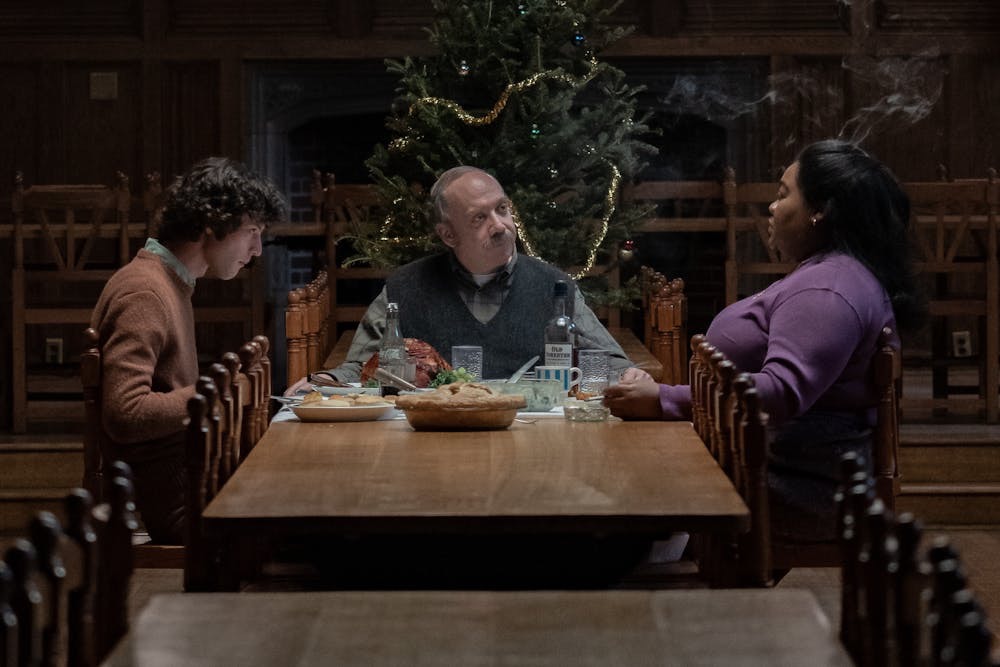
Early in Alexander Payne’s 2023 film, The Holdovers, Paul Hunham informs his students—without a trace of consolation—that “life is like a henhouse ladder: shitty and short.” It is not merely a joke, or even a provocation, but a thesis statement: a bleak, funny distillation of the film’s worldview, in which suffering is unavoidable, dignity is hard-won, and optimism must be earned rather than assumed. From that moment on, Alexander Payne’s The Holdovers announces itself as a film unafraid of discomfort, arriving like a misplaced artifact from another era—scratched at the edges, modest in its ambitions, and quietly devastating in its effect. The “holdovers” of the title are, at first, literal: the unwanted few left behind at a New England boarding school over Christmas break—students without homes to return to, a teacher no one wants, and a grieving cafeteria manager with nowhere else to be. By the film’s end, the word has expanded to mean something far more human: those left behind by history, by war, by institutions that prize comfort over character, and by a world that keeps moving while some people are forced to stand still. The film looks backward without irony and forward without apology. From its grainy, wintry cinematography to its unhurried pacing and tart, literate dialogue, it seems to remember a time when movies trusted audiences to sit still, to listen, and to feel something complicated without being told exactly what that feeling should be. In an age of volume and velocity, The Holdovers whispers—and somehow, that whisper lingers.
Visually and thematically, the film wears its vintage sensibility proudly. It feels less like a contemporary release than a rediscovered 1970s character drama, the sort you might have once stumbled upon late at night on public television, or read a review from Roger Ebert about (I personally believe he would have loved this movie). Payne’s New England boarding school is rendered with austere affection: drafty hallways, threadbare common rooms, snow-packed courtyards that seem designed to trap thought as much as bodies. This is a movie that understands how spaces educate us, sometimes more harsly than people do.
At its center is Paul Hunham, played with sour, aching brilliance by Paul Giamatti. Hunham is a man fossilized by intellect—learned, precise, and spiritually stalled. He reveres education not as ornament but as moral labor, a process meant to refine character as much as mind. His contempt is reserved for those who treat learning as a transactional shield: something to purchase, leverage, or abandon once safety is assured. Giamatti gives him no easy charm. Instead, he builds Hunham out of grudges, pedantry, and buried disappointment, allowing flashes of decency to surface only when they can no longer be suppressed.
If Hunham is the mind of the film, Mary Lamb is its heart. Da’Vine Joy Randolph delivers a performance of astonishing depth and restraint, portraying grief not as a singular breakdown but as a daily, grinding presence. Mary’s son Curtis—brilliant, curious, and hardworking—died in Vietnam earlier that year, a casualty not just of war but of economics. Unlike the boys of Barton Academy, Curtis could not buy himself safety through tuition and pedigree. His intelligence, his promise, and his decency offered no exemption. Randolph allows that injustice to hum beneath every line, every gesture, making Mary the film’s quiet moral axis.
This is where The Holdovers becomes, unexpectedly, one of the most perceptive Vietnam War films of the last half-century. The war is never shown, barely discussed, yet it permeates the story like cold air through old windows. By December 1970, Vietnam had already reshaped American life—not only through protest and politics, but through the subtler hierarchies of who was protected and who was expendable. Education, here, is not just enlightenment; it is insulation. Hunham understands this too well, and his bitterness toward wealth masquerading as merit is the film’s sharpest blade.
That blade cuts deepest through Angus Tully, played with startling assurance by Dominic Sessa. Angus is not a rebel so much as a smart boy drowning in resentment and fear. Sessa resists the temptation to make him precocious or cute; instead, Angus feels unfinished, raw, and volatile in ways that feel true to adolescent intelligence. His relationship with Hunham evolves from mutual irritation into something rarer: recognition. Teacher and student see in each other the same wounded pride, the same fear of becoming irrelevant or broken beyond repair.
What makes The Holdovers so quietly devastating is its exquisite balance of humor and sorrow, the way Payne lets comedy sneak in sideways, never undercutting the sadness but gently coexisting with it. Hunham chasing Angus through Barton’s echoing, empty halls plays like academic farce, as does his painfully awkward encounter with a former Harvard classmate whose polished success mocks him without ever raising its voice. Even subtler are the film’s driest jokes: Hunham solemnly distributing copies of Meditations as Christmas gifts, or later invoking the tragedy of Icarus to a student blissfully unaware he is the punchline—moments that land softly, sadly, and very funny all at once, like laughter you only recognize after it’s already passed.
The film’s holiday setting deepens its emotional complexity. Christmas in The Holdovers is not cozy or redemptive; it is isolating, melancholic, and brutally honest. The season becomes a magnifying glass for absence—of family, of purpose, of futures that once seemed guaranteed. Payne understands that the holidays often intensify grief rather than soothe it, and he stages his most important moments not around joy, but around endurance.
Boarding school culture is rendered with unsentimental clarity. Barton Academy is a place designed to produce leaders, yet it is also a pressure cooker of inherited privilege and deferred empathy. Tradition here is both shelter and shackle. Hunham, once a scholarship student himself, embodies the contradiction: a man shaped by the institution’s generosity and ruined by its cowardice. His eventual sacrifice—professional, social, financial—feels less like martyrdom than inevitability.
Payne’s Boston interlude, including a visit to the Museum of Fine Arts and a screening of Little Big Man, quietly situates the story within a larger American reckoning. That particular film—satirical, mournful, anti-myth—mirrors The Holdovers’ own skepticism toward heroic narratives. History, both personal and national, is messy here, full of compromises and casualties no one quite knows how to honor.
Comparisons to classic teacher films are inevitable, and illuminating. Like Goodbye, Mr. Chips—one of the most beautiful depictions of the power of a good teacher and a good leader in 1930s Hollywood—The Holdovers recognizes teaching as a long, lonely vocation, shaped as much by loss as by legacy. Yet where Mr. Chips softens with sentiment, Payne’s film sharpens with realism. And while Dead Poets Society celebrates intellectual rebellion through poetry and charisma, The Holdovers distrusts spectacle. Hunham does not liberate his student with grand speeches; he does so by telling the truth, at cost to himself.
What ultimately distinguishes The Holdovers is its refusal to simplify. No one is redeemed entirely. No grief is cured. No institution is absolved. Instead, the film argues—quietly, insistently—that decency still matters, even when it changes nothing measurable. That education, pursued sincerely, is not a guarantee of safety or success, but it remains one of the few tools we have to resist moral numbness.
In its final moments, the film offers neither triumph nor despair, but motion. Hunham drives away, wounded but unburdened, carrying the possibility—no more than that—of becoming someone new. It is an ending that feels earned because it is modest.
In the crowded, hyperbolic landscape of 21st-century cinema, The Holdovers stands apart by refusing to announce its importance. It trusts craft over clamor, performance over plot, and thought over noise. That trust is repaid. This is not merely one of the best films of its year, but one of the rare modern films that understands how the past still breathes through us—especially in winter, especially when we are left behind.
★★★★1/2
 Show Me Cinema
Leave a comment