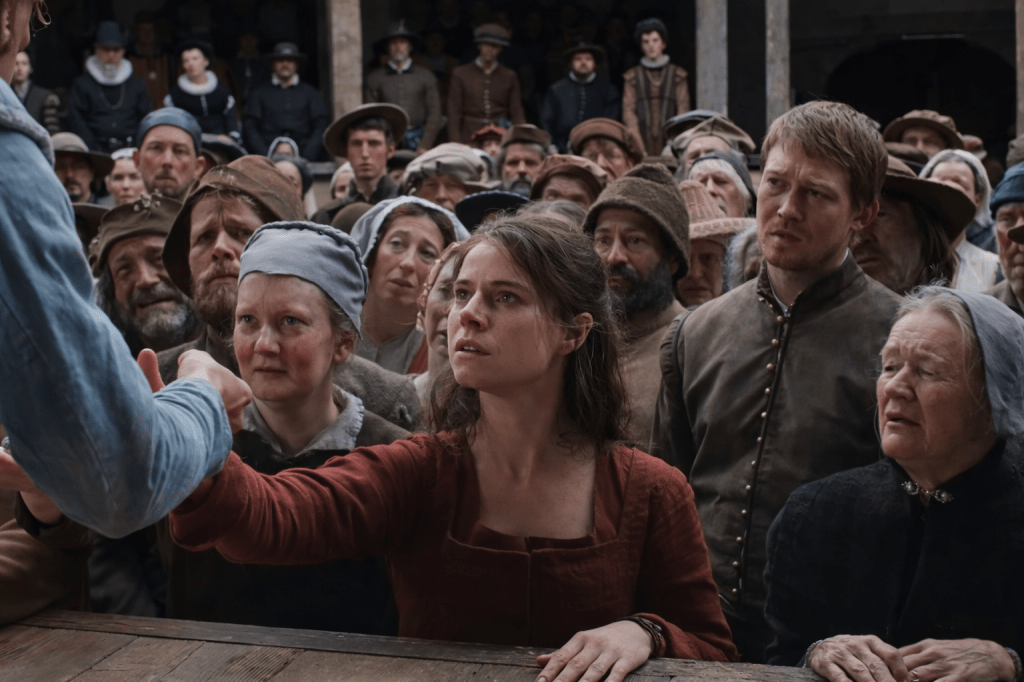
There are films that touch the heart, films that bruise it—and then there are films that ask you to live with your heart open. Hamnet is that rare, soul-deep experience. Watching it, boundaries between the modern audience and the people onscreen—whose real-life counterparts walked, loved, and mourned more than four hundred years ago—soften and blur, as if we were briefly allowed to occupy the same emotional space, sharing the same ache, the same breath, the same fragile experience of being alive.
Before the film, Maggie O’Farrell’s novel had already moved me in a way few books have since I was much younger. Hamnet was the book that made me fall back in love with reading. It reminded me that literature can be alive—that it has a pulse, a presence, a way of meeting you where you are and leaving you changed. Chloe Zhao’s film honors that truth with reverence bordering on the sacred. She does not adapt the novel so much as translate its heartbeat into image and sound, amplifying its quiet power until the screen itself seems to breathe.
Zhao’s filmmaking is not naturalistic; it is transcendental. The forest in Hamnet is not a location but a living consciousness. Her woods hum with intention, her landscapes hold memories the characters have not yet spoken aloud. Watching her frames feels like pressing your hand to the bark of a centuries-old tree and sensing something pulse back—something older than grief, older than story, older than us. Max Richter’s score (the composer most famous for his work on the film Arrival) is transcendent, even mystical, never intrusive.
Every leaf, every thread of moss, every curl of smoke is rendered with such care that the world of the film feels like a sacred plane. Zhao understands nature not as symbolism, but as inheritance—a reservoir of intuition, sorrow, and memory that her characters draw from as instinctively as breath itself. Łukasz Żao’s (The Zone of Interest) cinematography is breathtaking, distant enough that we never invade on private moments, but intimate enough that we truly feel every ache, longing, every physical and spiritual feeling occurring in this world.
Agnes, especially, belongs to this world. Jessie Buckley plays her with an intuitive depth that makes you believe she could speak to the forest and the forest would answer back. Buckley’s Agnes is not merely a character but a force of nature—one who carries centuries of women’s wisdom inside her bones, one whose knowing is bodily rather than intellectual. Buckley never signals this intuition; she inhabits it. Even in stillness, her Agnes seems to be listening to something just beyond the edge of language.
The Latin tutor, the glover’s son—Agnes’s husband, the man whose name is not uttered until the final act of the film but whom we all know by reputation—enters this world as her counterpoint and her equal. Their attraction is immediate, as though something long dormant in each of them has suddenly recognized its counterpart. He watches her with awe and disbelief, sensing that she understands him in ways he does not yet understand himself. There is an electricity in their early scenes together—quiet, charged, impossible to ignore—where even the smallest exchanges, even glances absent of dialogue, hum with meaning. Paul Mescal plays him with gentleness and vulnerability, allowing this magnetism to feel discovered rather than imposed. In her presence, he sheds the armor he has built around himself, revealing a man startled by connection and starving for it.
Their romance moves quickly, but never carelessly. Zhao understands the velocity of young love—the kind of recognition that bypasses reason entirely. In these early moments, they rush through the forest together, unguarded and exhilarated, two bodies cutting through the world in its purest form. These scenes are rugged and youthful, full of motion and life, untouched yet by grief, defined by instinct rather than fear.
It is during this period—when everything still feels possible—that he tells her the story of Orpheus and Eurydice. The moment is deceptively simple, filmed as something hushed and sacred. The forest seems to listen. What he offers her is not a lesson but a glimpse into how his mind works: even in love, he reaches for story as a way of understanding devotion and loss. The myth casts a long shadow forward—a story about love powerful enough to challenge death and fragile enough to be undone by a single backward glance. Zhao allows both truths to coexist. Their love remains deeply human and believable even as it brushes against something older and mythic.
Together, they build a home that feels warm, chaotic, alive. Zhao lingers here not to sentimentalize happiness, but to give us something solid to hold onto—so that when loss finally arrives, it does not merely wound, but shatters. Even in these early years, Agnes’s husband is frequently away, London calling him back again and again, the work of writing and performing plays drawing him into absences that feel ordinary at first, barely noticed, and therefore all the more devastating in retrospect.
Then come the children. Before tragedy, the film invests deeply in the texture of family life, particularly in Agnes’s relationship with her children, which feels remarkably unforced and whole. Her motherhood exists as naturally as breath. She understands her children the way some people understand weather or light—not through effort but through presence. With Judith, the more fragile twin, her vigilance is instinctive. With Hamnet, she carries a different certainty. When she holds his hand and reads his future, she feels reassurance: he will grow strong. He will endure. Zhao lets this belief settle gently into the story, making its inevitability all the more devastating.
All of the children in Hamnet are astonishingly well cast and sensitively directed, their performances grounded in quiet observation rather than affectation. But Jacobi Jupe, as Hamnet, is something extraordinary. He gives us a child whose inner life feels vast and legible without being overstated—a boy who absorbs the emotional weather of the room before anyone speaks. Jupe plays Hamnet with a gentleness that makes his love for his family palpable, and with a restraint that allows fear, devotion, and bravery to register in the smallest shifts of expression. Watching him, you feel how deeply this child understands more than he can possibly articulate.
The bond between Hamnet and Judith deepens this sense of tragic inevitability. They are inseparable, moving through the world as if joined by something beyond proximity, communicating through glances and shared rhythms rather than words. They trade clothes and identities, delighting in the small trick they play on their family, a private game born of intimacy and trust. That innocent ritual becomes devastating when illness comes, as a brother grows frantic, desperate to save his sister. Hamnet understands immediately—not because he is told, but because he feels it. He watches his mother’s attention narrow, senses her growing fear and urgency to keep Judith alive, and begins to confront a possibility he cannot yet articulate: a world without his twin. When Judith later believes, with a child’s absolute faith, that Hamnet has somehow tricked death itself, the moment is a gut punch—a reminder that these are still children, clinging to wonder and possibility, believing the unbelievable, seeing hope where the world offers only loss.
When illness enters the home, Zhao’s filmmaking takes a breath—and then holds it. Time bends. Agnes works desperately to save Judith from the plague that had already claimed a third of Europe. In doing so, she assumes Hamnet is safe. The truth that unfolds—that Hamnet will die instead—is unbearable. Zhao films his illness without distance. The camera stays. It stays through the moment of death and the stillness that follows.
Buckley’s performance here reaches beyond technique. Her grief feels ancient, pre-verbal. Jacobi Jupe, in his final moments, delivers something so raw it feels as though life itself is leaving him onscreen. Zhao does not cut. We are forced to remain.
In the aftermath, Agnes’s husband returns from London. Relief at finding Judith alive gives way to confusion, then disbelief, then grief. Mescal plays this sequence with devastating restraint. His body understands before his mind can. Afterward, the film grows quiet—not peaceful, but hollow. Agnes moves through the world as if gravity has increased. Language fails them both.
But then—four years pass. A play is written. A stage is lit. And something impossible happens. The play Hamlet enters the story not as art, but as necessity. Agnes walks into the Globe Theatre, and Zhao films the approach as though she is crossing into sacred ground. Richter’s score escalates, and the moment is transcendent.
When the play begins, Noah Jupe’s Hamlet takes the stage, and it is immediately clear what has been done. This is not the tragic prince of Denmark. This is Hamnet imagined into adulthood. Agnes sees it instantly—the tilt of his head, the softness of his voice, the sorrow carried in his posture. Buckley’s face registers the realization breath by breath: her son has been resurrected not in body, but in presence. In movement. In possibility.
Onstage, Agnes’s husband appears as the Ghost of Hamlet’s father—just as the real playwright, and the real grieving father, did at the Globe in the spring of 1600. Mescal plays this moment as three selves at once: the playwright shaping language, the father bearing unbearable loss, and the spirit granted the mercy no parent ever receives—the chance to speak again, to take back what life stole, and to say goodbye. His performance is hushed, reverent, and devastating. Art becomes communion.
This is what Hamlet truly is: a father’s attempt to rewrite the ending he could not bear.
The play proceeds, and the inevitable end that readers of Hamlet across generations know draws near. Hamlet, after avenging his father’s death, after fulfilling the duty that has kept him alive throughout the story ends, he nears his death – a death that within the context of the play, is pure accident. Noah Jupe’s Hamlet is dying when Agnes reaches for the stage. Instinctively. As a mother. In reaching toward Hamlet as he dies, she is reaching toward her son—finally allowed to witness a death without terror, without agony. In that moment, her husband gives her the greatest gift possible: assurance that their son mattered, that he would be remembered, that the world would grieve alongside them.
Everything we know of Shakespeare’s most famous tragedy, perhaps the greatest story written in the English language, was shaped by the loss of a child. One boy. And Hamnet insists on the truth history often forgets: this child mattered. This child matters still.
This is why art matters. Not as ornament. As survival. In a world where empathy is disappearing and even mocked by certain leaders, and the power of art is in danger of becoming hostage to certain politicians, Hamnet stands quietly defiant. It reminds us that to feel deeply is not weakness. That art is not indulgence. It is how we carry the unbearable together.
For me, Hamnet is not just the most beautiful film of this year, but the most meaningful film I’ve seen in the past two years. It has not loosened its hold on me. It reminds me why stories endure, why we gather around them, why we need them—especially now. Hamnet does not ask to be admired. It asks to be remembered. And I don’t think it will ever leave me.
★★★★★
 Show Me Cinema
Leave a comment